Establishing secure connection…Loading editor…Preparing document…

Petition to Be Relieved of Registering Pursuant to LA RS 15540 et Seq Sex Offender with Order to Show Cause

This template is fully customizable. Edit the text, fill out the fields, and send it for signature. Give it a try!
Petition to Be Relieved of Registering Pursuant to LA RS 15540 et Seq Sex Offender with Order to Show Cause

What this petition is and when it applies

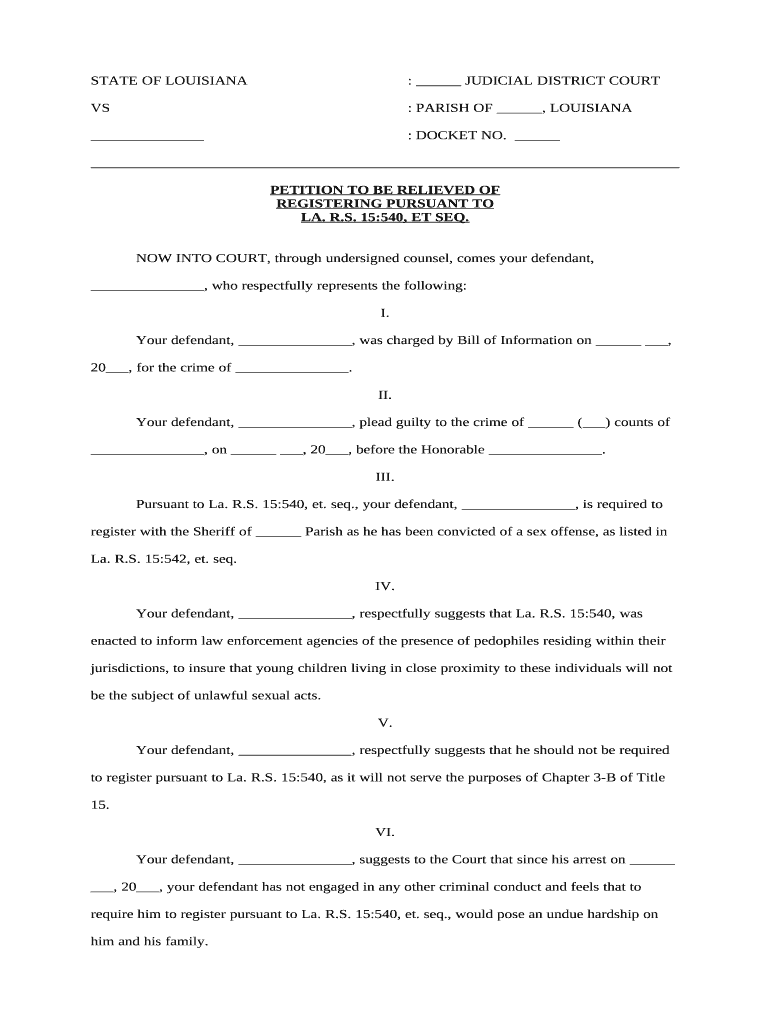
The Petition to Be Relieved of Registering Pursuant to LA RS 15540 et Seq Sex Offender with Order to Show Cause is a Louisiana court filing asking a judge to excuse a person from sex-offender registry obligations under LA RS 15540 et seq. The petition sets out the statutory grounds, factual history, and supporting evidence and asks the court to issue an order to show cause scheduling a hearing. It typically includes a proposed order, sworn statements, conviction and sentencing records, and any rehabilitative documentation the petitioner wants the court to consider.

Why petitioning for relief from registration matters

Filing this petition can restore civil liberties, relieve ongoing reporting burdens, and clarify legal status when statutory criteria are met under LA RS 15540 et seq; it creates a formal record and gives the court authority to grant or deny relief after a hearing.

Why petitioning for relief from registration matters

Who typically files or responds to this petition

Typical parties involved in these proceedings include the petitioner, defense counsel, and the state or local prosecutor.

  • Petitioner seeking relief from registry obligations, often a formerly convicted person with documented rehabilitation.
  • Defense attorneys or appointed counsel preparing legal argument and assembling supporting evidence for court.
  • Prosecutors or the state responding to the petition and presenting any objections at hearing.

Courts schedule an order to show cause so the parties can present evidence and the judge can rule on statutory eligibility and public-safety considerations.

Primary users and professional roles

Applicant — Individual

A person previously convicted of a registrable offense who believes statutory criteria under LA RS 15540 et seq are satisfied and who assembles records, certificates, and affidavits to support relief.

Defense Attorney

An attorney who drafts the petition and proposed order, ensures proper service and notice, prepares witness lists, and argues statutory eligibility and mitigating factors at the order-to-show-cause hearing.

Essential data and proof to include

Full legal name: Use exact name from government ID
Date of birth: MM/DD/YYYY format
Case number: Official docket number from conviction
Conviction details: Offense, date, and court of conviction
Supporting records: Probation reports, completion certificates
Signature and date: Signed under penalty of perjury

Risks and consequences of errors

Denial of relief: Petition may be denied
Perjury exposure: False statements risk criminal charges
Procedural dismissal: Service defects can dismiss petition
Continued registry duty: Failure leaves reporting obligations in place
Costs and fees: Court or attorney costs may apply
Collateral impact: Employment or licensing delays possible

Common preparation pitfalls to avoid

  • Incomplete supporting records, such as missing probation completion certificates or court minutes, which weakens the factual showing at hearing.
  • Failing to correctly identify the statutory subsection of LA RS 15540 et seq relied upon, causing the petition to be returned or delayed.
  • Improper service on the prosecutor or relevant agency, resulting in a continuance or dismissal for lack of notice to opposing parties.
  • Submitting unsigned affidavits or unsworn declarations; statements should be executed under penalty of perjury where required.

Practical examples of how petitions are used

Two illustrative scenarios show typical petition structure and the kinds of evidence courts consider.

Successful relief after rehabilitation

An applicant completed probation and underwent treatment and monitoring for five years

  • Court focused on rehabilitation documentation and stable residence
  • The judge granted relief based on statutory factors and public-safety assessment, citing steady employment and no subsequent incidents.

Denied without sufficient proof

An applicant lacked up-to-date supervision records and treatment attestations

  • Prosecutor opposed based on incomplete files
  • The court denied relief, noting the record failed to establish the statutory threshold for removal from the registry.

Step-by-step: preparing and filing the petition

Follow these steps to prepare a complete petition and support the order-to-show-cause process in Louisiana courts.

  • 01
    Gather records: Collect conviction and supervision documents
  • 02
    Draft petition: State statutory grounds and factual basis
  • 03
    Proposed order: Include an order to show cause for hearing
  • 04
    Service: Serve prosecutor and appropriate agencies

Where to file and how the court process unfolds

This petition is filed in the criminal district or parish court that entered the conviction; procedures vary by local rules and docketing practice.

  • Filing court: File in the original convicting court
  • Order to show cause: Judge issues hearing date and notice
  • Hearing: Parties present evidence and argument
  • Judicial decision: Court grants or denies relief with order

How to configure an online petition workflow

Set up an e-filing and e-document workflow to collect signatures, supporting evidence, and serve opposing parties digitally where allowed.

Field Online Setting
Petitioner name Required text field with ID validation
Case number Required numeric/text field
Affidavit Attach PDF; require e-signature
Proposed order Template upload; signer role for judge

Digital signing and eSubmission technical notes

Confirm local court e-filing and county clerk acceptance before e-submitting petitions or affidavits.

  • Document formats: PDF, DOCX accepted by most systems
  • Authentication: Email or SMS code for signer verification
  • Integrations: Supports Google Workspace and NetSuite

Use secure eSignature platforms that meet ESIGN (15 U.S.C. ch. 96) and UETA requirements to preserve legal enforceability and an audit trail.

Timing, hearing windows, and expected processing

Timelines depend on local docket schedules and court rules; expect variable periods for scheduling the order-to-show-cause hearing and receiving a ruling.

Initial filing window:

No universal deadline; file promptly after eligibility identified

Service period:

Follow local rules for serving prosecutor and agencies

Hearing schedule:

Set by court; timing varies by parish

Post-hearing order:

Court issues written ruling after consideration

Appeal timing:

Appeal periods follow Louisiana appellate rules

Core components to include in a professional petition

A complete petition combines court captioning, statutory citation, sworn facts, evidentiary attachments, and a clear proposed order to allow efficient judicial review.

Court caption

Full caption with court name, docket number, and parties so the clerk can properly file and index the petition.
Statutory basis

Specify the LA RS 15540 et seq subsection relied on and explain how facts meet statutory criteria for relief.

Factual statement

Concise sworn narrative describing conviction, sentence, supervision, rehabilitation, and community ties relevant to relief evaluation.

Evidence attachments

Include certified court minutes, probation completion certificates, treatment records, employer letters, and any expert reports.

Proposed order

Draft an order to show cause and a proposed judgment for the judge to sign if relief is granted.

Service proof

File declarations or certificates demonstrating service on prosecutors and required agencies to avoid procedural challenges.

Frequently asked questions and practical answers

Answers to common questions about eligibility, documentation, e-signatures, and court procedures for petitions under LA RS 15540 et seq.


Need help? Contact support

Comparison: eSignature solutions for preparing and executing the petition

These pricing and capability points illustrate common plan dimensions; signNow is listed first for direct comparison with other widely used vendors.

signNow DocuSign Adobe Sign PandaDoc HelloSign
Starting Price $8/user/mo $15/user/mo $14/user/mo $19/user/mo $15/user/mo
Free Trial 7-day free trial, no credit card Varies by plan Varies by plan Varies by plan Varies by plan
Bulk Send Yes (Business Premium) Yes Yes Yes No
Audit Trail Yes Yes Yes Yes Yes
HIPAA Compliant Yes (BAA available) Yes Yes No No
be ready to get more
Join over 28 million airSlate SignNow users