Establishing secure connection…Loading editor…Preparing document…

Confidential Informant Declaration of Understanding and Agreement

This template is fully customizable. Edit the text, fill out the fields, and send it for signature. Give it a try!
Confidential Informant Declaration of Understanding and Agreement

What the Confidential Informant Declaration of Understanding and Agreement Is

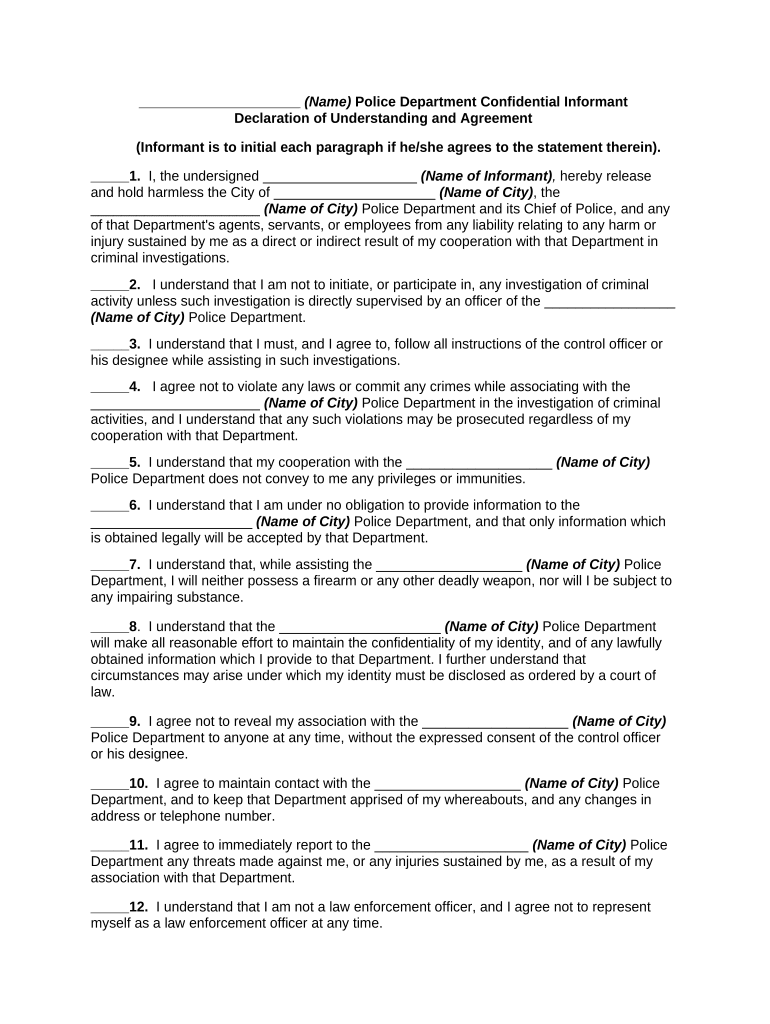
A Confidential Informant Declaration of Understanding and Agreement is a written acknowledgement between a confidential informant and a law enforcement entity or prosecutor documenting the informant’s role, duties, limitations, confidentiality obligations, and any terms of cooperation. The form records consent to information sharing, possible compensation or immunity terms, risks of participation, and signature blocks for the informant and authorized agency representative. When completed correctly it creates a clear record of expectations, protects investigatory integrity, and supports later use of information in investigations or prosecutions under applicable law.

Why this Declaration Matters for Investigations and Case Records

This agreement documents legal and operational terms, reduces ambiguity about the informant’s role, protects confidentiality, and preserves evidence integrity under ESIGN and applicable state electronic signature laws.

Why this Declaration Matters for Investigations and Case Records

Typical parties who prepare or sign this agreement

Agencies and legal teams use the declaration to document cooperation and manage risk before and during investigations.

  • Law enforcement agencies and investigators responsible for handling confidential sources and case files.
  • Prosecutors and county/state attorneys who need a formal record for charging and trial preparation.
  • Defense counsel or oversight bodies reviewing chain-of-custody and informant reliability for case strategy.

Authorized signers and their roles

Agency Representative

A designated law enforcement officer or prosecutor signs to confirm the agency’s terms, oversight, and any promised considerations; the representative should be authorized to bind the office administratively.

Informant

The confidential informant signs to acknowledge understanding of duties, confidentiality obligations, risks, and any compensation or immunity conditions; identify by full legal name and method of identity verification.

Core components to include in a professional declaration

A thorough document balances factual case details with legal safeguards. The following components clarify obligations, protect confidentiality, and create admissible records for investigators and courts.

Parties

Full legal names and agency designations for the informant and the signing law enforcement or prosecutorial office with contact and case reference details.
Scope

Clear description of the informant’s tasks, permitted activities, geographic and temporal limits of cooperation, and any restrictions on independent action.

Confidentiality

Terms specifying how informant identity and information will be protected, disclosure exceptions, limits of confidentiality, and internal handling procedures.

Duties & Expectations

Actions required of the informant, reporting cadence, truthful disclosure obligations, and consequences of noncompliance.

Consideration

Any compensation, expense reimbursement, record of immunity or leniency discussions, and conditions that affect promised benefits.

Signatures

Signature blocks with printed names, dates, identity verification method, witness or notary lines if required, and audit metadata for electronic signing.

Step-by-step: completing and executing the declaration

Follow these steps in order to create a clear, enforceable record and to reduce risk of later dispute or inadmissibility.

  • 01
    Prepare: Populate parties, case reference, and operative clauses accurately.
  • 02
    Verify Identity: Confirm informant ID using agency procedures or notarization.
  • 03
    Obtain Consent: Explain terms verbally, then obtain informed signature and date.
  • 04
    Record: File signed copy in the case file, and preserve audit trail metadata.

Configure an online signing workflow for this agreement

Set up a clear signing order, authentication, and record retention before sending the document for signature.

Field Configuration
Signing Order Informant first, then agency representative
Authentication Email plus SMS code or agency ID check
Attachments Attach identity documents as conditional required files
Retention Enable automatic archival with audit trail

Digital signing and technical considerations

Choose a platform that supports secure authentication, tamper-evident audit trails, and exportable signed records.

  • Authentication: Email, SMS, KBA, or agency-managed SSO
  • Audit Trail: IP, timestamp, and action log
  • File Formats: PDF/A or PDF exports recommended

Where to send and how the submission flows

A clear routing and filing plan keeps the record auditable and readily available for investigations or court use.

  • Upload Document: Place final draft in the signing platform or case management system.
  • Assign Signers: Add informant and authorized agency signer with contact details.
  • Authenticate: Use selected verification method before signing.
  • Archive: Save signed copy to the secure case file with metadata.

Primary legal risks and consequences of errors

Compromised Confidentiality: May expose informant and jeopardize cases
Perjury or Misstatement: False statements risk criminal charges
Invalid Agreement: Improper execution can void protections
Civil Liability: Agency or informant may face lawsuits
Evidence Exclusion: Poor recordkeeping can limit trial use
Operational Exposure: Leaks can endanger personnel or investigations

Common mistakes to avoid when preparing this declaration

  • Using ambiguous confidentiality language that leaves exceptions undefined and invites future challenges to protection.
  • Failing to verify the informant’s identity or to record proof of identity, undermining later authentication and admissibility.
  • Overpromising immunity or benefits without documented approval from the proper prosecutorial authority or written agreement.
  • Neglecting to preserve the audit trail and signed original, which weakens evidentiary value and chain-of-custody records.

Security and compliance controls to include or verify

Encryption: TLS 1.2/1.3 in transit; AES-256 at rest
Audit Trail: Timestamps, IP addresses, and action logs
Access Controls: Role-based permissions and logging
HIPAA Support: BAA available when PHI is present
21 CFR Part 11: Controls for FDA-regulated records where applicable
Retention Export: Exportable signed PDFs with metadata

Practical tips for accurate and efficient completion

Follow a consistent process and use quality controls to lower risk. Training and templates reduce variation across cases.

Use standardized templates
Draft a vetted agency template that includes required legal language, identity‑proofing steps, and space for case references, reducing drafting errors and review time.
Document verbal briefings
Record or contemporaneously note the informed-consent explanation to the informant; this supplements the written signature and supports later credibility.
Preserve the original
Store the signed original or certified electronic copy in the official case file with restricted access and a recorded retention schedule.
Coordinate approvals
Route proposed immunity or consideration terms through authorized supervisory and prosecutorial channels before presenting them to an informant.

Real-world scenarios where a declaration is used

These examples illustrate typical uses and outcomes; adapt language to your agency’s policies and legal requirements.

Undercover Cooperation

An informant agrees to provide controlled buys and reporting in a narcotics investigation

  • Informant supplies scheduled meet-ups and evidence
  • The signed declaration documents duties, compensation for expenses, and confidentiality protections for trial preparation and disclosure.

White-Collar Tip

A confidential witness reports financial fraud and agrees to produce documents

  • Witness will provide records and testify if required
  • The declaration records the scope of cooperation, information-handling rules, and the agency’s recordkeeping and witness protection commitments.

Multi-vendor eSignature pricing snapshot for executing the agreement

Different eSignature vendors offer varied pricing and enterprise features. signNow is listed first per vendor-comparison conventions; confirm vendor pages for plan details.

signNow DocuSign Adobe Sign PandaDoc HelloSign
Starting Price $8/user/mo $15/user/mo $14/user/mo $19/user/mo $15/user/mo
Free Trial 7-day trial Varies by plan Varies by plan Varies by plan Varies by plan
Bulk Send Yes Yes Yes Yes No
Audit Trail Yes Yes Yes Yes Yes
HIPAA Compliant Yes Yes Yes No No

Frequently asked questions about using and signing the declaration

Answers to common concerns about execution, e-signature validity, notarization, and revocation for Confidential Informant Declarations.


Need help? Contact support

be ready to get more
Join over 28 million airSlate SignNow users