Establishing secure connection…Loading editor…Preparing document…

Postnuptial Agreement

This template is fully customizable. Edit the text, fill out the fields, and send it for signature. Give it a try!
Postnuptial Agreement

What a Postnuptial Agreement Is and When It Applies

A Postnuptial Agreement is a written contract executed by spouses after marriage that defines ownership and division of assets, allocation of debts, and any spousal support arrangements in the event of separation, divorce, or death. It commonly addresses separate versus marital property, business interests, retirement accounts, and estate planning coordination. While governed by general contract principles, enforceability typically depends on full financial disclosure, voluntariness, and compliance with applicable state law. Parties often use independent counsel and notarization to strengthen evidentiary weight.

Why a Postnuptial Agreement Matters for Financial Clarity

A Postnuptial Agreement creates predictable outcomes for property and support, reduces litigation risk, and preserves business and estate plans; electronic execution is acceptable when parties consent under federal and state e‑signature laws (15 U.S.C. ch. 96; UETA).

Why a Postnuptial Agreement Matters for Financial Clarity

Who Typically Prepares or Signs a Postnuptial Agreement

Couples, family law attorneys, estate planners, and financial advisors commonly prepare or review Postnuptial Agreements to document rights and expectations.

  • Married couples seeking to clarify property division, debt responsibility, or support obligations during marriage.
  • Business owners protecting company ownership, succession plans, and valuation methods within a marital contract.
  • Individuals coordinating estate planning, inheritance terms, or correcting premarital omissions following marriage.

Core Sections to Include in a Professional Postnuptial Agreement

A clear Postnuptial Agreement segments material topics—parties, background, asset allocation, support, property transfers, and dispute resolution—to reduce ambiguity and aid judicial review where enforceability is contested.

Parties

Identify each spouse by full legal name, include any legal entities or trusts connected to a spouse, and provide contact and identification details to avoid identity disputes.
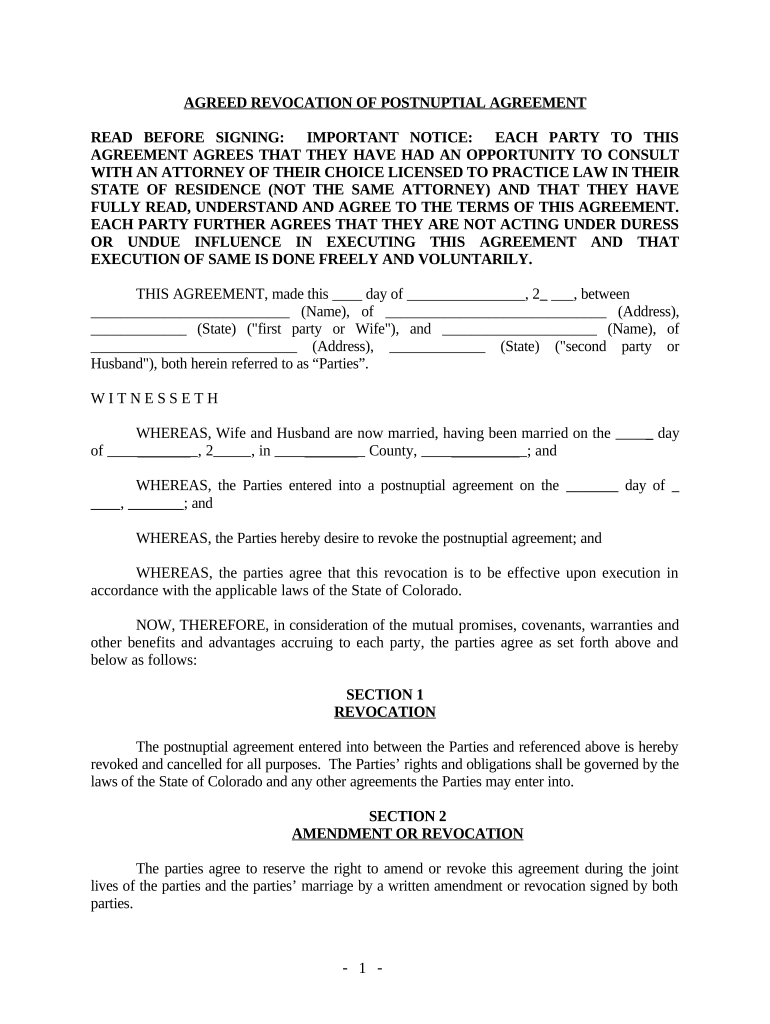
Recitals

State the marriage date, purpose of the agreement, and background facts; recitals help demonstrate intent and may assist courts evaluating voluntariness.

Assets and Liabilities

Specify separate and marital property, accounts, retirement plans, and debts; include valuation methods, dates, and attached schedules for clarity.

Spousal Support

Address whether spousal support is waived, limited, or deferred; include triggering events, calculation formulas, and duration where applicable.

Property Transfers

Document any transfers of real property or business interests and state whether recording or deed changes are intended in county records.

Dispute Resolution

Include governing law, venue, and mediation or arbitration clauses to streamline dispute resolution and reduce litigation costs.

Step-by-Step: Preparing and Executing a Postnuptial Agreement

Follow a structured process—document finances, draft terms, obtain review, and execute with proper formalities—to reduce later disputes and increase enforceability.

  • 01
    Gather Documents: Collect comprehensive asset, liability, and income documentation.
  • 02
    Draft Agreement: Use clear, specific legal language to define rights.
  • 03
    Review and Counsel: Each spouse obtains independent legal advice and reviews terms.
  • 04
    Sign and Notarize: Sign in presence of required witnesses or notary where recommended.

Where to Store and Send Executed Copies

Execution and delivery practices for Postnuptial Agreements prioritize secure signature capture, notarization when recommended, and reliable distribution of signed copies to each party and their counsel.

  • Original Retention: Each party should keep an original signed copy.
  • Attorney Retention: Counsel typically retains a dated, signed copy.
  • File Property Records: Record deeds only if a property transfer is executed.
  • Digital Archive: Store secure electronic copies with a verifiable audit trail.

Key Risks If a Postnuptial Agreement Is Deficient

Unenforceability: Agreement may be set aside.
Financial Loss: Assets may be redistributed unpredictably.
Tax Consequences: Unexpected tax reporting and liabilities.
Credibility Issues: Incomplete disclosure undermines enforceability.
Legal Costs: Increased litigation and attorney expenses.
Execution Gaps: Missing notarization or signatures raise challenges.

Security and Compliance Considerations for Electronic Execution

Encryption: AES-256 at rest, TLS 1.2/1.3 in transit.
Certifications: SOC 2 Type II and ISO 27001 certified.
HIPAA: BAA available when protected health information is included.
eSignature Law: Compliant with ESIGN and UETA frameworks.
Audit Trail: Timestamps, IP addresses, and action history retained.
Access Controls: SSO and role-based permissions with session controls.

How to Amend or Revise a Postnuptial Agreement

Amendments should be deliberate, mutual, and documented in writing; follow the same formalities as the original agreement to reduce the risk of later challenge.

01

Draft Amendment:

State the precise changes and effective date clearly.
02

Mutual Consent:

Both spouses must sign the amendment voluntarily.
03

Independent Counsel:

Each party should obtain separate legal advice prior to signing.
04

Notarize:

Notarize signatures and witnesses as recommended for added weight.
05

Attach Exhibits:

Include updated financial schedules and evidentiary exhibits.
06

Record Copies:

Distribute signed copies to counsel and retain originals securely.

Notarization and Witness Steps for Execution

Notarization and witness steps vary; follow local rules, confirm identity, and retain records of the signing session to support later verification.

01

Determine Local Law

Confirm state requirements for execution and formalities.

02

Notary Acknowledgement

Use a notary acknowledgement to verify signatures when appropriate.

03

Witness Requirements

Verify whether your state requires one or more witnesses.

04

Remote Notarization

RON is permitted in most states with identity proofing and recording.

05

Identity Proofing

KBA or credential analysis plus MFA commonly required for RON.

06

Audio-Video Record

Some states require retention of the RON session recording.

07

Notary Journal

Notaries maintain journal entries for the session where required.

08

Record Transfers

Record deeds separately when real property transfers are executed.

Common Mistakes to Avoid When Preparing a Postnuptial Agreement

  • Failing to provide complete financial disclosure undermines enforceability; include detailed asset lists, recent valuations, and supporting documentation to prevent motions to set aside the agreement.
  • Using vague or open-ended language about consideration or property division invites conflicting interpretations; use precise dollar amounts, percentages, or explicitly identified property to reduce ambiguity.
  • Not securing independent counsel for each spouse can create conflict-of-interest arguments; document counsel participation or advise parties to obtain separate representation.
  • Omitting notarization or skipping formal execution steps where state law values notarization increases evidentiary burdens and may complicate enforcement.

How a Postnuptial Agreement Differs from Other Marital Documents

Compare timing, purpose, and enforceability to distinguish Postnuptial Agreements from related documents and to choose the right instrument for your circumstances.

Criteria Postnuptial Agreement Prenuptial Agreement
Timing after marriage before marriage
Purpose adjust rights during marriage set terms before marriage
Filing private contract private contract
Enforceability contract law governed contract law governed

eSignature Vendor Comparison for Executing Postnuptial Agreements

Compare common vendor pricing and enterprise features relevant to executing and storing signed Postnuptial Agreements; signNow appears first as the platform reference in this table.

signNow DocuSign Adobe Sign PandaDoc HelloSign
Starting Price $8/user/mo $15/user/mo $14/user/mo $19/user/mo $15/user/mo
Free Trial 7-day free trial Varies by plan Varies by plan Varies by plan Varies by plan
Bulk Send Yes Yes Yes Yes No
Audit Trail Yes Yes Yes Yes Yes
HIPAA Compliant Yes Yes Yes No No
Envelope Cap No envelope cap 100 envelopes/user/year Varies by plan Varies by plan Varies by plan

Customize an Online Execution Workflow for a Postnuptial Agreement

Configure fields, authentication, and notifications to match required formalities and to capture a verifiable audit trail for the signed agreement.

Field Configuration
Signature Type Visible signature field with timestamp
Authentication Email link, SMS code, or KBA
Notarization Enable RON workflow if available
Notifications Auto-send signed copies to parties and counsel

Practical Best Practices for Durable Postnuptial Agreements

Adopt best practices to improve enforceability, reduce ambiguity, and limit later litigation risk when drafting and executing a Postnuptial Agreement.

Full financial disclosure
Provide complete schedules of assets, liabilities, income, and valuations; attach bank statements, account summaries, and appraisals where appropriate to avoid disclosure-based challenges.
Independent legal counsel
Encourage each spouse to obtain separate counsel and document that advice; courts frequently consider independent representation as evidence of informed consent.
Clear, specific terms
Use precise language for allocations, support calculations, and triggering events; define key terms and include valuation dates to prevent ambiguity.
Consider tax consequences
Consult a tax advisor for implications of transfers, waivers, or recharacterizations; unanticipated tax effects can undermine intended outcomes.

FAQs and Troubleshooting for Postnuptial Agreements

Answers to common questions about execution, enforceability, electronic signing, and how to reduce the risk of a later court challenge.


Need help? Contact support

be ready to get more
Join over 28 million airSlate SignNow users