Establishing secure connection…Loading editor…Preparing document…

Pre-Incorporation Agreement

This template is fully customizable. Edit the text, fill out the fields, and send it for signature. Give it a try!
Pre-Incorporation Agreement

What a Pre-Incorporation Agreement Is and When It Applies

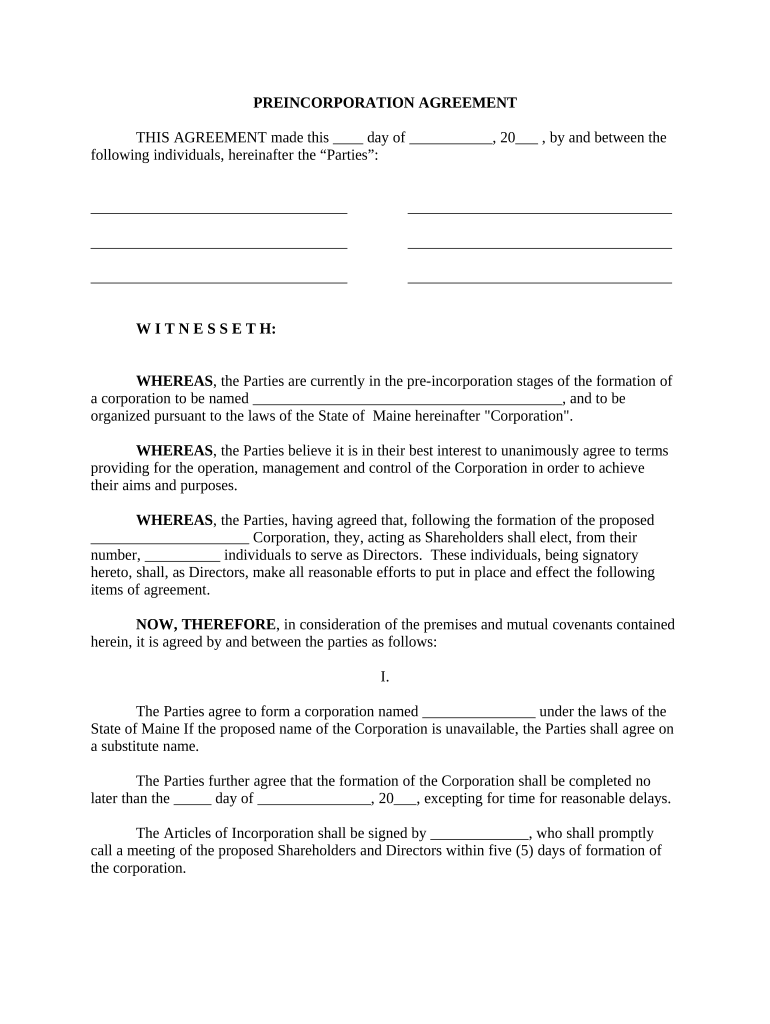
The Pre-Incorporation Agreement is a written contract used by founders, prospective shareholders, and other early contributors to record commitments made before forming a corporation. It documents initial equity allocation, capital contributions, promises to assign intellectual property, reimbursement for pre‑formation expenses, and any conditions that will govern issuance of shares at incorporation. The agreement creates an evidentiary record that supports investor due diligence, tax reporting, and smooth transition into formal corporate governance once articles of incorporation are filed and the business obtains an EIN and bank accounts.

Why a Pre-Incorporation Agreement Matters

A Pre‑Incorporation Agreement reduces ambiguity among founders, documents consideration and IP transfers, and sets clear triggers for stock issuance at formation. It helps prevent later disputes, supports investor diligence, and creates a paper trail used for tax and corporate governance reasons once the corporation is established.

Why a Pre-Incorporation Agreement Matters

Typical Parties and Use Profiles

Founders, prospective shareholders, early investors, and startup counsel commonly prepare or request this agreement to lock in pre‑formation terms.

  • Founders and co‑founders documenting initial equity splits, vesting schedules, roles, and responsibilities before formal incorporation.
  • Early investors documenting funding commitments, conversion rights, and conditions tied to incorporation or financing events.
  • Corporate counsel drafting assignment, warranty, and indemnity provisions to align pre‑formation promises with later corporate documents.

Who Signs and Why

Founder / CEO

A founder executing a Pre‑Incorporation Agreement records capital contributions, assigns preexisting intellectual property to the future corporation, and agrees to vesting and reimbursement terms. This record protects future ownership claims and supports investor due diligence during entity formation.

Startup Counsel

Corporate counsel drafts clear transfer language, aligns the agreement with state incorporation filings, and advises on tax and securities implications. Counsel also ensures post‑incorporation mechanics are anticipated for share issuance and board approvals.

Core Elements to Include in the Agreement

Include the following key sections to make a Pre‑Incorporation Agreement effective, enforceable, and useful for transition into a corporation.

Parties

Identify all parties by full legal name and entity type, include addresses, and state whether signers act individually or on behalf of a future entity to avoid later identity disputes.
Purpose

Describe the enterprise purpose and scope of pre‑incorporation activities; list milestones that trigger incorporation or share issuance and obligations while the entity is not yet formed.

Capital

Detail promised cash, property, services, or convertible notes; state valuation, timing of contributions, and remedies for failure to fund or adjust allocations.

IP Assignment

Require founders to assign inventions, code, copyrights, and other IP to the future corporation with signed assignment language and an attached schedule of preexisting works.

Expenses

Allocate responsibility for pre‑formation expenses and reimbursements, specify invoicing and documentation required for repayment or capitalization at formation.

Conditions

Define conditions precedent to share issuance, conversion of obligations, or termination if incorporation or financing is not completed by a specified date.

Step-by-Step Execution Checklist

Follow these steps to complete and secure a Pre‑Incorporation Agreement before filing incorporation documents.

  • 01
    Draft Agreement: List parties, contributions, IP assignments, and conditions.
  • 02
    Review with Counsel: Confirm tax, securities, and corporate implications.
  • 03
    Sign and Date: All founders sign; include dates and witness if required.
  • 04
    Preserve Records: Store executed copies and supporting documents securely.

Recommended Online Field Settings and Validations

Recommended field settings, validations, and conditional logic for preparing a Pre‑Incorporation Agreement in a digital workflow.

Field Configuration
Effective Date MM/DD/YYYY format; conditional if post‑incorporation
Parties Full legal names; auto-fill from contact lists
Capitalization Numeric currency fields; specify shares and percentages
IP Schedule Attach schedule; require signer verification checkbox

Where to Send and File the Executed Agreement

After execution, deliver copies to each signer, counsel, and corporate records to ensure continuity into formation and early operations.

  • Future Corporate Records: File executed agreement in the corporate minute book after incorporation.
  • Legal Counsel: Provide counsel copies for incorporation steps and securities analysis.
  • Investors: Share executed terms with prospective investors for diligence.
  • Bank Records: Present agreement when establishing corporate bank accounts if requested.

Digital Signing and Integration Requirements

Digital signing platforms and integrations with CRM or document storage speed execution, ensure an audit trail, and centralize records for Pre‑Incorporation Agreements.

  • File Formats: PDF, DOCX, and plain text supported
  • Integrations: Salesforce, NetSuite, Google Workspace
  • Authentication: Email, SMS, and optional KBA

Security and Compliance Considerations

Encryption in Transit: TLS 1.2 and TLS 1.3 are used
Encryption at Rest: AES-256 encryption for stored documents
Certifications: SOC 2 Type II and ISO 27001
Regulatory Compliance: ESIGN, UETA; HIPAA requires a BAA
Audit Trail: Detailed timestamp and action logs
Accessibility: WCAG 2.0 Level AA support

Common Preparation Errors to Avoid

  • Relying on informal emails or chat messages instead of a signed agreement leaves founders without enforceable proof of commitments.
  • Failing to specify contribution timing or valuation often produces later dilution disputes and complicates the cap table during fundraising.
  • Overlooking explicit IP assignment language risks future claims that inventions or code remain personal property of a founder.
  • Not aligning pre‑incorporation promises with the chosen state's incorporation documents can create contradictions after formation.

Short-Form Risks and Consequences

Personal Liability: Founders may face personal liability
Tax Consequences: Incorrect reporting triggers penalties
IP Ownership Disputes: Unassigned IP causes litigation
Invalid Terms: Ambiguous provisions may be unenforceable
Funding Failure: Unfunded commitments disrupt formation
Regulatory Risks: Securities rules may be violated

Timing and Key Deadlines to Consider

Track tasks that surround incorporation—execution, filing, identifier issuance, and capitalization—so obligations convert cleanly at formation.

Execution Before Filing:

Execute the agreement before articles of incorporation are filed to preserve pre‑formation commitments.

Articles Filing:

State filing times vary; expedited options may be available for quicker processing.

EIN Application:

Apply for an EIN with the IRS after incorporation to open corporate bank accounts.

Stock Issuance:

Issue shares per the agreement terms once the corporation and board adopt issuance resolutions.

Tax Filings:

Maintain records to meet IRS reporting and payroll setup after formation.

eSignature Pricing and Feature Snapshot

Comparative pricing and feature snapshot for common eSignature providers often used to execute Pre‑Incorporation Agreements.

signNow DocuSign Adobe Sign PandaDoc HelloSign
Starting Price $8/user/mo $15/user/mo $14/user/mo $19/user/mo $15/user/mo
Free Trial 7-day free trial Varies by plan Varies by plan Varies by plan Varies by plan
Bulk Send Yes Yes Yes Yes No
Audit Trail Yes Yes Yes Yes Yes
HIPAA Compliant Yes Yes Yes No No

Representative Use Cases

These brief examples show how Pre‑Incorporation Agreements are used to prevent disputes and streamline formation in real situations.

Startup Formation

A three‑founder software startup used a Pre‑Incorporation Agreement to document initial capital, equity splits, and IP assignments before filing articles.

  • This clarified ownership and vesting expectations.
  • After incorporation the company issued shares cleanly, avoided cap table disputes during investor due diligence, and had documentation to support tax reporting and later stock option grants, reducing negotiation time with early investors.

Law Firm Spin-out

A legal services team spun out a practice group and used an agreement to record fee splits, client matter transfers, and resource contributions prior to incorporation.

  • This mitigated billing and client transition disputes.
  • When the entity formed, client consents and assignments were documented, enabling smooth transfer of retainer balances and expedited ethical clearances while minimizing post‑formation disputes.

Common Questions About Enforceability and Execution

Answers to frequent questions about electronic execution, notarization, retention, and practical next steps for Pre‑Incorporation Agreements.


Need help? Contact support

be ready to get more
Join over 28 million airSlate SignNow users