Establishing secure connection…Loading editor…Preparing document…

Wyoming Pretrial Disclosures

This template is fully customizable. Edit the text, fill out the fields, and send it for signature. Give it a try!
Wyoming Pretrial Disclosures

What Wyoming Pretrial Disclosures Are and when they apply

Wyoming Pretrial Disclosures are formal case-management filings used in civil litigation to exchange witness names, exhibit lists, expert reports, and other evidence before trial. They implement scheduling orders and local rules, create a shared record of expected proof, and limit surprise at trial. Disclosures typically identify each witness and exhibit, summarize expert opinions, and attach or reference supporting documents so opposing parties and the court can evaluate admissibility and prepare motions.

Why accurate pretrial disclosures matter in Wyoming cases

Timely, complete disclosures narrow disputed issues, preserve evidence admissibility, and support orderly motion practice. They reduce surprise at trial, enable efficient briefing on evidentiary motions, and help courts manage calendars and trial preparation.

Why accurate pretrial disclosures matter in Wyoming cases

Who commonly prepares and relies on these disclosures

Typical users include litigation attorneys, paralegals, and self-represented litigants preparing witness lists, exhibit indexes, and expert disclosures before trial.

  • Plaintiff and defense counsel who must exchange witness and exhibit information
  • Paralegals tasked with compiling exhibits, Bates ranges, and production lists
  • Self-represented litigants required to follow court scheduling orders and disclosure rules

Primary roles involved

Lead Counsel

Lead Counsel (trial attorney) prepares and certifies the pretrial disclosure, assembles witness lists and exhibits, and ensures timely filing per the scheduling order. Counsel coordinates discovery, confirms expert disclosures, and verifies that exhibits meet evidentiary foundation requirements.

Self-Represented

Self-represented litigants must prepare witness and exhibit lists, file required disclosures with the court, and serve opposing parties. Courts expect compliance with local rules; late or incomplete disclosures expose the filer to exclusions or sanctions.

Core elements to include in a professional disclosure

A proper Wyoming pretrial disclosure presents witnesses, exhibits, and expert materials in a clear, numbered format, with concise descriptions and service details so parties and the court can quickly assess the record.

Witness List

Provide full names, contact counsel, and a brief description of testimony expected from each witness, including percipient versus expert role and anticipated subject matter.
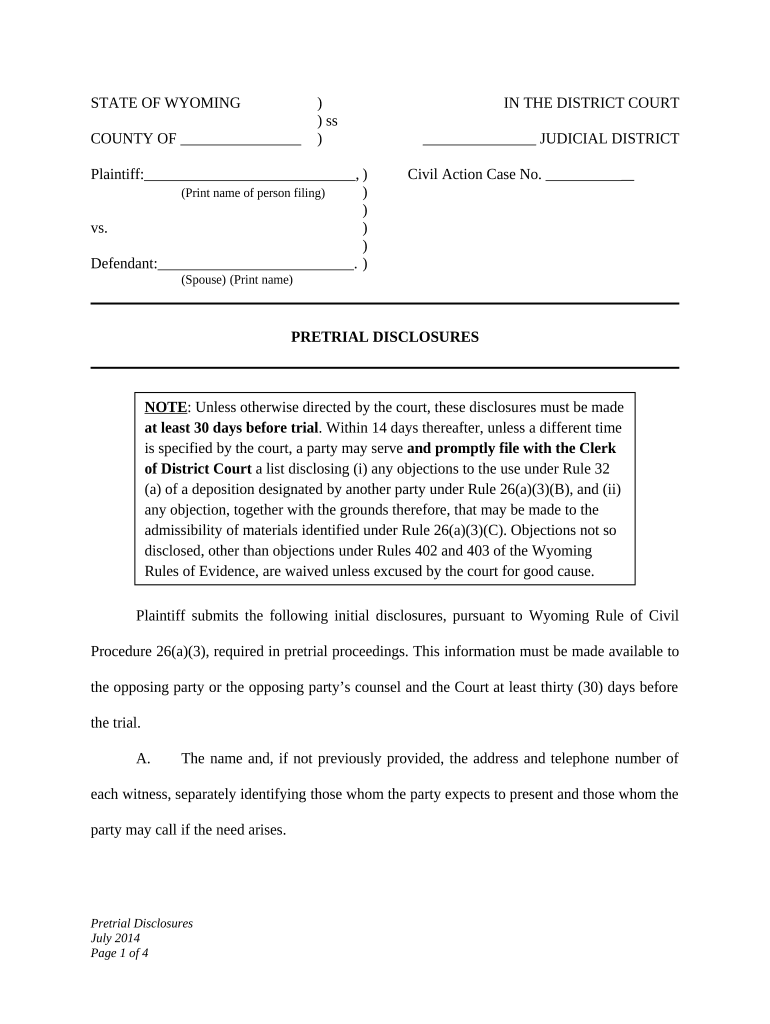
Exhibit Index

Numbered exhibit list with short descriptions, Bates ranges or file names, document dates, and an indication whether the exhibit will be offered for authentication.

Expert Reports

Attach or reference written expert reports, disclose expert names, qualifications, opinions, and the basis for those opinions consistent with court scheduling orders.

Deposition Designations

Identify deposition testimony to be used at trial, including page and line citations and any counter-designations or objections.

Stipulations & Issues

Summarize agreed facts, legal stipulations, and the specific contested issues that the parties anticipate presenting to the court.

Certificate of Service

Document how and when disclosures were served on all parties, including method (electronic, mail, hand-delivery) and proof of service details.

Required fields and essential information

Case Caption: Court name, county, docket number
Party Names: Full legal names for each party
Case Number: Court-assigned docket or file number
Disclosure Date: Date of filing or service
Exhibit Identifiers: Sequential exhibit numbers or Bates ranges
Service Method: E-service, mail, or personal delivery

Step-by-step: completing a Wyoming pretrial disclosure

Follow these sequential steps to prepare and serve a compliant disclosure under a typical scheduling order.

  • 01
    Gather Case Information: Collect caption, case number, and scheduling order details
  • 02
    List Witnesses: Identify each witness, role, and expected topics of testimony
  • 03
    Assemble Exhibits: Number exhibits, add brief descriptions, and attach files
  • 04
    File and Serve: File with court clerk and serve all parties per local rules

Where to file, how to serve, and official routing

Disclosures are filed with the court clerk in the designated division and served on opposing counsel and parties according to the court’s electronic-filing and service rules.

  • File with Clerk: Submit the disclosure through the court’s e-filing system or by paper filing
  • Serve Parties: Serve counsel and self-represented parties by the approved methods in the scheduling order
  • Record in Docket: Confirm the filing appears on the public docket or court record
  • Retain Copies: Keep a complete service copy and proof of service for your file

Customizing an online pretrial disclosure workflow

Configure your digital template and delivery settings to match the court’s requirements and streamline service to opposing counsel.

Field Configuration
Document Template Use a checklist template with labeled witness and exhibit fields
Signature Method Choose eSignature or manual signature as permitted
Authentication Enable email or SMS verification for recipients
Attachments Attach PDFs; maintain clear file names and Bates ranges

Technical considerations for electronic completion and submission

Ensure your e-filing platform supports court-required formats, signer authentication, and clear Audit Trails before submitting disclosures electronically.

  • File Format: PDF preferred; searchable when possible
  • Authentication: Email or SMS KBA as required
  • Integrations: Connect with case management or storage systems

Typical deadlines and scheduling milestones

Scheduling orders set the specific disclosure dates; below are common categories you should track against your case calendar.

Initial Disclosures:

Often due within weeks of the scheduling order

Expert Disclosure:

Deadlines for expert reports and exchange of expert lists

Exhibit Exchange:

Date by which exhibits must be numbered and shared

Deposition Cutoff:

Last date to take depositions relevant to trial

Pretrial Conference:

Court's final opportunity to resolve outstanding issues

Key case milestones from filing to trial

A sequential view of critical stages helps coordinate disclosures, discovery, motions, and trial readiness.

01

Case Filing

Docket opened and initial scheduling order entered

02

Discovery Phase

Exchange of disclosures, written discovery, and depositions

03

Motions Deadline

Cutoff for dispositive and Daubert-style motions

04

Trial Preparation

Final exhibit lists, jury instructions, and witness readiness

Common mistakes to avoid when preparing disclosures

  • Failing to number exhibits consistently between disclosure, production, and trial lists, which complicates authentication and referencing at trial
  • Omitting expert qualifications or incomplete expert reports, risking exclusion under the scheduling order or motion practice
  • Serving disclosures late or using an incorrect service method, creating grounds for exclusion or sanctions by the court
  • Providing vague exhibit descriptions that prevent opposing counsel from assessing relevance or preparing objections effectively

Consequences of late, incomplete, or inaccurate disclosures

Evidence Exclusion: Court may bar late or undisclosed evidence
Monetary Sanctions: Fines or cost-shifting ordered by the court
Preclusion Orders: Claims or defenses may be limited or barred
Trial Delays: Scheduling disruption and increased litigation costs
Reputational Harm: Credibility impacted with judge or jury
Default Risk: Severe noncompliance can lead to default judgment

eSignature pricing and feature snapshot for disclosure workflows

Common eSignature plans and essential capabilities for managing pretrial disclosures and secure service. signNow is shown first for direct feature comparison.

signNow DocuSign Adobe Sign PandaDoc HelloSign
Starting Price $8/user/mo $15/user/mo $14/user/mo $19/user/mo $15/user/mo
Free Trial Yes, 7-day trial Yes, trial available Yes, trial available Yes, trial available Yes, trial available
Bulk Send Yes Yes Yes Yes No
Audit Trail Yes Yes Yes Yes Yes
HIPAA Compliant Yes Yes Yes No No
Envelope Cap No cap 100 envelopes/user/year Varies by plan Varies by plan Varies by plan

Practical tips for accurate and efficient completion

Adopt consistent internal templates, verify service rules, and document every transmission to reduce disputes and support admissibility.

Use a Template
Standardize witness and exhibit fields to ensure consistent numbering and easier reference across filings
Validate Dates
Confirm scheduling-order deadlines and use MM/DD/YYYY consistently to avoid confusion
Keep Audit Trails
Retain signed copies, delivery receipts, and platform Audit Trails to prove service and signature attribution
Redact Carefully
Remove unnecessary sensitive data before attaching exhibits to prevent privacy violations

Example scenarios showing how disclosures are used

Two practical examples show typical disclosure use and the downstream effects on trial readiness and motion practice.

Commercial Contract Dispute

A plaintiff lists five percipient witnesses and 120 exhibits, including emails and invoices

  • Defense narrows to key documents and designates two expert rebuttals
  • The clear exchange reduced surprise and allowed rapid resolution of admissibility issues before the jury was empaneled, saving days of testimony.

Personal Injury Case

Defense provides medical records and an expert biomechanics report with exhibit numbers

  • Plaintiff organizes treatment records by date and attaches a chronology
  • Early exchange identified disputes about causation that were briefed in motions and narrowed live testimony time at trial.

Frequently asked questions about Wyoming Pretrial Disclosures

Answers to common procedural and technical questions when preparing, serving, and electronically submitting disclosures in Wyoming civil cases.


Need help? Contact support

be ready to get more
Join over 28 million airSlate SignNow users