Establishing secure connection…Loading editor…Preparing document…

Probate Will

This template is fully customizable. Edit the text, fill out the fields, and send it for signature. Give it a try!
Probate Will

What a Probate Will Is and how it fits in estate administration

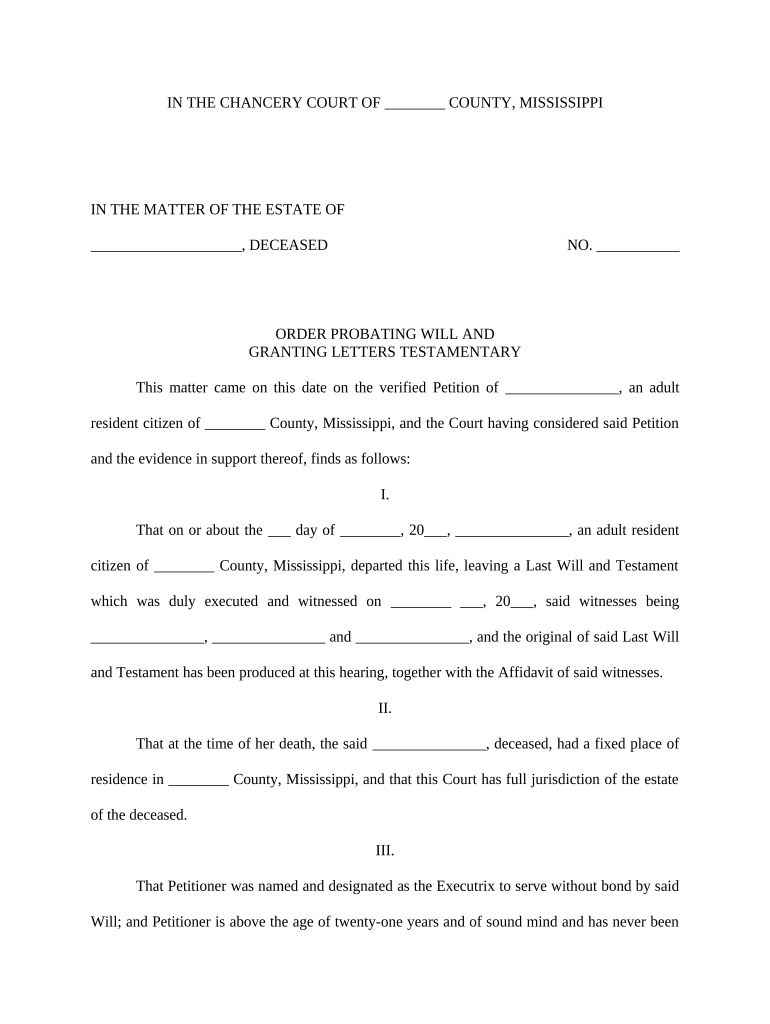
A Probate Will is a formal last will and testament intended to be submitted to probate court so a decedent's estate is administered under judicial supervision. It names an executor, identifies beneficiaries and specific bequests, and often addresses guardianship for minors, debts, and funeral directions. Probate court review validates the will, supervises creditor claims, and oversees asset distribution according to the will and applicable state law. Meeting state execution formalities helps reduce contests, delays, and procedural obstacles during estate administration.

Why a well-prepared Probate Will matters

A Probate Will documents a decedent's wishes for court-supervised distribution, clarifies executor authority, and reduces intestacy risks. Proper drafting and execution streamline probate administration and improve certainty for beneficiaries and creditors.

Why a well-prepared Probate Will matters

Who commonly prepares or requests a Probate Will

Typical users who prepare or request a Probate Will include estate planners, executors, attorneys, and family members coordinating probate filings.

  • Estate planning attorneys managing testamentary language and formalities for clients.
  • Individual testators who want court-supervised estate distribution and named executor instructions.
  • Executors and personal representatives who must file the will, inventory assets, and administer probate.

Essential information fields included in a Probate Will

Testator Name: Full legal name matching ID.
Date of Execution: MM/DD/YYYY or projected date.
Executor Designation: Name and contact for appointed executor.
Beneficiary Details: Names, relationships, and distribution percentages.
Asset Schedule: List real estate, accounts, and personal property.
Witness/Notary Blocks: Spaces for signatures, dates, and notarization.

Step-by-step: preparing and submitting a Probate Will

Follow these sequential steps to prepare and submit a Probate Will for probate court review.

  • 01
    Gather Documents: Collect certified death certificate and asset records.
  • 02
    Draft Will: Use clear bequests, name executor, and include residuary clause.
  • 03
    Witnesses: Obtain required number of witnesses per state rules.
  • 04
    File with Court: Submit will and inventory to probate court as required.

Configuring an e-signature workflow for a Probate Will

Use this configuration checklist when creating an online Probate Will workflow for e-signature and document routing.

Field Configuration
Authentication Method Email link, optional SMS code for stronger verification
Signing Order Specify signer sequence or allow parallel signing
Notifications Enable automated emails to executor and beneficiaries
Document Retention Store final PDF and audit trail for legal record

How an online Probate Will signing process typically flows

Typical digital Probate Will workflow shows steps from document upload through signature collection to producing court-ready documents and audit records.

  • Upload: Sender uploads draft will as PDF or DOCX.
  • Place Fields: Add signature, date, and witness fields for each party.
  • Authenticate: Choose email, SMS, or KBA depending on state requirements.
  • Complete: System records audit trail and generates final PDF for filing.

Platform capabilities to check for electronic Probate Will handling

For eSubmission and distribution, ensure your platform supports PDF/DOCX uploads, secure authentication, and audit trail capture compatible with court filings.

  • File Formats: PDF and DOCX supported.
  • Integrations: Works with Salesforce, NetSuite, Google Workspace.
  • Authentication: Email, SMS, and multi-factor options.

Common risks and potential negative outcomes

Invalid Execution: Missing witnesses can void provisions.
Tax Liabilities: Unreported assets cause penalties.
Creditor Claims: Untimely notice increases claims exposure.
Filing Delays: Delayed submission prolongs administration.
Name Mismatches: Incorrect names prevent probating.
Contested Wills: Ambiguous language invites litigation.

Typical timing and court-related deadlines to expect

Key timing expectations for Probate Will submission, estate administration milestones, and common filing deadlines in most jurisdictions.

File Within:

Submit will to probate court promptly after death; local rules vary.

Inventory Deadline:

Provide estate inventory within the court's required period, often months after filing.

Creditor Notice:

Publish or mail creditor notice per state requirements to limit claims period.

Will Contest Window:

Beneficiaries typically have months to contest; timing depends on jurisdiction.

Final Accounting:

Executor files final account and distributes assets after settling debts and court approval.

Key elements to include in a professional Probate Will

A professionally prepared Probate Will includes clear beneficiary designations, executor powers, asset descriptions, residuary clauses, testamentary trusts, and witness/notary attestations to ensure enforceability in probate court.

Executor Powers

Specify the executor's authority to manage assets, pay debts, hire professionals, sell property, and distribute estate proceeds; clear powers reduce the need for court intervention and speed administration.
Beneficiary Clauses

Identify primary and contingent beneficiaries with exact legal names and distribution shares or specific bequests; include alternate beneficiaries to address predeceasing heirs and minimize intestacy risk.

Residuary Clause

Include a residuary clause to allocate assets not specifically bequeathed, preventing partial intestacy and giving the executor discretion to resolve unforeseen asset distributions in a timely manner.

Testamentary Trusts

When used, specify trustee powers, funding sources, distribution schedules, and termination conditions to provide for minors or protect assets from creditors or tax exposure.

Witness/Notary

Provide signature blocks meeting state witness counts and notary acknowledgment language; include a self-proving affidavit if available to streamline probate and reduce court appearances.

Asset Schedule

Attach detailed schedules listing real property with addresses, account numbers, titles, and valuations where possible to simplify inventorying and reduce court inquiries during estate administration.

Practical examples of Probate Will outcomes

Two concise case examples show how Probate Wills resolve common estate administration issues.

Family Estate

A small blended-family estate used a Probate Will to name an executor, allocate personal effects, and set guardianship for minor children.

  • Executor followed clear distribution instructions.
  • Because the will specified contingent beneficiaries and included a residuary clause, the probate court completed administration without extended litigation; creditor claims were resolved during the standard claims period and assets were distributed within months.

Estate with Real Property

An estate holding a residential property used a Probate Will to direct sale proceeds and appoint a trustee to manage temporary rental income during administration.

  • Clear sale authority avoided court petitions.
  • The executor's explicit power to sell real property and use sale proceeds for debts and distributions prevented delays; the filing included property attachments and expedited approval for closing within statutory timelines.

Practical best practices for accurate Probate Will completion

Practical tips improve Probate Will clarity and reduce court disputes; use precise language, confirm identities, and follow state execution requirements.

Confirm legal names and IDs
Verify the testator's legal name against government ID and estate account records. Have witnesses check identification and record their information. Name mismatches are a leading cause of probate delays and may require court orders to correct.
Use specific asset descriptions and IDs
List property addresses, account numbers, VINs, and titled assets with sufficient detail so the executor can locate and transfer assets without protracted searches. Ambiguity increases court inquiries and can delay distributions for months.
Include contingent and alternate beneficiaries
Name contingent beneficiaries to address situations where primary beneficiaries predecease the testator. Alternate designations reduce intestacy risk and simplify probate by providing clear fallback recipients for specific assets or residuary shares.
Consider self-proving affidavit to streamline probate
Attach a self-proving affidavit when permitted by state law so witnesses need not testify in probate court. This often speeds estate administration and reduces the likelihood of contested witness testimony at the probate hearing.

eSignature plan feature comparison relevant to Probate Wills

Comparison of typical eSignature plan features and starting prices relevant to executing Probate Wills securely and compliantly.

signNow DocuSign Adobe Sign PandaDoc HelloSign
Starting Price $8/user/mo $15/user/mo $14/user/mo $19/user/mo $15/user/mo
Free Trial 7-day trial Varies by vendor Varies by vendor Varies by vendor Varies by vendor
Bulk Send Yes (Premium) Yes Yes Yes No
Audit Trail Yes Yes Yes Yes Yes
HIPAA Compliant Yes Yes Yes No No

Frequently asked questions about Probate Wills, signatures, and filing

Answers to frequent questions about preparing, signing, and filing a Probate Will, including eSignature and notarization considerations.


Need help? Contact support

be ready to get more
Join over 28 million airSlate SignNow users