Parties Identified
List all parties by full legal name and specify their capacities (e.g., individually, as successor, or as insurer) so there is no doubt who releases and who receives release.
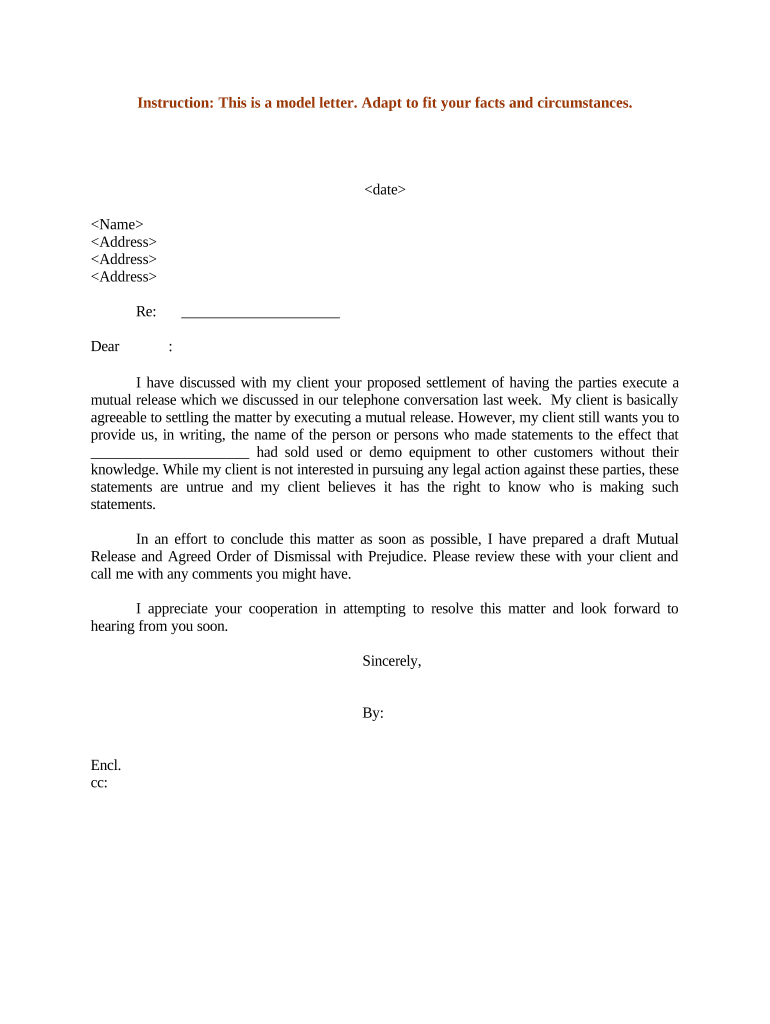
A concise proposed settlement and release letter clarifies obligations, reduces future disputes, and creates a written trail useful for enforcement or court filings. It also helps both sides evaluate tax and reporting consequences before execution.

Typical drafters include in-house counsel, outside litigation counsel, or claims adjusters who prepare the proposed settlement and release for the opposing party to accept or counter.
After review, parties either sign, negotiate further, or convert the letter into a formal settlement agreement, stipulation, or court order as appropriate.
An individual or entity asserting a claim; usually needs authority to release specified claims and should confirm identity and capacity before signing to avoid later challenges.
The party making payment or consideration; must show corporate authority or insurer approval when signing a mutual release to ensure enforceability against successor liability.
List all parties by full legal name and specify their capacities (e.g., individually, as successor, or as insurer) so there is no doubt who releases and who receives release.
Briefly describe the dispute background and the claims being resolved to provide context and intention for the release.
Set out the precise payment or nonmonetary consideration, including timing, method, and any escrow instructions to avoid payment disputes.
Draft mutual release language specifying scope, time period, and any carved-out exceptions (e.g., future claims, fraud claims, enforcement of the settlement).
If confidentiality is required, state obligations, permitted disclosures, and consequences for breach; be mindful of required disclosures to courts or regulators.
Name the state law that will govern interpretation and enforcement and include forum or arbitration clauses if parties prefer alternative dispute resolution.
| Field | Configuration |
|---|---|
| Signature Field | Required; enable signer authentication |
| Date Field | Auto-populate or require MM/DD/YYYY entry |
| Attachment Field | Allow supporting documents upload |
| Signer Order | Set role-based signing sequence when required |
Use a platform that supports secure PDFs, audit trails, and appropriate signer authentication for a settlement and release.
Ensure the chosen system can produce a certificate of completion, retain a reproducible copy, and support the ESIGN Act and state UETA compliance.
Specify how many days the recipient has to accept or counter the proposal.
Set the exact payment deadline and conditions for late payment.
If approval is needed, include the date by which parties must file a stipulation or order.
Allow time for issuing Form 1099 or other tax documents by statutory deadlines.
Specify retention responsibilities for final signed materials and payment records.
Sender delivers the proposed settlement letter and sets the acceptance deadline.
Parties and counsel review terms, conditions, and tax implications; revisions made if necessary.
Final letter or converted agreement is signed by authorized parties and dated.
Payment made, releases exchange, and parties confirm completion and close files.
Optica’s COO used a concise settlement letter to document payment terms and releases.
BIS used a release letter to settle a vendor dispute quickly.
| signNow | DocuSign | Adobe Sign | PandaDoc | HelloSign | |
|---|---|---|---|---|---|
| Starting Price | $8/user/mo | $15/user/mo | $14/user/mo | $19/user/mo | $15/user/mo |
| Free Trial | 7-day trial | No | No | No | No |
| Bulk Send | Yes | Yes | Yes | Yes | No |
| Audit Trail | Yes | Yes | Yes | Yes | Yes |
| HIPAA Compliant | Yes | Yes | Yes | No | No |
| Envelope Cap | No cap | 100 envelopes/user/year | Varies by plan | Varies | Varies |