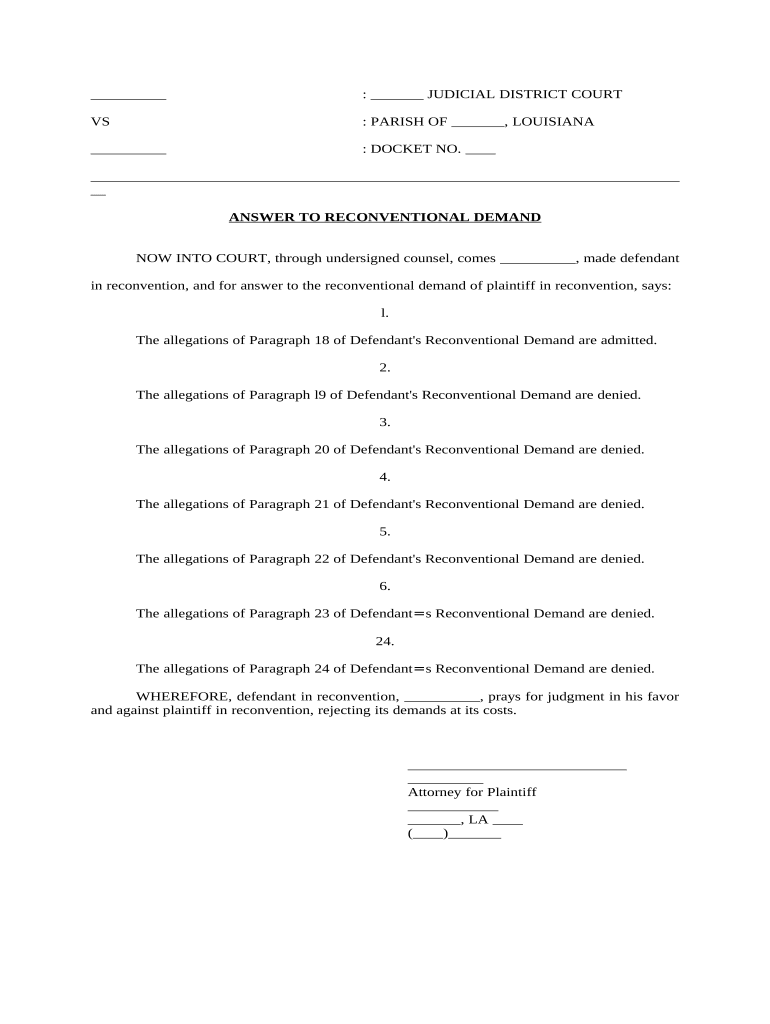
Reconventional Demand
What a Reconventional Demand Is and when it's used
Why filing a Reconventional Demand matters
Filing a Reconventional Demand preserves affirmative defenses or counterclaims, consolidates dispute resolution, and often reduces overall litigation cost and delay. It secures remedies within the pending action and narrows issues for discovery and trial.
Who typically prepares and files Reconventional Demands
Common users who prepare or file Reconventional Demands include litigation attorneys, in-house legal teams, and litigation support specialists who manage court pleadings.
- Litigation attorneys — Draft pleadings, analyze legal theories, and advocate for consolidation and relief.
- In-house counsel — Evaluate exposure, authorize filings, and align claims with corporate strategy and reserves.
- Paralegals and litigation support — Assemble exhibits, verify docket information, and manage e-filing and service logistics.
Typical signers and stakeholders
Defense Attorney
Trial counsel who evaluates potential counterclaims, drafts the Reconventional Demand to meet jurisdictional pleading standards, and presents arguments to preserve claims and consolidate discovery while coordinating court filings and service.
Claims Manager
In-house claims or litigation manager who coordinates with outside counsel, assesses indemnity and exposure, approves settlement authority, and ensures administrative tasks like filings, notices, and document retention are completed.
Consequences of errors or omissions
Common drafting and filing mistakes to avoid
- Naming the wrong party or omitting an indispensable party, which can lead to dismissal or later amendment motions and additional litigation delay.
- Providing vague or conclusory allegations instead of specific facts and dates, increasing the risk of a successful motion to dismiss.
- Missing filing or service deadlines under local rules or FRCP, which can forfeit claims or prevent consolidation.
- Failing to attach or authenticate supporting exhibits and calculations, weakening damages claims and evidentiary positions.
Step-by-step: preparing and filing a Reconventional Demand
-
01Review Pleadings: Identify facts and potential counterclaims
-
02Draft Demand: State claims, factual support, and relief sought
-
03File & Serve: File with court clerk and serve plaintiff per rules
-
04Preserve Evidence: Attach exhibits and preserve chain of custody
Configure online review, signing, and filing workflows
| Document workflow field mapping header | Field | Configuration |
|---|---|
| Signing order and reviewers | Signing order | Sequential routing with reviewer assignments |
| Authentication and verification | Authentication | Use email, SMS OTP, or KBA as required |
| Document retention and audit | Retention | Retain signed PDF and audit trail for records |
| Notifications and integrations | Notifications | Email notices; integrate with e-filing or DMS |
Where to file, send, and submit a Reconventional Demand
-
Prepare: Draft complaint and attach exhibits
-
Authorize: Counsel signs and affirms accuracy
-
File: Submit to court via e-filing or clerk
-
Serve: Serve plaintiff per court or local rules
Technical requirements for e-filing and e-signing
Ensure your e-signature and e-filing tool supports PDF and DOCX exports, tamper-evident signed PDFs, an audit trail, and required signer authentication.
- File Formats: PDF, DOCX supported
- Authentication Options: Email, SMS OTP, KBA
- Integrations: CM/ECF, DMS, cloud storage
Key timelines and deadlines to monitor
Answer Deadline:
Typically within defendant's pleading deadline (commonly 21–30 days)
Amendment Period:
Local rules or judge's scheduling order govern amendment windows
Service Deadline:
Serve opposing counsel per local rules after filing
Motion to Strike Deadline:
Opposing party may move to strike promptly after service
Trial Preparation Cutoff:
Meet scheduling order dates for discovery and dispositive motions
E-signature vendor comparison for filing and signing Reconventional Demands
| signNow | DocuSign | Adobe Sign | PandaDoc | HelloSign | |
|---|---|---|---|---|---|
| Starting Price | $8/user/mo | $15/user/mo | $14/user/mo | $19/user/mo | $15/user/mo |
| Free Trial | 7-day free trial | Varies by vendor | Varies by vendor | Varies by vendor | Varies by vendor |
| Bulk Send | Yes | Yes | Yes | Yes | No |
| Audit Trail | Yes | Yes | Yes | Yes | Yes |
| HIPAA Compliant | Yes | Yes | Yes | No | No |
| Envelope Cap | No cap | 100 envelopes/user/year | Varies | Varies | Varies |
Practical examples of common Reconventional Demand scenarios
Commercial Breach Counterclaim
A supplier sued for breach files a Reconventional Demand alleging unpaid invoices and defective delivery dates as separate claims.
- Key point: seek specific damages and setoffs.
- The demand includes invoice schedules, delivery records, and a damages computation; integrating these evidentiary exhibits at filing strengthens the claim and frames discovery needs.
Construction Payment Dispute
A contractor named in a suit files a Reconventional Demand seeking payment and asserting lien rights for unfinished work.
- Key point: attach contract and change orders.
- Ensure the demand itemizes amounts due, references retainage clauses, and includes lien waiver history; state-specific lien notice rules and prompt payment statutes often govern remedies available.
Practical tips for accurate and efficient completion
Downloading, exporting, and preserving signed pleadings
PDF/A Export
Export a tamper-evident PDF/A copy for the court file. PDF/A preserves content and is widely accepted by e-filing systems; include an embedded signature appearance and maintain the audit trail separately.
Signed Certificate
Produce a certificate of completion that lists signer identity, timestamps, IP addresses, and action log entries. This document supports attribution and evidentiary authentication in court.
Editable DOCX
Keep a secure editable DOCX master for internal revisions before filing. Do not submit editable originals to the court; convert to final PDF for filing to avoid unintended changes.
Audit Trail
Store a human-readable audit trail with every signed version. The trail should document each action, authentication step, and delivery event for later verification.
Frequently asked questions about Reconventional Demands
-
What is a Reconventional Demand?
A Reconventional Demand is the defendant's claim against the plaintiff within the same pending action. It functions like a counterclaim and consolidates related disputes to be resolved together, subject to the governing civil procedure rules in the jurisdiction.
-
Can a Reconventional Demand be e-signed?
Electronic signatures are generally accepted under U.S. law (ESIGN and UETA) if the jurisdiction and court allow e-signatures for pleadings. Confirm local e-filing rules and preserve the audit trail showing intent, authentication, and retention.
-
How should the demand be served?
Service follows local rules or the Federal Rules of Civil Procedure. Acceptable methods include electronic service where permitted, personal service, or certified mail; retain proof of service and docket the filing per court protocol.
-
What if the demand names the wrong party?
Naming the incorrect party risks dismissal or motion practice. File a timely amendment under applicable rules once the error is identified and promptly serve corrected pleadings to mitigate prejudice.
-
When must a Reconventional Demand be filed?
Timing depends on the responding pleading deadline and local amendment rules. Many jurisdictions require counterclaims to be asserted in the responsive pleading or within specified amendment windows; missing the window can bar the claim.
-
Can I amend a Reconventional Demand later?
Yes, subject to court approval and local rules governing amendments. Courts generally permit amendments to add facts or claims before trial unless prejudice or undue delay is shown; preserve supporting evidence when amending.