Establishing secure connection…Loading editor…Preparing document…

Reconventional Demand

This template is fully customizable. Edit the text, fill out the fields, and send it for signature. Give it a try!
Reconventional Demand

What a Reconventional Demand Is and when it's used

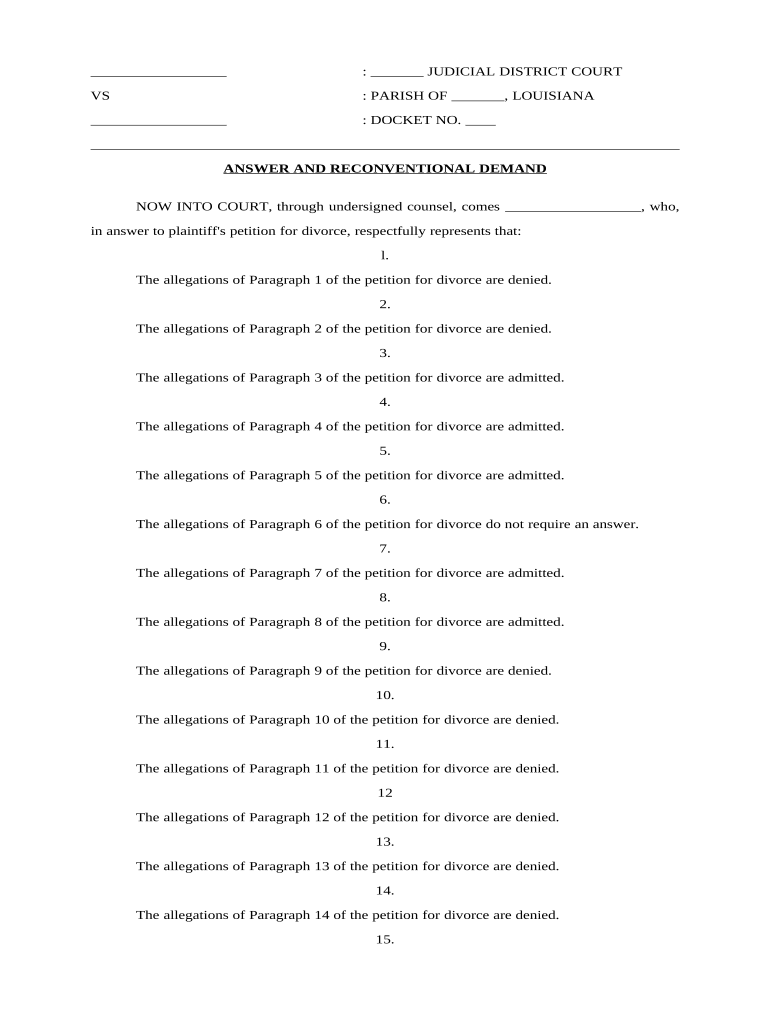
A Reconventional Demand is a defendant's formal counterclaim filed within the same civil proceeding to assert independent causes of action against the original plaintiff. It brings related claims into the pending case record so the court can adjudicate both sides together, conserving resources and avoiding separate litigation. Typical content includes party identification, factual allegations, legal theories, and a statement of requested relief. Terminology and procedural handling vary across jurisdictions; practitioners must follow the applicable local rules or federal rules of civil procedure when drafting and filing a Reconventional Demand.

Why filing a Reconventional Demand matters

Filing a Reconventional Demand preserves affirmative defenses or counterclaims, consolidates dispute resolution, and often reduces overall litigation cost and delay. It secures remedies within the pending action and narrows issues for discovery and trial.

Why filing a Reconventional Demand matters

Who typically prepares and files Reconventional Demands

Common users who prepare or file Reconventional Demands include litigation attorneys, in-house legal teams, and litigation support specialists who manage court pleadings.

  • Litigation attorneys — Draft pleadings, analyze legal theories, and advocate for consolidation and relief.
  • In-house counsel — Evaluate exposure, authorize filings, and align claims with corporate strategy and reserves.
  • Paralegals and litigation support — Assemble exhibits, verify docket information, and manage e-filing and service logistics.

Typical signers and stakeholders

Defense Attorney

Trial counsel who evaluates potential counterclaims, drafts the Reconventional Demand to meet jurisdictional pleading standards, and presents arguments to preserve claims and consolidate discovery while coordinating court filings and service.

Claims Manager

In-house claims or litigation manager who coordinates with outside counsel, assesses indemnity and exposure, approves settlement authority, and ensures administrative tasks like filings, notices, and document retention are completed.

Required information typically included

Case Caption: Full case caption exactly as filed
Docket Number: Court-assigned docket number
Parties' Names: Full legal names of all parties
Statement of Facts: Concise factual basis for claims
Causes of Action: Legal theories with supporting facts
Relief Sought: Specific remedies or damages requested

Consequences of errors or omissions

Dismissal Risk: Court may dismiss defective claims
Waiver of Claims: Late or improper pleading can waive rights
Sanctions: Court can impose sanctions for misconduct
Statute of Limitations: Untimely claims may be barred
Default Judgment: Procedural failures risk default outcomes
Fee Shifting: Prevailing party fee awards possible

Common drafting and filing mistakes to avoid

  • Naming the wrong party or omitting an indispensable party, which can lead to dismissal or later amendment motions and additional litigation delay.
  • Providing vague or conclusory allegations instead of specific facts and dates, increasing the risk of a successful motion to dismiss.
  • Missing filing or service deadlines under local rules or FRCP, which can forfeit claims or prevent consolidation.
  • Failing to attach or authenticate supporting exhibits and calculations, weakening damages claims and evidentiary positions.

Step-by-step: preparing and filing a Reconventional Demand

Follow a clear sequence to draft, review, sign, file, and serve the Reconventional Demand so it integrates with the pending case without procedural defects.

  • 01
    Review Pleadings: Identify facts and potential counterclaims
  • 02
    Draft Demand: State claims, factual support, and relief sought
  • 03
    File & Serve: File with court clerk and serve plaintiff per rules
  • 04
    Preserve Evidence: Attach exhibits and preserve chain of custody

Configure online review, signing, and filing workflows

Set up a workflow that routes the draft for internal review, counsel signatures, and court-ready export while maintaining a secure audit trail and configurable authentication steps.

Document workflow field mapping header Field | Configuration
Signing order and reviewers Signing order | Sequential routing with reviewer assignments
Authentication and verification Authentication | Use email, SMS OTP, or KBA as required
Document retention and audit Retention | Retain signed PDF and audit trail for records
Notifications and integrations Notifications | Email notices; integrate with e-filing or DMS

Where to file, send, and submit a Reconventional Demand

Typical routing moves the document from draft to counsel approval, then to court filing (e‑file or clerk) and service on opposing parties consistent with local rules.

  • Prepare: Draft complaint and attach exhibits
  • Authorize: Counsel signs and affirms accuracy
  • File: Submit to court via e-filing or clerk
  • Serve: Serve plaintiff per court or local rules

Technical requirements for e-filing and e-signing

Ensure your e-signature and e-filing tool supports PDF and DOCX exports, tamper-evident signed PDFs, an audit trail, and required signer authentication.

  • File Formats: PDF, DOCX supported
  • Authentication Options: Email, SMS OTP, KBA
  • Integrations: CM/ECF, DMS, cloud storage

Key timelines and deadlines to monitor

Timeliness is critical: deadlines for filing and service determine whether counterclaims survive and whether amendments are permitted; local rules control specific timeframes.

Answer Deadline:

Typically within defendant's pleading deadline (commonly 21–30 days)

Amendment Period:

Local rules or judge's scheduling order govern amendment windows

Service Deadline:

Serve opposing counsel per local rules after filing

Motion to Strike Deadline:

Opposing party may move to strike promptly after service

Trial Preparation Cutoff:

Meet scheduling order dates for discovery and dispositive motions

E-signature vendor comparison for filing and signing Reconventional Demands

Compare starting price and core capabilities relevant to pleadings and court-ready exports. signNow is listed first for reference; vendor features and tiers vary by plan.

signNow DocuSign Adobe Sign PandaDoc HelloSign
Starting Price $8/user/mo $15/user/mo $14/user/mo $19/user/mo $15/user/mo
Free Trial 7-day free trial Varies by vendor Varies by vendor Varies by vendor Varies by vendor
Bulk Send Yes Yes Yes Yes No
Audit Trail Yes Yes Yes Yes Yes
HIPAA Compliant Yes Yes Yes No No
Envelope Cap No cap 100 envelopes/user/year Varies Varies Varies

Practical examples of common Reconventional Demand scenarios

Two typical scenarios illustrate how defendants assert reconventional claims to protect contractual and payment rights within ongoing litigation.

Commercial Breach Counterclaim

A supplier sued for breach files a Reconventional Demand alleging unpaid invoices and defective delivery dates as separate claims.

  • Key point: seek specific damages and setoffs.
  • The demand includes invoice schedules, delivery records, and a damages computation; integrating these evidentiary exhibits at filing strengthens the claim and frames discovery needs.

Construction Payment Dispute

A contractor named in a suit files a Reconventional Demand seeking payment and asserting lien rights for unfinished work.

  • Key point: attach contract and change orders.
  • Ensure the demand itemizes amounts due, references retainage clauses, and includes lien waiver history; state-specific lien notice rules and prompt payment statutes often govern remedies available.

Practical tips for accurate and efficient completion

Adopt clear drafting, consistent party naming, and a documented review workflow to reduce deficiency motions and service disputes.

Use consistent party names
Always match party names and corporate identifiers to the original complaint and official records; inconsistencies can require amendments and disrupt service or discovery, increasing cost and delay.
Attach primary exhibits
Include contracts, invoices, communications, and calculations as numbered exhibits at filing; timely exhibit attachment prevents later admissibility challenges and supports initial plausibility of claims.
Confirm service method
Follow local rules for electronic service, certified mail, or personal service; document proof of service immediately to avoid motions challenging adequacy of notice.
Preserve originals and metadata
Retain original documents and native electronic files with metadata; maintain chain-of-custody logs to support authenticity in discovery and at trial.

Downloading, exporting, and preserving signed pleadings

Export formats and audit artifacts affect court acceptance and appellate record quality; choose formats that preserve signatures and metadata.

PDF/A Export

Export a tamper-evident PDF/A copy for the court file. PDF/A preserves content and is widely accepted by e-filing systems; include an embedded signature appearance and maintain the audit trail separately.

Signed Certificate

Produce a certificate of completion that lists signer identity, timestamps, IP addresses, and action log entries. This document supports attribution and evidentiary authentication in court.

Editable DOCX

Keep a secure editable DOCX master for internal revisions before filing. Do not submit editable originals to the court; convert to final PDF for filing to avoid unintended changes.

Audit Trail

Store a human-readable audit trail with every signed version. The trail should document each action, authentication step, and delivery event for later verification.

Frequently asked questions about Reconventional Demands

Answers to common procedural and practical questions about drafting, signing, filing, and preserving Reconventional Demands in U.S. litigation contexts.


Need help? Contact support

be ready to get more
Join over 28 million airSlate SignNow users