Establishing secure connection…Loading editor…Preparing document…

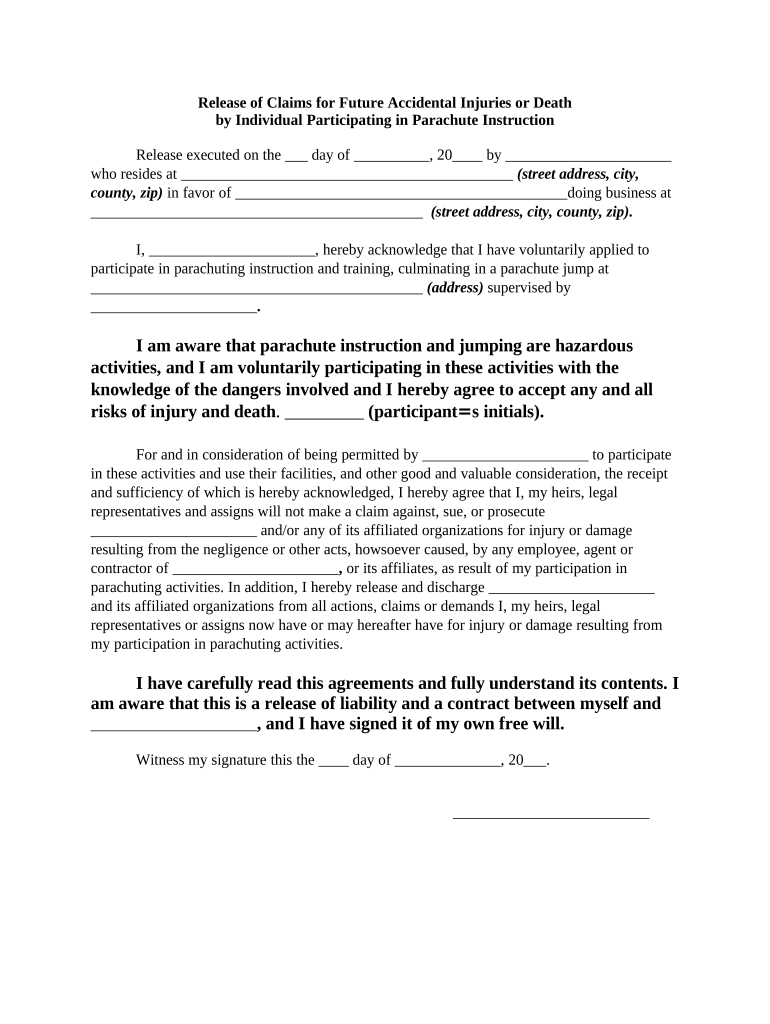
Release of Claims for Future Accidental Personal Injuries or Death

This template is fully customizable. Edit the text, fill out the fields, and send it for signature. Give it a try!
Release of Claims for Future Accidental Personal Injuries or Death

What this Release of Claims for Future Accidental Personal Injuries or Death Is

A Release of Claims for Future Accidental Personal Injuries or Death is a legal instrument in which a claimant agrees to waive the right to pursue future claims arising from accidental bodily injury or wrongful death related to a defined event or occurrence. It typically appears in settlement agreements, insurance releases, and indemnity frameworks to allocate risk and finalize compensation. The document should clearly identify the parties, the scope of waived claims, effective date, consideration, and any carve-outs for gross negligence or intentional acts to preserve enforceability and clarity.

Why a Clear Release Matters for Settlements and Risk Management

A well-drafted release clarifies allocated risks, prevents duplicated claims, and supports finality for insurers, defendants, and claimants. It reduces post-settlement disputes and helps courts and claims administrators interpret the parties' intent under ESIGN (15 U.S.C. ch. 96) and applicable state law such as UETA.

Why a Clear Release Matters for Settlements and Risk Management

Who Commonly Prepares or Signs This Release

This release is used by multiple parties involved in accident and claims resolution processes.

  • Insurance claims adjusters and carriers handling settlements after accidents and wrongful-death claims.
  • Plaintiffs and claimants who accept settlement funds in exchange for releasing future claims.
  • Defense counsel, corporate risk managers, and third-party administrators overseeing final releases.

Step-by-step: Completing the Release of Claims Document

Follow these steps in order to reduce errors and support enforceability when preparing or signing the release.

  • 01
    1. Identify parties: Enter full legal names for all parties.
  • 02
    2. Describe event: Summarize the accident, date, and location precisely.
  • 03
    3. State consideration: Specify payment or other consideration clearly.
  • 04
    4. Sign and date: All signatories must sign and date in original or e-signed form.

Frequently asked questions and common signing issues

Answers to common questions about validity, signatures, and post-signing concerns for releases of future accidental injury or death claims.


Need help? Contact support

Core elements every professional release should include

A complete release contains several standard sections that together define scope, obligations, and limits on future claims.

Parties Identified

Full legal names and capacity (individual, guardian, corporate officer) for every party to ensure the release binds the intended persons and entities.
Incident Details

Concise factual description of the accident, including date and location, to delineate which events the release covers and reduce ambiguity.

Scope of Waiver

Clear language listing waived causes of action (e.g., negligence, wrongful death) and any carve-outs for future claims, including limitations and exceptions.

Consideration

Exact payment terms, method, and timing; sufficient consideration supports enforceability and demonstrates a bargained-for exchange.

Representations

Statements that the signer has read the document, had opportunity for counsel, and signs voluntarily to strengthen documentary evidence against later challenges.

Execution Details

Signature blocks, dates, and notarization or witness lines as required by applicable state law or party agreement to authenticate the document.

Required information and essential metadata

Party Names: Full legal names
Identifiers: DOB or entity ID
Incident Date: MM/DD/YYYY
Consideration: Dollar amount stated
Signature Date: MM/DD/YYYY
Execution Method: Wet, e-sign, or notarized

Risks and consequences of an incorrect or incomplete release

Unenforceability: Release may be voided
Duplicate Claims: Further litigation risk
Insurance Denial: Payment disputes arise
Tax Reporting: 1099 implications possible
Delay Costs: Settlement delays increase expense
Malpractice Risk: Counsel exposure if errors

Common mistakes to avoid when preparing a release

  • Using vague language like 'all claims' without defining scope creates ambiguity and invites litigation over intended coverage.
  • Failing to identify parties’ legal capacity (minor, conservator, corporate officer) may render the release unenforceable or subject to rescission.
  • Omitting consideration amount or payment timing can allow a claimant to argue no bargained-for exchange occurred, risking invalidation.
  • Neglecting required disclosures for consumer-facing transactions risks statutory challenges; follow ESIGN consumer disclosure rules when applicable.

Where to send, file, or record the signed release

Routing depends on the context: insurer claims file, settlement administrator, defense counsel, or court if part of a filed action.

  • To Insurer: Submit signed original to claims administrator.
  • To Counsel: Send copies to each party’s attorney for records.
  • To Court: File with settlement papers if court approval is required.
  • To Medical Providers: Provide copies for lien resolution when applicable.

Configuring an electronic signing workflow for this release

Set up a clear e-sign workflow with authentication, field validation, and document retention before sending the release for signatures.

Setting Recommended value
Authentication Method Email link plus SMS code
Required Fields Name, date, signature field
Notarization Option Enable RON where permitted
Audit Trail Capture IP, timestamps, and certificate

Digital signing and distribution considerations

Use an eSignature platform that supports audit trails, secure storage, and applicable integrations for claims workflows.

  • File Formats: Accept PDF and Word DOCX for signed originals
  • Integrations: Connect with claims systems like RMS or with cloud storage platforms
  • Authentication: Support email, SMS, and optional KBA for higher trust

Timing and processing items to monitor

Track key dates to maintain enforceability and manage claim settlement timing effectively.

Execution Date:

Date parties sign; defines when waiver takes effect

Payment Timing:

State when consideration is paid or due

Notarization Window:

Notarize at signing or immediately after

Record Retention:

Keep signed copies per retention rules

Statute of Limitations:

Varies by state; confirm local deadlines

eSignature vendor comparison for executing releases

Comparison of typical vendor cost and technical capabilities relevant to signing and storing releases; signNow appears first per platform selection guidance.

signNow DocuSign Adobe Sign PandaDoc HelloSign
Starting Price $8/user/mo $15/user/mo $14/user/mo $19/user/mo $15/user/mo
Free Trial 7-day trial Varies by plan Varies by plan Varies by plan Varies by plan
Bulk Send Yes Yes Yes Yes No
Audit Trail Yes Yes Yes Yes Yes
HIPAA Compliant Yes Yes Yes No No
be ready to get more
Join over 28 million airSlate SignNow users