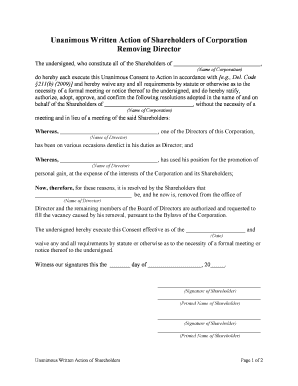
Unanimous Written Action of Shareholders Removing Director
What the Unanimous Written Action of Shareholders Removing Director Is
Why a Written Unanimous Action Matters
A Unanimous Written Action of Shareholders Removing Director creates an auditable, signed record of unanimous consent that avoids convening a meeting, satisfies governance formalities, and supplies evidence for banks, regulators, and counterparties when updating director records.
Who Typically Prepares and Signs This Document
Typical users include corporate secretaries, majority shareholders, and small-business owners handling governance outside formal meetings.
- Corporate secretary who prepares the written action and maintains corporate minutes and records.
- All voting shareholders who must provide unanimous consent to remove a director.
- Outside counsel or corporate counsel who reviews compliance with bylaws and state statutes.
Representative Roles Who Sign or Manage the Action
Corporate Secretary
Corporate Secretary — Responsible for preparing the unanimous written action, ensuring signatures from all entitled shareholders, verifying voting entitlements, and attaching the consent to corporate minutes. Often files any required state amendments or coordinates with outside counsel for compliance with bylaws and statutes.
Majority Shareholder
Majority Shareholder — Signs or directs execution of the consent when entitled to vote, confirms voting power and class rights, and may initiate removal where bylaws permit. Must ensure all other shareholders consent or the action conforms to the shareholder agreement to avoid disputes.
Step-by-Step: Prepare, Sign, and Record the Unanimous Action
-
01Prepare Document: Identify company, director, reasons, and effective date before circulation.
-
02Circulate to Shareholders: Provide copies with signature blocks to all entitled shareholders.
-
03Collect Signatures: Obtain handwritten or electronic signatures from every voting shareholder.
-
04Record and File: Attach action to minutes and file amendments if state law requires.
Frequently Asked Questions About Execution and Validity
-
Can shareholders act without a meeting?
Yes. When all shareholders entitled to vote sign a written consent adopting the removal, it is equivalent to action taken at a meeting under most state statutes and UETA/ESIGN, provided corporate bylaws permit unanimous written actions and signatures are properly authenticated.
-
Are electronic signatures valid for removal?
Electronic signatures are valid under the ESIGN Act and UETA where adopted if the signature shows intent, consent to electronic records, signer attribution, and the record can be retained. Check any corporate bylaws that require additional authentication or original ink signatures.
-
Is notarization required for this action?
Generally notarization is not required to effect removal, but some third parties or state filings may request notarized signatures. If a notarized acknowledgement is obtained, follow state RON or in-person notary rules to ensure validity.
-
Must this action be filed with the state?
Typically corporate shareholder consents are internal records and do not require Secretary of State filing unless the removal triggers an amendment to articles or officer/agent changes; consult state corporate code for filing requirements.
-
Can a unanimous written action be revoked?
Revocation depends on timing and corporate bylaws; once executed and delivered, unanimous action generally stands unless shareholders unanimously agree to rescind and record the revocation per governance rules.
-
How long should records be retained?
Retain original signed consents for the active life of the corporation plus at least three additional years; for tax or SEC matters retain per IRS or SEC retention rules.
Common Risks and Consequences of Errors
Avoidable Preparation Mistakes
- Distributing inconsistent document versions leads to signature gaps and later challenges to validity; circulate a single controlled version and track signers carefully.
- Failing to confirm voting entitlement (class rights, transfer restrictions) may result in insufficient consent even with all signatures present.
- Using poor authentication for electronic signatures increases the risk that a court will question signer identity and the action's enforceability.
- Neglecting to attach the consent to corporate minutes or failing to notify affected parties can create operational and contractual confusion.
How to Configure an eSignature Workflow for Shareholder Consent
| Field | Configuration |
|---|---|
| Choose document template file format | PDF/A or Word DOCX template |
| Set signer authentication method (email/SMS/KBA) | Email link or SMS code recommended |
| Place signature and date fields precisely | Use required fields and validation rules |
| Configure archival and audit trail retention | Enable PDF export and tamper-evident audit log |
Digital Signing Requirements and Integrations
Use an eSignature platform that supports ESIGN, UETA, and secure audit trails for shareholder actions.
- File Formats: PDF and Word DOCX supported
- Integrations: Connects to Google Workspace and NetSuite
- Signer Authentication: Email, SMS, or stronger MFA options
End-to-End eSigning Flow for the Written Action
-
Upload: Upload the completed template to the signing platform
-
Place Fields: Add signature, date, and name fields for each shareholder
-
Authenticate: Choose authentication level and send signing invites
-
Archive: Export signed PDF with audit trail and store securely
Timing Considerations and Deadlines to Watch
Confirm Effective Date For Removal:
Effective date controls when removal is operative and obligations change.
Check bylaws for required notice periods:
Some bylaws require advance notice before removal actions.
Determine state filing deadlines if applicable:
State codes vary; amendments may have specific filing windows.
Define retention start date and recordkeeping timeline:
Retention begins on execution date; follow IRS or state rules where applicable.
Notify banks, registries, and payors promptly:
Entities often require certified copies or updated officer listings.
Key Milestones from Draft to Record
Draft Consent
Prepare written action detailing removal and effective date.
Review and Approval
Legal and bylaws review for quorum and authority compliance.
Execution
All shareholders sign both physical or electronic copies.
Recordkeeping
Attach consent to minutes and update registries as needed.
Unanimous Written Action Compared with Other Removal Routes
| Criteria | Unanimous Written Action | Board/Meeting Resolution |
|---|---|---|
| Meeting required | ||
| Formality level | lower | higher |
| Speed | faster | slower |
| Record type | written consent | meeting minutes |
eSignature Vendor Pricing Snapshot Relevant to This Document
| signNow | DocuSign | Adobe Sign | PandaDoc | HelloSign | |
|---|---|---|---|---|---|
| Starting Price | $8/user/mo | $15/user/mo | $14/user/mo | $19/user/mo | $15/user/mo |
| Free Trial | 7-day trial | No | No | No | No |
| Bulk Send | Yes | Yes | Yes | Yes | No |
| Audit Trail | Yes | Yes | Yes | Yes | Yes |
| HIPAA Compliant | Yes | Yes | Yes | No | No |
Practical Examples of Using a Unanimous Written Action
Small Corporation
A privately held S corporation removed a director after a conflict of interest finding and avoided convening a special meeting by unanimous written consent.
- All shareholders signed electronically with verified emails.
- The signed consent was added to corporate minutes, provided to the company registrar, and used to update bank signatories; counsel reviewed the action to confirm compliance with bylaws and state statute to prevent later challenge.
Mid-Size Company
A family-owned real estate firm removed a director whose employment ended and used a unanimous written action to record the change efficiently.
- Physical signatures were notarized and filed.
- The company filed an amendment with the state where required, notified lenders, updated title and financing records, and preserved the action in the minute book to avoid closing delays.