Establishing secure connection…Loading editor…Preparing document…

Reprimand for Unacceptable Conduct

This template is fully customizable. Edit the text, fill out the fields, and send it for signature. Give it a try!
Reprimand for Unacceptable Conduct

What the Reprimand for Unacceptable Conduct is and when it’s used

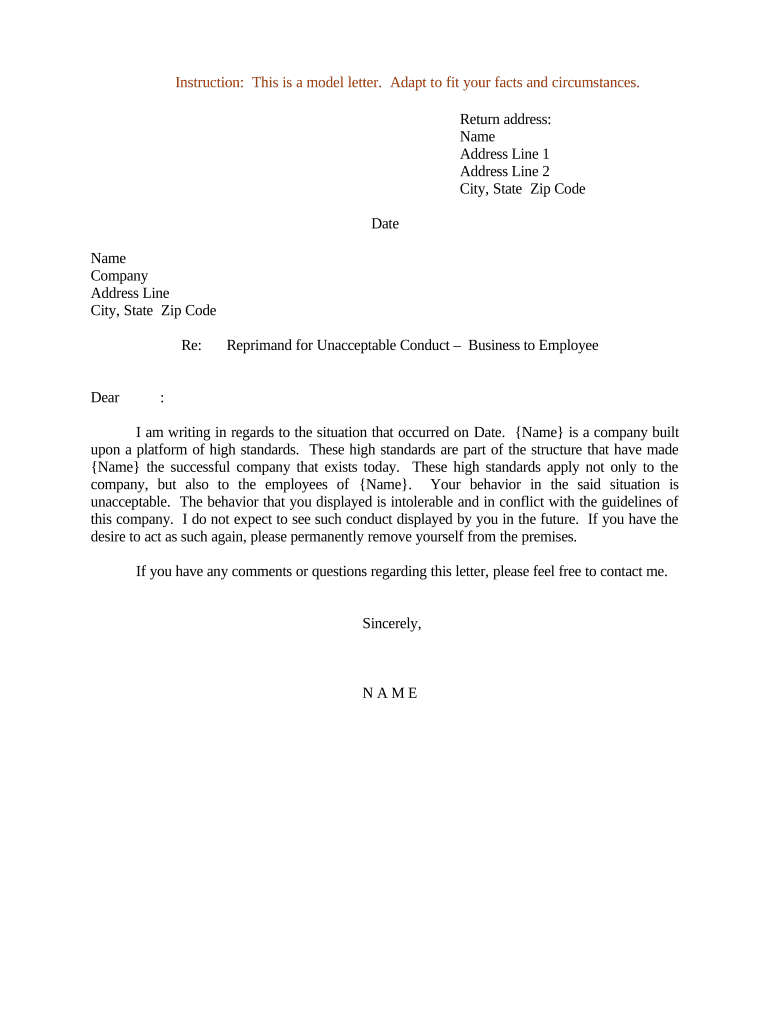
A Reprimand for Unacceptable Conduct is a formal human resources document used to record incidents of inappropriate or policy-violating behavior, provide a factual summary of the event, and state any corrective action or disciplinary measures. It establishes an official record for personnel files, protects due process by documenting investigation findings, and clarifies expectations going forward. Employers use it to communicate consequences, preserve evidence for potential appeals, and demonstrate consistent enforcement of workplace policies while maintaining confidentiality and compliance with applicable privacy laws.

Why a clear, documented reprimand matters

Documented reprimands create an auditable record of misconduct, protect the organization against inconsistent discipline claims, and support later corrective or legal actions if misconduct recurs.

Why a clear, documented reprimand matters

Who typically prepares and receives this document

Human resources, direct supervisors, and compliance officers most commonly prepare reprimands and retain copies in personnel files.

  • Supervisors and managers: Prepare factual incident descriptions and recommend corrective measures within policy.
  • Human resources teams: Review for consistency, finalize wording, and file in official personnel records.
  • Employees receiving the reprimand: Review, acknowledge receipt, and may provide a written response or appeal.

Well-drafted reprimands balance factual detail with procedural fairness and should be shared only with those who have a legitimate need to know.

Essential parts of a professional reprimand

A reprimand should be concise, factual, and structured so readers can quickly find the incident description, policy references, and expected corrective steps.

Header

Date, employee name, job title, department and document title; identifies the record and responsible parties.
Incident

Clear chronological summary of events including dates, times, locations, and any witnesses or related documents.

Policy Cited

Specific policy sections or handbook citations that were violated, quoted or paraphrased for precision.

Investigation Summary

Brief description of steps taken to investigate, evidence considered, and persons interviewed.

Corrective Action

Discipline imposed, performance expectations, deadlines for improvement, and follow-up review dates.

Signatures

Signature and date lines for the issuer and recipient, plus space for a written employee response.

Required data elements to include

Employee name: Full legal name
Date of incident: MM/DD/YYYY
Supervisor name: Full name and title
Location: Worksite or department
Policy reference: Handbook section identifier
Action taken: Specific remedy or discipline

How to complete the reprimand step by step

Follow a repeatable four-step workflow to ensure accuracy, consistency, and defensibility when issuing a reprimand.

  • 01
    Document incident: Record facts, dates, times, witnesses, and evidence precisely.
  • 02
    Cite policy: Reference the specific rule or handbook section violated.
  • 03
    Determine action: State corrective measures, timelines, and monitoring steps.
  • 04
    Sign and file: Obtain signatures and place the original in the personnel file.

Where to file, send, and preserve the signed reprimand

Maintain a clear routing path so the document is reviewed, signed, and stored by appropriate custodians while preserving confidentiality.

  • Immediate recipient: Deliver to the employee for acknowledgment and response.
  • HR copy: File the signed original in the official personnel record.
  • Manager copy: Provide a redacted copy to the direct manager for follow-up.
  • Legal hold: Retain separate secure copy if litigation or audit is pending.

Recommended digital workflow settings

Configure the electronic workflow to require identity checks, an audit trail, and secure storage for the reprimand.

Field Configuration
Authentication Email link plus optional SMS code
Audit trail Capture IP, timestamp, and actions
Access control Restrict views to HR and management
Retention policy Map to HR document retention schedule

Digital delivery and eSignature considerations

Use an eSignature platform that provides tamper-evident copies, an auditable event history, and configurable signer authentication.

  • Document format: PDF or DOCX
  • Authentication options: Email, SMS, KBA
  • Security controls: AES-256 encryption

Ensure the chosen platform supports compliance needs such as ESIGN/UETA legal validity, HIPAA BAA when handling protected health information, and secure long-term storage for personnel records.

Typical timelines and internal deadlines

Establish internal deadlines so investigations and discipline proceed promptly and consistently while allowing for appeals or additional review.

Initial documentation:

Complete within 24–72 hours of the incident.

Investigation period:

Conduct interviews within 5–10 business days.

Issuance of reprimand:

Issue within 7–14 business days after investigation.

Improvement timeframe:

Set measurable goals and review within 30–90 days.

Appeal period:

Allow employee to submit response within 5–10 business days.

Common mistakes to avoid when preparing a reprimand

  • Including opinionated language or insults rather than objective facts, which can create legal exposure and reduce the document’s credibility.
  • Failing to cite the exact policy section or handbook provision, leaving discipline unsupported and open to challenge.
  • Delaying documentation for weeks, which weakens the timeline and the employer’s ability to rely on accurate recollection.
  • Distributing the reprimand too broadly or storing it insecurely, risking confidentiality breaches and potential privacy law violations.

Potential risks if the reprimand is incorrect or mishandled

Discrimination claim: May trigger unlawful discrimination allegations
Wrongful termination: Weak documentation can harm termination defenses
Privacy breach: Improper disclosure risks HIPAA/CCPA issues
Union grievance: Collective bargaining agreements may permit challenge
Regulatory scrutiny: Industry regulators may request personnel files
Reputational harm: Poor handling can damage employer credibility

Comparing eSignature vendor basics for issuing reprimands

Basic vendor features relevant to secure delivery, audit trails, and compliance; signNow is listed first for direct feature comparison.

signNow DocuSign Adobe Sign PandaDoc HelloSign
Starting Price $8/user/mo $15/user/mo $14/user/mo $19/user/mo $15/user/mo
Free Trial 7-day free trial Varies by vendor Varies by vendor Varies by vendor Varies by vendor
Bulk Send Yes Yes Yes Yes No
Audit Trail Yes Yes Yes Yes Yes
HIPAA Compliant Yes Yes Yes No No

Frequently asked questions about reprimands and eSigning

Answers to common legal, procedural, and technical questions when preparing, signing, and storing a reprimand.


Need help? Contact support

be ready to get more
Join over 28 million airSlate SignNow users