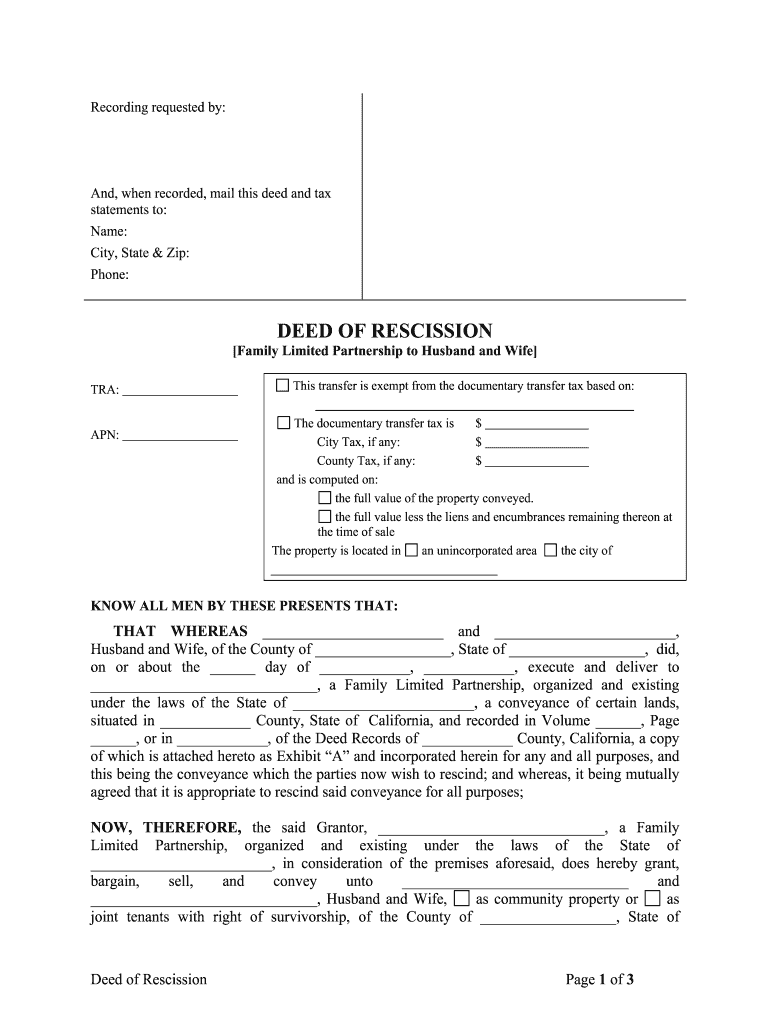
California Deed of Rescission
What a California Deed of Rescission Is and when it applies
Why a properly drafted rescission matters
A clear, correctly executed Deed of Rescission reduces title defects, avoids future litigation, and creates a public record that notifies title insurers and purchasers. Proper form and recording preserve chain-of-title integrity and reduce the risk of competing claims or unintended liability.
Who commonly prepares or requests a deed rescission
Typical users include grantors, grantees, title companies, lenders, and attorneys who discover an error or have a contractual rescission right.
- Grantors and grantees dealing with a mutual mistake or defective conveyance who need to correct title and avoid future disputes.
- Title companies or escrow officers who require recorded rescission to clear exceptions before issuing title insurance.
- Lenders or servicers enforcing a contractual rescission clause due to fraud, default, or post-closing remedies.
Work with counsel or a title professional to confirm the rescission approach matches the cause of rescission and the intended remedy.
Primary signers and stakeholders
Owner / Grantor
The individual or entity that conveyed the property originally and now signs to revoke or rescind that conveyance. The grantor should provide accurate identity documentation and ensure name consistency with the original deed to avoid rejection when recording.
Title Company
Title or escrow professionals review chain-of-title, verify the rescission will clear or correct title exceptions, and often coordinate recording and delivery of the recorded instrument to interested parties.
Key legal risks if the rescission is incorrect
Common drafting and processing mistakes to avoid
- Using inconsistent party names between the rescission and original deed — mismatched names often cause recorder rejections and delay clearing title.
- Failing to cite the original deed's recording reference (instrument number, book and page) which prevents the recorder from linking documents in the chain of title.
- Omitting a clear statement of intent or effective date, creating ambiguity about whether rescission applies retroactively or only prospectively.
- Skipping lender or beneficiary consents when the original conveyance affected mortgage or security interests; failure to secure consent may not clear encumbrances.
Step-by-step: completing a California Deed of Rescission
-
01Identify deed: Locate the original instrument and recording details.
-
02Draft rescission: Describe parties, original deed, and clear rescission language.
-
03Sign and notarize: Have grantor(s) sign before a notary public.
-
04Record document: File with county recorder and obtain recording receipt.
How to configure an online rescission form workflow
| Form field name and configuration | Validation rules | Required | Auto-fill from template |
|---|---|
| Grantor Name field | Required text | exact-match validation | autofill allowed |
| Legal Description field | Required multiline text | character limit | must match template |
| Notary acknowledgement | Require notarization checkbox | upload of stamped PDF |
| Delivery routing | Send recorded copy to title, lender, and signer |
Where to file and who receives the recorded rescission
-
County Recorder: Record in the county where the property is located.
-
Title Company: Send recorded instrument to clearing title exceptions.
-
Lender or Beneficiary: Provide recorded copy if loan or lien affected.
-
Grantor / Grantee: Deliver final recorded page and receipt to signers.
Digital signing, notarization, and distribution considerations
Use an e-signature workflow that supports notarization capture, secure storage, and delivery to county recorders or title partners.
- File formats: PDF/A recommended for archival and recorder acceptance.
- Authentication: Use strong signer verification and audit trails.
- Integrations: Connect to title platforms and cloud storage
Ensure your platform supports required notarization workflows and produces a tamper-evident recorded PDF for distribution to lenders and title insurers.
Timing considerations and recording expectations
Record promptly:
Record as soon as parties sign and notarize to protect priority.
County processing times:
Recorder review typically takes days to weeks depending on county workload.
Title update window:
Title companies update their records after receiving recorded pages.
Lender response time:
Lender consent or release may take additional days to process.
Retention of receipts:
Keep recording receipt and recorded PDF for permanent records.
Notarization and witness flow for recording acceptance
Prepare documents
Assemble rescission, original deed reference, and ID documents.
Signers present
Grantor(s) must sign in notary presence.
Notary acknowledgement
Notary completes statutorily required wording and seal.
Witness requirement check
Confirm if state or county requires witness signatures.
Remote notarization
Use RON only where permitted by state law and recorder.
Notary journal entry
Notary records the session per commission rules.
Certified copy
Obtain certified or recorded copy for title and lender.
File with recorder
Submit for recording with applicable fees and cover sheet.
Real-world scenarios where a deed rescission is used
Title Company Correction
A county recorder issue revealed an incorrect grantee in the recorded deed
- Title insurer required a rescission
- After recording the rescission, the title company removed the exception and issued a clear policy to the buyer.
Mutual Mistake Rescission
Parties discovered a mutual mistake in a conveyance description
- Both parties agreed to rescind and sign a corrective instrument
- Recording the rescission and corrective deed restored the intended ownership and reduced litigation risk.
Practical tips for accurate, efficient rescission handling
How a Deed of Rescission compares to related instruments
| Document Type | Primary Purpose | Typical result |
|---|---|---|
| Deed of Rescission | cancel conveyance | return title status |
| Quitclaim Deed | transfer interest | convey whatever interest exists |
| Reconveyance | release deed of trust | remove trustee lien |
| Release of Lien | release encumbrance | remove recorded lien |
eSignature vendor comparison for executing and notarizing deeds
| signNow | DocuSign | Adobe Sign | PandaDoc | HelloSign | |
|---|---|---|---|---|---|
| Starting Price | $8/user/mo | $15/user/mo | $14/user/mo | $19/user/mo | $15/user/mo |
| Free Trial | 7-day free trial | Varies by vendor | Varies by vendor | Varies by vendor | Varies by vendor |
| Bulk Send | Yes (Business Premium) | Yes | Yes | Yes | No |
| Audit Trail | Yes | Yes | Yes | Yes | Yes |
| HIPAA Compliant | Yes | Yes | Yes | Varies | Varies |
Frequently asked questions about California Deed of Rescission
-
Can a rescission be executed electronically?
Yes, electronic signatures are generally enforceable under the ESIGN Act (15 U.S.C. §7001) and UETA where adopted, provided the e-signature meets intent, consent, attribution, and record-retention requirements.
-
Is a notary required to record a rescission?
Most recorders require a notary acknowledgement on deeds, including rescissions. Confirm the county recorder’s specific acknowledgement language and any witness rules before notarization.
-
Can a lender object to rescission?
Yes. If a mortgage or trust deed was affected, lender consent or lien release may be necessary; rescission alone may not extinguish the lien or permit clear title issuance.
-
What if the recorder rejects the document?
Typical causes are incorrect indexing, missing original deed reference, or signature issues. Correct and resubmit promptly; obtain the recorder’s rejection reason to guide corrections.
-
Is remote online notarization permitted for rescissions?
RON is permitted only where state law and the county recorder accept RON-notarized deeds. Verify state RON status and recorder acceptance before using remote notarization.
-
Do rescissions affect tax reporting?
Potentially. Rescission may affect property transfer tax or federal reporting depending on timing and substance; consult tax counsel for implications and reporting requirements.