Establishing secure connection…Loading editor…Preparing document…

Resolution to Make Specific Loan

This template is fully customizable. Edit the text, fill out the fields, and send it for signature. Give it a try!
Resolution to Make Specific Loan

What a Resolution to Make Specific Loan Is

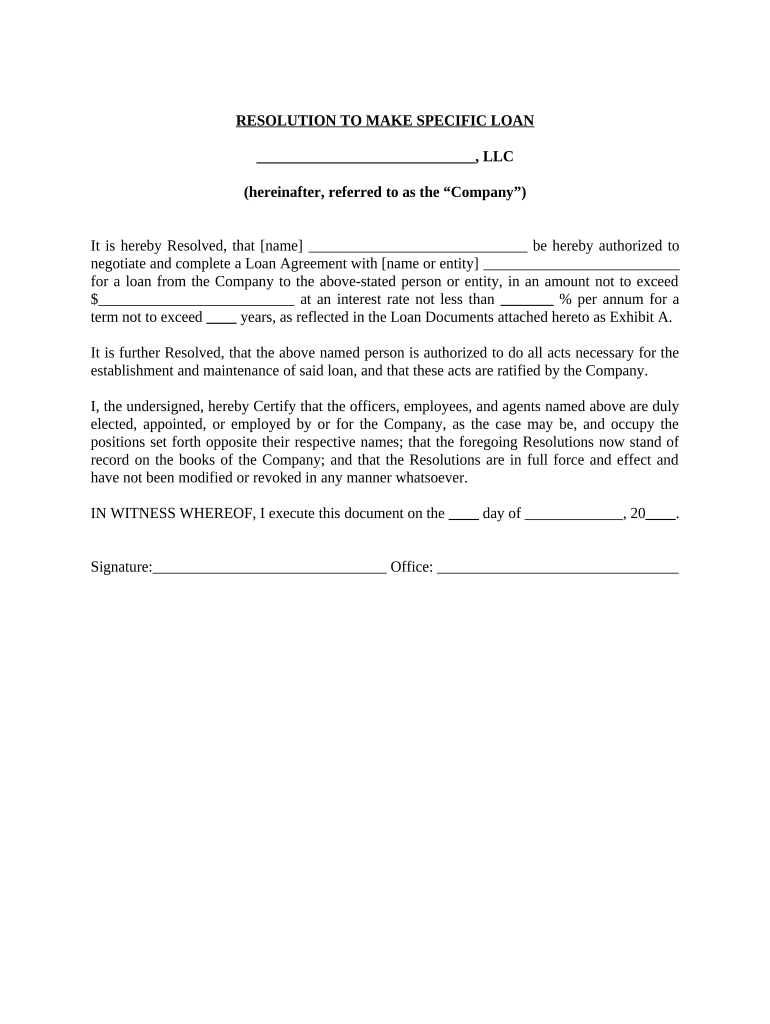
A Resolution to Make Specific Loan is a formal corporate action that documents board or member approval for a defined loan transaction. The resolution names the borrower and lender, states the approved loan amount, sets key economic terms such as interest rate and repayment schedule, and identifies authorized officers empowered to negotiate, execute, and deliver loan documents. It records any required corporate approvals, conditions precedent, and collateral or guaranty terms. Lenders, escrow agents, and auditors commonly request a certified copy as evidence of authority and corporate compliance.

Why Use a Resolution for a Specific Loan

A written resolution is the standard corporate evidence that authority exists to enter a loan, reduces signing disputes, and helps lenders rely on officer signatures and corporate approvals under internal governance and banking practice.

Why Use a Resolution for a Specific Loan

Who Typically Prepares and Relies on This Resolution

A clear resolution streamlines closing, supports due diligence, and documents compliance with bylaws and state law.

  • Corporate Secretary: Prepares, certifies, and maintains the signed resolution for the corporate minute book.
  • General Counsel: Reviews loan covenants, corporate authority, and conditions precedent before approval.
  • Lender/Closing Agent: Uses the certified resolution to confirm borrower authority and proceed with funding.

Authorized Signers and Their Roles

Board Chair

Often signs the certified resolution and attests to board approval. Responsible for ensuring minutes reflect the vote and for directing officers to execute loan documents if authorized.

Chief Financial Officer

Commonly authorized to negotiate and sign loan agreements and promissory notes. Responsible for confirming corporate funds, collateral availability, and compliance with financial covenants.

Essential Fields to Include in the Resolution

Resolution Title: Resolution name
Company Name: Legal entity
Effective Date: MM/DD/YYYY
Loan Amount: Principal figure
Authorized Officers: Names/titles
Conditions Precedent: Funding triggers

Core Components of a Professional Resolution to Make Specific Loan

A complete resolution organizes approvals, authority, conditions, and execution instructions to make the loan enforceable and auditable.

Preamble

Identifies the corporate entity, meeting type or unanimous written consent, and confirms quorum and vote results to establish valid action.
Authorized Transaction

Specifies the lender, borrower (if affiliate), maximum principal amount, permitted draw schedule, and permitted use of proceeds.

Terms Summary

Summarizes interest rate, maturity date, repayment terms, security or guaranty, and any prepayment provisions for quick lender review.

Officer Authority

Grants named officers power to negotiate, finalize, execute, notarize, and deliver loan and ancillary documents on behalf of the company.

Conditions

Lists conditions precedent such as corporate certificate, incumbency certificate, closing deliverables, and legal opinions if required.

Certification

Provides a signature block for the corporate secretary to certify a true copy and optionally specifies notarization or attestation requirements.

Step-by-Step: Prepare and Execute the Resolution

Follow these steps to create a clean, lender-ready resolution that evidences corporate authority and minimizes closing friction.

  • 01
    Draft Resolution: Populate title, parties, amount, and terms.
  • 02
    Board Approval: Hold meeting or obtain written consent and record vote.
  • 03
    Certification: Corporate secretary signs and dates certified copy.
  • 04
    Deliver to Lender: Provide certified copy and requested closing documents.

How to Complete and Customize the Resolution Online

Configure an electronic template and signer flow for repeatable, auditable closings using secure e-signature tools.

Field Configuration
Template Use a reusable template with locked clauses for standard terms
Authentication Require email plus SMS or ID check for officer signers
Signer Order Set corporate secretary to sign last after board approval
Storage Save signed PDF and audit trail to secure repository

Where to Send or File the Completed Resolution

A certified signed copy is usually shared with the lender and retained in the corporate record book; some transactions require delivery to escrow or closing counsel.

  • Lender/Bank: Provide certified copy for underwriting and funding
  • Escrow/Closing Agent: Submit if closing occurs through escrow
  • Corporate Records: Retain original in minute book or secure digital archive
  • Auditors/Legal: Share copies as requested during due diligence

Digital Signing and File Formats to Use

Ensure the platform complies with ESIGN and UETA, preserves signer attribution, and stores a reproducible audit trail for audits and lender review.

  • File Formats: PDF, DOCX supported
  • Integrations: Connects to CRM and storage
  • Authentication: Email, SMS, or ID verification

Typical Timing and Key Deadlines Around a Loan Resolution

Track internal and external dates carefully to coordinate board approvals, closing, and lender conditions for a smooth funding process.

Board Meeting Date:

Date when approval is adopted

Effective Date of Resolution:

Date obligations begin and officers gain authority

Funding Deadline:

Date lender will disburse funds

Document Delivery:

When certified copies must be provided

Record Retention Start:

Begin retention schedule on effective date

Key Processing Milestones for a Loan Resolution

Follow these milestones in sequence to ensure corporate approval, execution, and funding complete without gaps.

01

Prepare Draft

Legal drafts resolution and supporting documents

02

Board Vote

Directors approve and minute the action

03

Certification

Corporate secretary certifies and signs

04

Delivery and Funding

Certified copy delivered; lender funds per conditions

Notarization and Witness Options to Consider

Most corporate resolutions do not require notarization by statute, but lenders and escrow agents frequently request notarized or certified copies for closing.

01

Assess Lender Requirement

Confirm whether lender requires notarized or certified copies before finalizing

02

Corporate Seal

Use if company practice or lender requests a seal

03

Notary Acknowledgement

Notarize signature if lender needs proof of identity

04

Witnesses

Rare for corporate resolutions; follow lender instructions

05

Remote Notarization

Use RON where state law and lender accept it

06

Certified Copy

Secretary may certify a true copy for the lender

07

Record Journal

Retain notarization records per state rules

08

Verify State Rules

Check state notary commission for RON requirements

Common Preparation Mistakes to Avoid

  • Leaving the authorized officer unspecified, which delays lender acceptance and can cause additional approvals.
  • Using ambiguous consideration language such as 'up to reasonable amount' instead of a clear maximum principal amount.
  • Failing to certify or date the resolution properly, leading to lender requests for re-execution or additional proof.
  • Not verifying corporate bylaws or charter restrictions that may require shareholder approval for certain loan sizes.

Risks and Consequences of an Incorrect Resolution

Invalid Authority: Officer signatures disputed
Funding Delays: Lender rejects uncertified copies
Contractual Exposure: Unauthorized obligations accrue
Regulatory Scrutiny: Compliance reviews triggered
Reputational Harm: Third-party trust erodes
Additional Costs: Re-execution and legal fees

Real-World Examples of Using a Loan Resolution

These short examples show practical deployment and benefits when a resolution is used to support lending and closing.

Martin Properties (Founder)

When closing remote financings, we used an online certified resolution to authorize funding

  • Fast lender acceptance confirmed corporate authority
  • Tim Martin reported the approach enabled compliant remote execution and efficient turnaround across mobile and desktop devices, reducing in-person steps at closings.

Optica Ventures (COO)

Standardized resolution templates reduced review time during multiple closings

  • Lenders accepted certified electronic copies
  • Brian Fitzgibbons noted that a clear resolution made it easier for counterparties and auditors to verify corporate approval and officer authority.

Practical Tips for Accurate Completion

Follow these best practices to avoid common delays and lender requests for re-execution or supplemental documentation.

Use Template
Start from a vetted template to ensure consistent clause placement and required certification language.
Verify Names
Match legal entity and officer names to Secretary of State filings and incumbency certificates.
Document Vote
Include meeting minutes or unanimous written consent to show proper approval and quorum was satisfied.
Confirm Lender Needs
Ask the lender whether notarization, certified copy, or RON is acceptable before execution.

Frequently Asked Questions About Resolutions to Make Specific Loan

Answers to common legal and practical questions about preparing, signing, and delivering a loan resolution.


Need help? Contact support

Typical eSignature Pricing and Feature Comparison

Select an eSignature provider that supports secure PDF output, audit trails, and the authentication level your lender requires; signNow is shown first for comparison.

signNow DocuSign Adobe Sign PandaDoc HelloSign
Starting Price $8/user/mo $15/user/mo $14/user/mo $19/user/mo $15/user/mo
Free Trial 7-day free trial Varies by plan Varies by plan Varies by plan Varies by plan
Bulk Send Yes (Premium tier) Yes Yes Yes No
Audit Trail Yes Yes Yes Yes Yes
HIPAA Compliant Yes (BAA available) Yes Yes No No
be ready to get more
Join over 28 million airSlate SignNow users