Establishing secure connection…Loading editor…Preparing document…

Proposal Format for Responding to RFP

This template is fully customizable. Edit the text, fill out the fields, and send it for signature. Give it a try!
Proposal Format for Responding to RFP

What the Proposal Format for Responding to an RFP Covers

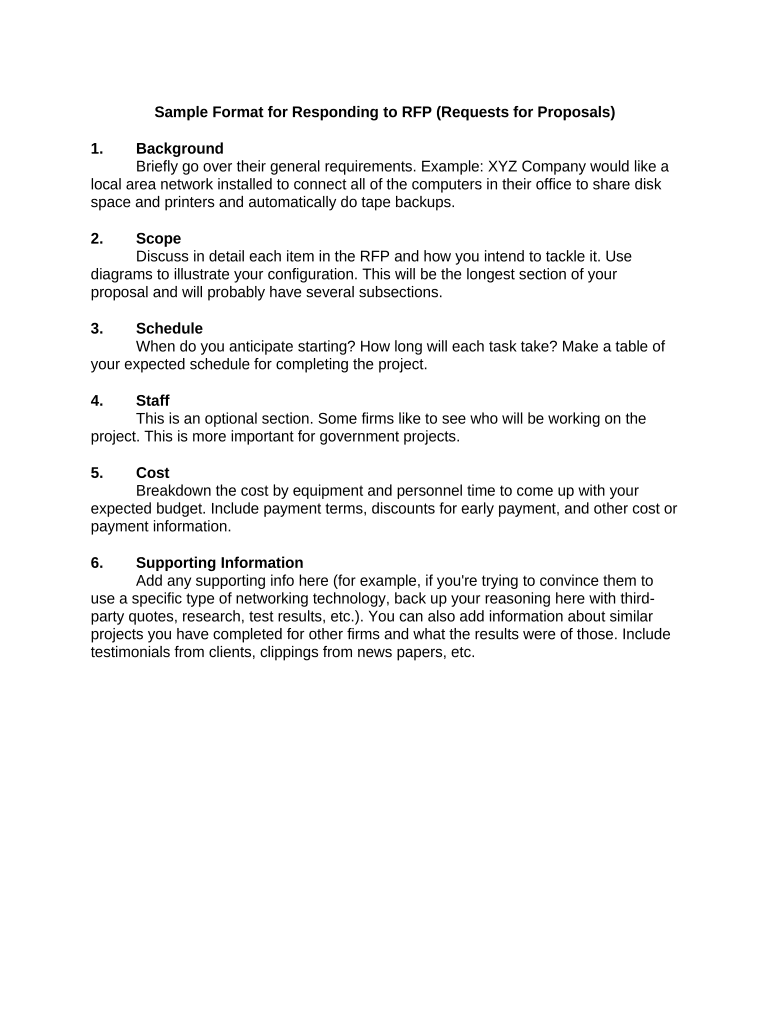
A Proposal Format for Responding to RFP is a structured submission that organizes technical approach, scope, pricing, timelines, qualifications, and required attachments so evaluators can compare offers consistently. It typically follows the procuring entity's instructions and includes a cover letter, executive summary, detailed solution, staffing and schedule, cost breakdown, compliance statements, terms and conditions, and required forms. Using a consistent format reduces evaluation errors, ensures required information is present, and demonstrates the bidder's ability to meet procurement rules and contractual expectations.

Why a Standardized Proposal Format Matters

A clear format aligns your response with the RFP evaluation criteria, reduces clarifying questions, and lowers the risk of disqualification for noncompliance. It also improves reviewer usability and speeds internal approvals when each section maps to procurement scoring.

Why a Standardized Proposal Format Matters

Who Prepares and Reviews RFP Proposal Formats

Reviewers from procurement, legal, and the receiving evaluation panel use the standardized format to score, compare, and shortlist offers efficiently.

  • Proposal Managers coordinating content, compliance, and schedules for submission readiness.
  • Technical Leads drafting scope, approach, deliverables, and staffing plans.
  • Finance and Pricing Analysts producing cost breakdowns, assumptions, and pricing tables.

Core Sections Every RFP Proposal Format Should Include

Organize the response so evaluators can find information matching RFP instructions. Each section should be labeled, paginated, and cross-referenced to mandatory forms or attachments.

Cover Letter

One-page executive summary of intent, prime contact, and key differentiators.
Executive Summary

Concise summary of approach, outcomes, and how the proposal meets evaluation criteria.

Technical Approach

Detailed methodology, deliverables, milestones, and acceptance criteria.

Staffing & Experience

Resumes, roles, certifications, and project references for proposed personnel.

Pricing & Assumptions

Line-item cost tables, pricing model, assumptions, and optional services.

Compliance & Forms

Signed certifications, insurance proof, subcontractor info, and required attachments.

Step-by-Step: Preparing a Compliant RFP Proposal

Follow these sequential steps to assemble, review, and submit a compliant proposal that aligns with evaluation criteria.

  • 01
    Review RFP: Read instructions, mandatory forms, and evaluation criteria before drafting.
  • 02
    Assign Roles: Designate authors for technical, pricing, legal, and attachments.
  • 03
    Assemble Draft: Populate each section, apply page limits, and attach required documents.
  • 04
    Quality Check: Run compliance checklist, version control, and authorized signature capture.

Typical Digital Proposal Preparation and Submission Flow

Modern submissions follow a repeatable digital workflow that preserves versioning, audit trails, and signatures.

  • Upload Documents: Collect proposal files into a single package and verify formats.
  • Place Fields: Add signature, initial, and date fields where the RFP requests signatures.
  • Authorize Signers: Assign signer roles and authentication requirements for approval routing.
  • Submit Electronically: Transmit package through the procuring body's accepted channel and record delivery proof.

Configuring an Electronic Submission Workflow for RFPs

Set workflow options to match procurement rules for authentication, attachments, and routing.

Field Configuration
Authentication Level Email link or SMS code depending on procurement rules
Routing Order Sequential approvals for technical, finance, then legal
Attachments Required Mandatory forms appended and locked before signing
Accepted File Types PDF preferred; follow solicitation if otherwise specified

Technical Considerations for eSubmission and eSigning

Align platform settings with the RFP's instructions for signature type, authentication strength, and file format to avoid submission rejection.

  • Integrations: Salesforce, NetSuite, Microsoft 365, Google Workspace supported for document management
  • Formats: PDF, DOCX, and Excel are commonly accepted; use PDF for locked final versions
  • Security: TLS in transit and AES-256 at rest required for sensitive proposals

Security and Compliance Elements to Include or Verify

Encryption: TLS 1.2/1.3 and AES-256
Audit Trail: Timestamped signer events
Access Controls: Role-based permissions
Certifications: SOC 2 Type II, ISO 27001
Legal Compliance: ESIGN and UETA support
HIPAA Support: BAA available when required

Common Preparation Pitfalls to Avoid

  • Missing mandatory attachments or required signatures leads to automatic disqualification in many procurements.
  • Inconsistent pricing tables or undisclosed assumptions create scoring penalties and can void evaluations.
  • Incorrect or expired certificates and licenses in the attachments can delay award or require cure periods.
  • Late submission due to wrong file format or delivery method is a frequent, avoidable cause of rejection.

Key Risks and Consequences of an Incorrect Proposal Format

Disqualification: Immediate removal from evaluation
Bid Bond Forfeiture: Loss of security on award failure
Contract Delay: Extended negotiations or cure periods
Financial Penalties: Damages if contract terms violated
Reputation Damage: Reduced chances in future solicitations
Tax Withholding: Backup withholding risk for missing TINs

Typical RFP Timelines and Key Dates to Track

Track mandatory milestones from solicitation release through contract award. Missing any required date can invalidate your submission.

Request for Clarifications Due:

Date for written questions and clarifications

Proposal Submission Deadline:

Final date/time for complete submission

Proposal Opening / Evaluation:

Window when proposals are reviewed

Notification of Shortlist:

Advisory date for shortlisted vendors

Contract Award / Start:

Target award date and anticipated contract start

Sequential Milestones: From RFP Release to Contract Start

A linear milestone view helps coordinate authors, reviewers, and signers from issuance to execution.

01

RFP Issued

Solicitation published and available to bidders

02

Q&A Window

Vendors submit questions to clarify requirements

03

Proposal Due

Completed proposals must be uploaded or delivered

04

Award & Execution

Winning bidder signs contract and mobilizes

How a Formal RFP Proposal Differs from an Informal Quote

Comparing formal proposals to informal quotes clarifies expectations for detail, signatures, and enforceability.

Criteria Formal RFP Proposal Informal Quote
Binding Terms often yes usually no
Signature Required sometimes
Detailed Scope limited
Evaluation Process formal scoring ad hoc

Provider Pricing and Feature Snapshot for eSignature in Proposal Workflows

This table summarizes starter price and common feature points for typical eSignature vendors used to sign RFP proposals and related compliance documents.

signNow DocuSign Adobe Sign PandaDoc HelloSign
Starting Price $8/user/mo $15/user/mo $14/user/mo $19/user/mo $15/user/mo
Free Trial Yes, 7-day free trial No No Yes, limited Yes, limited
Bulk Send Yes Yes Yes Yes Yes
Audit Trail Yes Yes Yes Yes Yes
HIPAA Compliant Yes Yes Yes No No

Frequently Asked Questions About the Proposal Format for Responding to RFP

Answers to common questions cover signature acceptability, corrections, notarization, signatory authority, and retention practices for RFP proposals.


Need help? Contact support

be ready to get more
Join over 28 million airSlate SignNow users