Establishing secure connection…Loading editor…Preparing document…

Revocation of Prenuptial Agreement Maryland

This template is fully customizable. Edit the text, fill out the fields, and send it for signature. Give it a try!
Revocation of Prenuptial Agreement Maryland

What the Revocation of Prenuptial Agreement Maryland Is

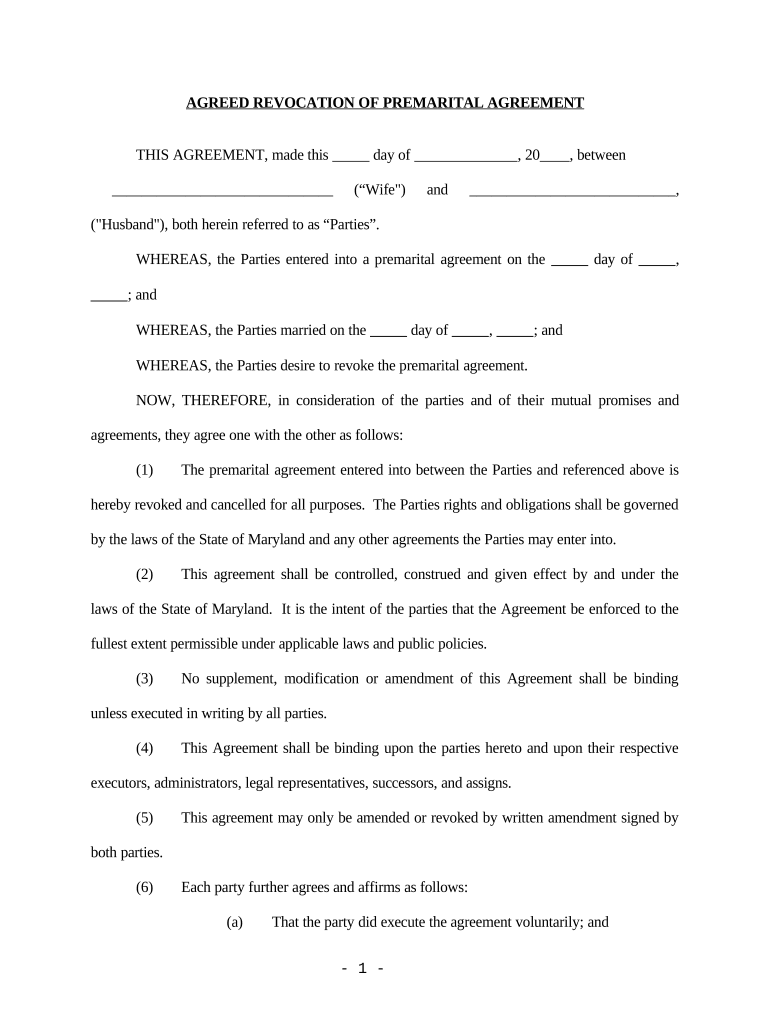
A Revocation of Prenuptial Agreement Maryland is a written document executed by the parties to cancel or terminate a previously signed prenuptial (antenuptial) agreement under Maryland law. It records the mutual intent to rescind the original contract in whole or in part, describes the effective date of revocation, and identifies the parties and the instrument being revoked. The revocation is a contract-based record and should clearly show signatures, dates, and any notarization or witness acknowledgments required by the parties or their attorneys. When properly prepared and executed, it documents the parties’ changed agreement and provides evidence for future proceedings or financial transactions.

Why a Formal Revocation Matters

A formal revocation creates clear, contemporaneous evidence that the parties intended to cancel the prenuptial agreement, reducing ambiguity in later disputes and when dealing with third parties such as financial institutions or courts.

Why a Formal Revocation Matters

Who Typically Prepares or Signs This Revocation

Parties and professionals preparing a revocation include both spouses, family law attorneys, and notaries; the document serves as the official record that a prior antenuptial agreement is no longer in effect.

  • Married parties seeking to cancel a premarital agreement after a change in circumstances or mutual decision
  • Family law attorneys drafting a clean, enforceable revocation for clients and advising on collateral effects
  • Notaries and title officers who may need an acknowledged instrument for third-party reliance

Use the revocation when both parties agree to terminate the agreement; contested revocations typically require counsel and may involve litigation to resolve enforceability or surrounding circumstances.

Who Has Authority to Sign

Spouse A

The named party to the original prenuptial agreement must sign to effectuate revocation. If a party lacks capacity or signs under duress, the revocation may be challenged; legal counsel often confirms capacity and voluntary execution.

Spouse B

The other named party must also sign when revocation is mutual. If both signatures are required under the original agreement or state law, a single-party signature typically will not suffice to revoke the contract.

Core Elements to Include in a Professional Revocation

A well-drafted revocation contains standardized elements that make intent and scope clear while preserving evidentiary value for courts and third parties.

Document Title

Clear caption identifying the instrument as a Revocation of Prenuptial Agreement Maryland, with cross-reference to the original agreement date.
Parties Identified

Full legal names and current addresses of both spouses as they appear on the original agreement.

Recital of Original

Citation of the original prenuptial agreement by date and parties to avoid ambiguity about which instrument is revoked.

Scope of Revocation

Explicit language stating whether the revocation is total or partial and noting any surviving clauses.

Execution Block

Signature lines for both parties, printed names, and dates; include notary acknowledgment if required or desired.

Notary/Witness

Notary acknowledgment or witness lines as appropriate for third-party reliance or local practice.

Step-by-Step: How to Complete and Execute the Revocation

Follow these sequential steps to prepare, sign, and preserve a legally useful revocation of a prenuptial agreement in Maryland.

  • 01
    Prepare Draft: Identify the original instrument, state scope of revocation, and insert party names and dates.
  • 02
    Review with Counsel: Have both parties consult counsel to confirm voluntariness and collateral effects.
  • 03
    Sign and Date: Obtain signatures from all required parties and include execution dates adjacent to signatures.
  • 04
    Notarize/Record: If desired for third-party reliance, obtain a notary acknowledgment; recording is not typically required for prenups.

Where to Send or File the Completed Revocation

Choose routing based on the intended use: private recordkeeping, delivery to counsel, or submission to third parties like financial institutions or courts.

  • Counsel: Deliver signed copies to each party’s attorney for client files and future reference.
  • Personal Records: Each party should retain an original signed copy in a secure location for evidentiary use.
  • Financial Institutions: Provide a copy when required by banks, title companies, or investment firms that previously relied on the prenup.
  • Court Filings: File only if a court proceeding makes the revocation material to the record; typically not required.

How to Configure an Online Revocation Workflow

Set up an electronic workflow that ensures signatures, identity verification, and archival copies are captured reliably.

Field Configuration
Signature Field Require signature + typed name and date
Authentication Use email link or SMS code; consider stronger ID for higher assurance
Notary Field Include a separate notary block if notarization will be used
Copy Distribution Automatically send completed PDF to all signers and counsel

Digital Signing Considerations and System Requirements

Confirm the eSignature platform supports identity verification, an audit trail, and secure storage before executing a revocation electronically.

  • Identity Options: Email, SMS code, or KBA depending on required assurance
  • Audit Trail: Timestamp, IP, and action log for each signer
  • Integrations: Works with Microsoft 365, Google Workspace, Salesforce as required

For higher-assurance needs, choose a platform that offers notarization/RON support and advanced signer authentication; maintain encrypted records and an audit trail for evidentiary value.

Common Mistakes to Avoid When Preparing a Revocation

  • Using inconsistent party names between the original agreement and the revocation, which creates ambiguity about which instrument is revoked.
  • Failing to state the effective date clearly, causing disputes over whether actions occurred before or after revocation.
  • Omitting a notarization when third parties expect an acknowledged document, which can reduce acceptance by banks or title companies.
  • Relying on a single-party signature when the original agreement required mutual consent to modify or revoke.

Risks and Potential Consequences of an Improper Revocation

Unenforceability: Revocation may be void if formalities are not met
Litigation: Disputes can lead to costly court proceedings
Third-Party Reliance: Banks may refuse transactions without acknowledged revocation
Tax Implications: Incorrect timing can affect tax reporting or asset treatment
Record Gaps: Failure to distribute copies creates evidentiary gaps
Challengeability: Claims of duress or incapacity can invalidate revocation

Practical Tips for a Clear and Durable Revocation

Apply these best practices to reduce risk and make the revocation readily acceptable to third parties and courts.

Use Precise Language
Reference the original prenuptial agreement by date and parties, state whether revocation is total or partial, and identify any clauses that survive.
Confirm Mutual Consent
Document that both parties assent in writing and consider a joint counsel or separate counsel acknowledgments to reduce later claims of coercion.
Notarize for Reliance
Obtain a notary acknowledgment if the revocation will be shown to banks, title companies, or used in property transfers to ease acceptance.
Keep Certified Copies
Provide signed originals to both parties and maintain a certified PDF with an audit trail for long-term storage.

eSignature Pricing Comparison — Options for Executing a Revocation

Choose an eSignature provider based on required features (notarization support, audit trail, HIPAA), pricing, and integration needs; the table compares common vendor starting prices and feature availability.

signNow DocuSign Adobe Sign PandaDoc HelloSign
Starting Price $8/user/mo $15/user/mo $14/user/mo $19/user/mo $15/user/mo
Free Trial 7-day free trial Contact vendor Contact vendor Contact vendor Contact vendor
Bulk Send Yes Yes Yes Yes No
Audit Trail Yes Yes Yes Yes Yes
HIPAA Compliant Yes Yes Yes No No

Frequently Asked Questions About Revoking a Prenuptial Agreement in Maryland

Answers to common questions about execution, electronic signatures, notarization, and practical next steps for a revocation.


Need help? Contact support

be ready to get more
Join over 28 million airSlate SignNow users