Establishing secure connection…Loading editor…Preparing document…

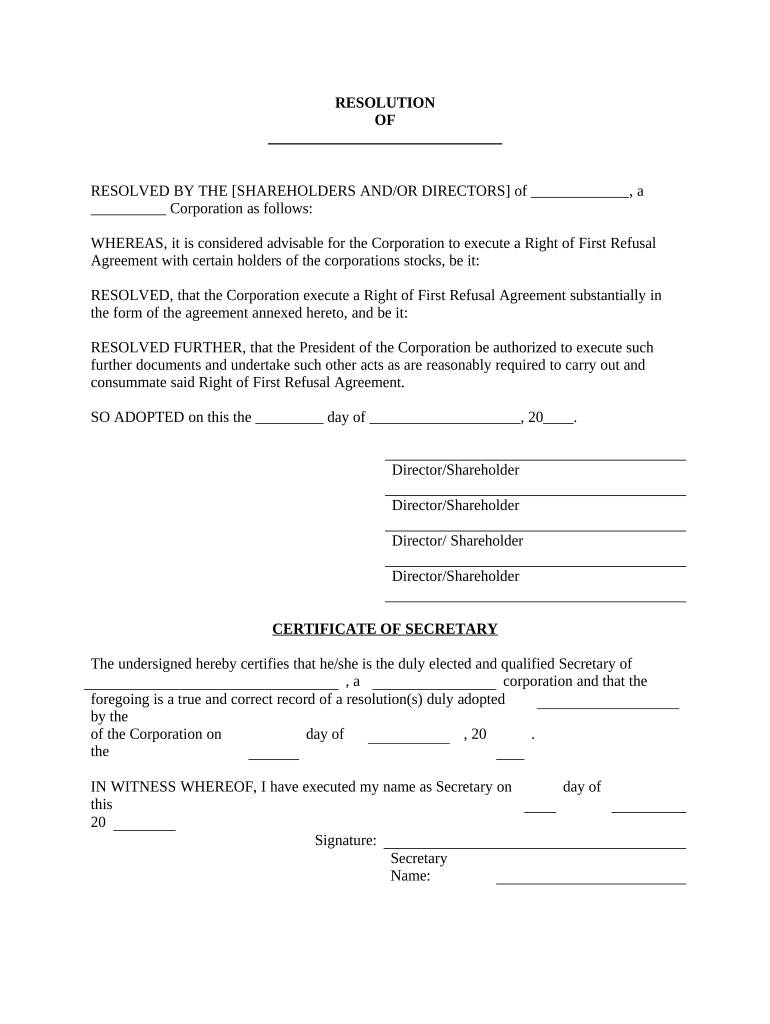
Resolution Authorizing Right of First Refusal Agreement

This template is fully customizable. Edit the text, fill out the fields, and send it for signature. Give it a try!
Resolution Authorizing Right of First Refusal Agreement

What this resolution does and when it’s used

A Resolution Authorizing Right of First Refusal Agreement is a corporate action authorizing an entity to enter into a contractual right of first refusal (ROFR) with a third party. The resolution documents board or member approval, designates authorized signatories, identifies the counterparty and property or equity interest subject to the ROFR, and records any conditions or timelines for offers and responses. It becomes part of corporate minutes and supports enforceability by showing internal approval and delegated authority. Organizations use this resolution to create a clear administrative record and to reduce later challenges to the agreement’s validity.

Why include a board resolution before executing a ROFR

A formal resolution clarifies corporate authority, documents fiduciary oversight, reduces disputes about signer authority, and creates an auditable record for stakeholders, auditors, and counterparty reliance.

Why include a board resolution before executing a ROFR

Typical users and contributors

These resolutions are most often prepared when a company or ownership group needs documented approval to bind the entity to a conditional transfer right.

  • Corporate boards and directors — Approve delegation, set terms, and authorize officers to sign the ROFR agreement on behalf of the company.
  • Real estate owners and developers — Use ROFRs to control transfers of property interests and preserve right-to-match protections.
  • Transaction counsel and corporate secretaries — Draft resolution language, confirm authority, and ensure corporate minutes accurately reflect approval.

Because parties rely on recorded corporate action, include legal counsel or the corporate secretary in drafting and storing the final resolution.

Essential elements to include in a professional resolution

A complete resolution should be concise yet specific, tying approval to named documents, delegations, and effective dates so third parties and internal records clearly reflect authorized action.

Preamble

Identify the meeting (board or members), quorum confirmation, and the authority under the company’s bylaws or operating agreement that permits the resolution.
Parties

Name the entity granting the ROFR, the counterparty, and any affected owners or classes of equity or parcels of real property covered by the resolution.

Grant of ROFR

Specify the scope of the right of first refusal, what triggers the ROFR (sale, transfer, voluntary assignment), and any limits on the types of transfers.

Key Terms

Set the notice procedures, response period, price determination method, and whether matching is strictly identical or materially similar offers.

Delegation

Authorize named officers or agents to negotiate, execute, and deliver the ROFR agreement and related documents on the entity’s behalf.

Effective Date

State the date the resolution takes effect and whether it survives changes in board composition or requires ratification at a later time.

Step-by-step: prepare, approve, and document the resolution

Follow a simple sequence so the resolution, ROFR agreement, and corporate records align and create a defensible trail of authority.

  • 01
    Draft Resolution: Prepare specific language referencing the ROFR and delegation.
  • 02
    Board Approval: Obtain quorum and vote; record the motion and results in minutes.
  • 03
    Execute Documents: Have authorized signer(s) sign the resolution and the ROFR agreement.
  • 04
    Record and Distribute: File in the corporate minute book and send certified copies to relevant parties.

Where to file and who receives official copies

Route the executed resolution and ROFR agreement to designated internal and external repositories to preserve evidence of authority and notice.

  • Corporate Records: Minute book or secure company repository; retains original executed resolution.
  • Counterparty: Provide a signed copy to the buyer or prospective transferee for reliance.
  • Legal Counsel: Retain counsel’s executed copy and advice memos related to authority and interpretation.
  • Recorder’s Office: If real property is affected, record instrument per local recorder requirements.

Digital workflow settings to capture approval and signatures

Configure your e-signature workflow to match corporate approval steps and to capture an auditable chain of custody for the resolution and ROFR.

Field Configuration
Signature Method Electronic signature with audit trail and timestamp
Authentication Email plus optional SMS code for higher assurance
Storage Save PDF in minute book and cloud repository
Notarization Enable RON session or arrange in-person notarization as required

Technical considerations for eSigning corporate resolutions

Ensure your eSignature platform supports audit trails, flexible signer authentication, secure storage, and any required notarization workflows.

  • Integrations: Salesforce, NetSuite, Microsoft 365, Google Workspace
  • File Formats: PDF, Word DOCX, and archived PDF/A
  • Security Standards: TLS 1.2/1.3 and AES-256 at rest

Choose a platform that preserves the audit trail and retention copy; confirm HIPAA, ESIGN, and UETA compliance for regulated industries.

Timing considerations and common deadlines

Schedule approvals and notices so offer periods, recording windows, and contractual response times do not conflict with corporate reporting or transfer deadlines.

Board Meeting Date:

Date of recorded approval; ensures delegated authority is effective.

Effective Date:

Date the resolution and ROFR obligations commence.

Offer Response Period:

Commonly 30 days but verify the agreement’s specified period.

Recording Window:

Record deeds or transfer instruments per county timelines if necessary.

Retention Start:

Retention clock typically begins on execution or termination date.

Key legal and practical risks to watch for

Unauthorized Execution: Resolution absent or signer lacks authority
Fiduciary Exposure: Improper approval may create breach of duty claims
Transfer Defects: Failure to follow ROFR steps can permit unwanted transfers
Recording Errors: Incorrect instruments may lead to title issues
Tax Consequences: Improper transfers can trigger tax reporting or withholding
Enforceability: Vague terms increase litigation risk

Common preparation mistakes and how they cause delays

  • Mismatched party names between the resolution and the ROFR agreement lead to challenges in enforcement and may require corrective ratification.
  • Failing to document quorum or voting results in corporate minutes creates uncertainty about whether the entity validly authorized the agreement.
  • Ambiguous description of the covered asset or transfer type invites disputes about whether a subsequent offer triggers the ROFR.
  • Skipping proper authentication or notarization when local law or recording will require it can prevent acceptable recording or third-party reliance.

Practical examples from organizations that standardized approvals

Real teams use resolutions to speed approvals while preserving compliance and auditability; the following examples show how documented authority reduces friction.

Martin Properties

When Martin Properties adopted a standardized resolution form, board approvals became predictable and auditable.

  • The form tied ROFRs to precise property IDs.
  • "I can process and execute all of these documents online with 100% compliance and built-in security," said Tim Martin, Founder, describing faster execution and better recordkeeping.

Optica Ventures LLC

Optica created a template to delegate signature authority for small asset transfers to the COO.

  • Delegation reduced board time for routine matters.
  • Brian Fitzgibbons, COO, said their interface is simple for internal teams and customers, helping them complete transactions with consistent documentation.

eSignature vendor pricing and capability snapshot for executing resolutions

Compare starting prices and capabilities that matter when eSigning a resolution and ROFR agreement; signNow is listed first to align vendor comparison formatting.

signNow DocuSign Adobe Sign PandaDoc HelloSign
Starting Price $8/user/mo $15/user/mo $14/user/mo $19/user/mo $15/user/mo
Free Trial 7-day free trial No free trial No free trial Yes, limited Yes, limited
Bulk Send Yes Yes Yes Yes No
Audit Trail Yes Yes Yes Yes Yes
HIPAA Compliant Yes Yes Yes No No
Envelope Cap No cap 100 envelopes/user/year Varies by plan Varies by plan Varies by plan

Common questions when preparing a resolution for a ROFR

Answers to frequent questions about authority, eSigning, notarization, recordkeeping, and revocation to help avoid common pitfalls.


Need help? Contact support

be ready to get more
Join over 28 million airSlate SignNow users