Establishing secure connection…Loading editor…Preparing document…

Right of First Refusal to Purchase Shares of Corporation

This template is fully customizable. Edit the text, fill out the fields, and send it for signature. Give it a try!
Right of First Refusal to Purchase Shares of Corporation

What the Right of First Refusal to Purchase Shares of Corporation Means

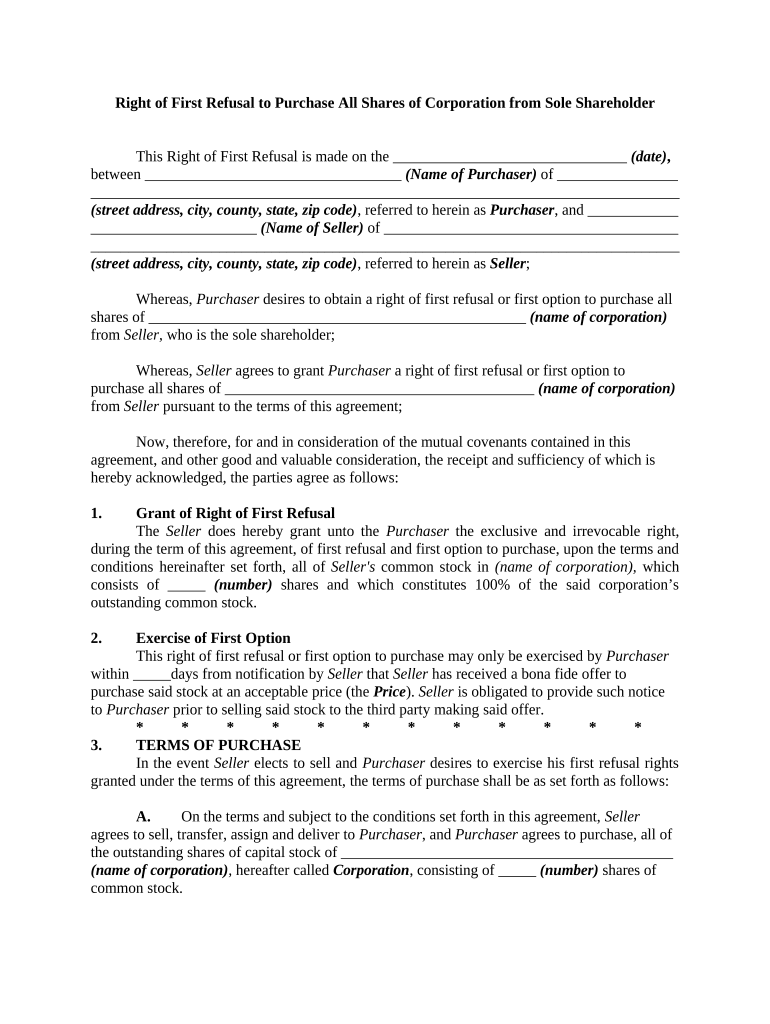
A Right of First Refusal to Purchase Shares of Corporation (ROFR) is a contractual preemptive right that gives existing shareholders or the corporation the option to purchase shares before the seller transfers them to a third party. Typical in shareholder agreements and bylaws, a ROFR specifies notice procedures, price determination, time limits for exercising the right, and closing terms. It is designed to protect ownership structure, prevent unwanted third-party owners, and preserve control. The ROFR operates alongside transfer restrictions, buy-sell provisions, and corporate approval requirements under state corporation law.

Why include a Right of First Refusal in shareholder documents

A ROFR helps maintain control over ownership, reduces dilution risk for existing shareholders, and creates a clear process for transfers. It can improve valuation predictability by defining price mechanics and reduce litigation risk by specifying notice and exercise procedures.

Why include a Right of First Refusal in shareholder documents

Who typically relies on a Right of First Refusal

Parties that commonly implement ROFR provisions include founders, investors, and the corporation itself to manage ownership transitions and protect strategic control.

  • Founders and majority shareholders who want to limit outside ownership and preserve voting control.
  • Minority investors seeking a controlled exit path and protection against opportunistic transfers that dilute value.
  • Corporations and boards that need first opportunity to retain shares and prevent unwanted third-party stakeholders.

ROFRs are negotiated based on bargaining power and the company’s governance needs; counsel often tailors scope, price mechanism, and exception carve-outs.

Signatory roles that can bind the company

Board Chair

Board chairs often have authority to present and ratify transfer restrictions when the board has delegated signing authority; ensure corporate minutes or board resolutions expressly authorize the ROFR execution to avoid challenges.

Corporate Secretary

The corporate secretary typically records ROFR notices and maintains execution records; where bylaws require officer signatures, the secretary’s attestation supports enforceability and evidences proper corporate procedure.

Key elements every professional ROFR should include

A clear ROFR balances predictability for sellers with protective rights for holders; include precise definitions and mechanics to reduce disputes.

Trigger Event

Define what constitutes a proposed transfer that activates the ROFR, including sales, gifts, or pledges where applicable.
Notice Procedure

Specify required content of the offer notice, delivery method, and to whom notices must be sent.

Price Mechanics

State whether price equals third-party offer, fixed formula, appraisal, or negotiated value, and how evidence is provided.

Exercise Period

Set a firm, reasonable deadline for holders to accept the offer and accept related closing conditions.

Transfer Exceptions

List carve-outs (e.g., transfers to affiliates, family, or pursuant to estate planning) and any preclearance steps.

Closing Terms

Address payment timing, adjustments, escrow, and filings required to effect the sale and update the transfer ledger.

Essential fields to include in the ROFR document

Shareholder Name: Full legal name
Number of Shares: Exact share count
Class of Shares: Common or preferred
Purchase Price: Price per share or formula
Notice of Offer: Date and delivery method
Exercise Period: Deadline in days

Step-by-step: filling out and enforcing a ROFR

Follow these sequential steps to prepare, issue, and exercise a Right of First Refusal to ensure procedural compliance and clear proof of notice.

  • 01
    Identify Transfer: Confirm the proposed transfer triggers the ROFR under its defined scope.
  • 02
    Prepare Notice: Draft an offer notice with price, purchaser identity, and supporting documents.
  • 03
    Deliver Notice: Send to holders via approved delivery method and record proof of transmission.
  • 04
    Exercise & Close: Holder accepts within deadline, then complete payment and update share register.

Configure an online ROFR workflow for efficient processing

Set digital workflow parameters to align notice, authentication, and storage with corporate policy and legal requirements.

Field Configuration
Notice Template Pre-fill price and purchaser fields
Authentication Email + SMS code or stronger
Signing Order Seller then holders sequentially
Expiration Auto-expire after exercise period

Digital delivery and integration considerations

Choose file formats and integrations that preserve evidentiary metadata and support your audit trail requirements.

  • File Types: PDF and DOCX supported
  • Integrations: CRM and document storage
  • Authentication: Email, SMS, or KBA

Integrate with systems like Salesforce, NetSuite, Google Workspace, Box, or an internal document repository to automate notices, capture signatures, and maintain a tamper-evident audit trail for compliance and governance.

Where to file and who should receive ROFR notices

ROFR notices and executed instruments should be routed to the parties responsible for corporate records, transfer restrictions, and regulatory filings.

  • Company Secretary: Maintains originals and updates stock ledger
  • Board Approval: If required, place executed documents in board minutes
  • Escrow Agent: Use for conditional closings or disputed price holds
  • Transfer Agent: Record share transfers and issue certificates

Common deadlines and timing expectations

Timelines in ROFRs are critical; clearly state each deadline and how it is calculated to avoid disputes.

Notice Period:

Specify days to respond from receipt

Exercise Period:

Fixed window for acceptance

Closing Date:

Date by which funds must be transferred

Record Date:

Date when shareholder entitlement is determined

Extension Mechanism:

State if automatic or by agreement

Key milestones from offer to transfer

A sequential milestone view clarifies duties and enforces timing for all parties involved in a ROFR transaction.

01

Trigger Event

Seller receives bona fide third-party offer

02

Offer Issued

Seller serves written ROFR notice to holders

03

Decision Window

Holders accept or decline within the exercise period

04

Transfer Completion

Closing, payment, and ledger update

How ROFR compares with related transfer rights

Compare common transfer mechanisms to understand obligations and seller flexibility.

Criteria ROFR ROFO Tag-Along
Trigger third-party offer negotiation start third-party sale
Price Determination third-party price negotiated or formula third-party price
Obligation to Sell yes for holders
Typical Use control protection encourages first negotiation protects minority exits

Consequences of drafting or executing a faulty ROFR

Contract Voidance: May render transfer unenforceable
Dilution Risk: Unclear terms can allow unwanted transfers
Breach Liability: Damages and injunction exposure
Tax Consequences: Incorrect reporting or withholding
Shareholder Disputes: Litigation or arbitration costs
Regulatory Noncompliance: Securities law or filing issues

Common drafting and execution errors to avoid

  • Failing to define the triggering event precisely can create ambiguity about when the ROFR applies and invite litigation over whether a transfer qualifies.
  • Omitting a clear price determination method leaves parties fighting over valuation or relying on costly appraisals that delay closings and increase costs.
  • Not specifying notice delivery method and proof of receipt risks disputes about whether holders had a fair opportunity to exercise their rights.
  • Allowing open-ended exercise periods or unclear closing mechanics can permit sellers to bypass holders or produce perpetual uncertainty for potential buyers.

eSignature vendor pricing and feature snapshot for ROFR workflows

Compare basic pricing and capabilities relevant to executing and managing ROFR notices and signed instruments across common e-signature vendors.

signNow DocuSign Adobe Sign PandaDoc HelloSign
Starting Price $8/user/mo $15/user/mo $14/user/mo $19/user/mo $15/user/mo
Free Trial 7-day trial Varies Varies Varies Varies
Bulk Send Yes Yes Yes Yes No
Audit Trail Yes Yes Yes Yes Yes
HIPAA Compliant Yes Yes Yes No No

Practical drafting and execution tips for reliable ROFRs

Adopt clear drafting practices and procedural safeguards to improve enforceability and reduce disputes when ROFRs are exercised.

Be precise about triggers and scope
Define the types of transfers that trigger the ROFR (sales, assignments, pledges) and whether transfers to family or affiliates are exempt to avoid ambiguity and unanticipated claims.
Specify evidence for third-party offers
Require a copy of the bona fide third-party purchase agreement and proof of funds to validate the seller’s representation and establish the correct purchase price.
Set enforceable timing
Use specific calendar-day deadlines measured from receipt of notice; provide methods for calculating receipt (e.g., email delivery + read receipt) and allow limited extension for good-faith negotiations.
Record and update corporate books
After closing, promptly update the stock ledger, notify transfer agents, and retain executed documents and audit trail metadata for governance and potential audits.

Frequently asked questions about ROFRs and electronic execution

Answers to common questions about enforceability, e-signatures, timing, and practical issues when using a Right of First Refusal to Purchase Shares of Corporation.


Need help? Contact support

be ready to get more
Join over 28 million airSlate SignNow users