Establishing secure connection…Loading editor…Preparing document…

Road Maintenance Agreement

This template is fully customizable. Edit the text, fill out the fields, and send it for signature. Give it a try!
Road Maintenance Agreement

What a Road Maintenance Agreement Covers

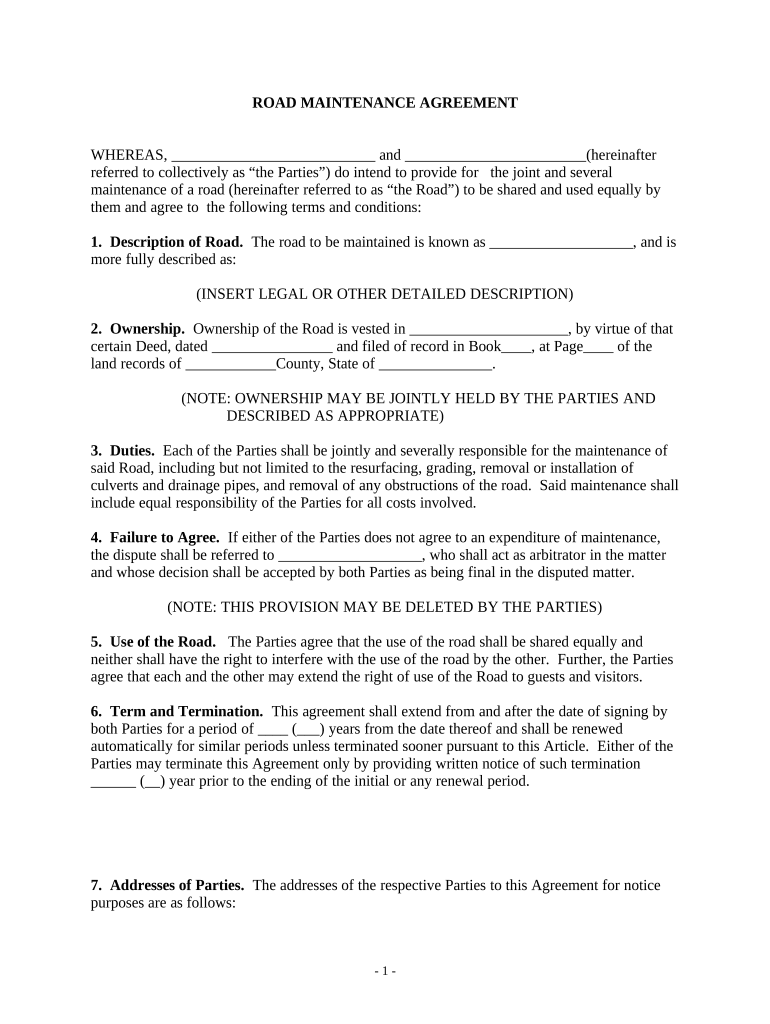
A Road Maintenance Agreement is a written contract that assigns responsibilities for upkeep, repairs, and cost sharing for a specific road or accessway between private parties, homeowners associations, developers, or government entities. It identifies the parties, defines the segment of roadway, establishes the scope and frequency of maintenance tasks, allocates expenses and labor, sets inspection and notice procedures, and includes insurance, indemnity and dispute-resolution provisions. The agreement may also specify who may perform work, permitting requirements, and any recording instructions for easements or covenants affecting title.

Why a Road Maintenance Agreement Matters

A clear agreement reduces disputes by assigning maintenance duties, cost allocation, scheduling, and access rights, and creates enforceable expectations between parties. Using a written contract helps preserve property values and supports enforcement through recorded easements; electronic execution is generally valid under the ESIGN Act (15 U.S.C. §7001) and UETA when state law applies.

Why a Road Maintenance Agreement Matters

Who Typically Prepares and Signs These Agreements

Several types of organizations and individuals commonly use road maintenance agreements; identify which category fits your situation before drafting.

  • Homeowners associations and neighborhood boards responsible for private subdivision roads and shared driveways.
  • Private landowners and adjoining property owners who share access, private lanes, or private roads.
  • Developers, property managers, and municipal agencies when private maintenance terms interface with public access or utilities.

Common Signatories and Their Roles

Public Works Director

A municipal or county public works director reviews technical standards, accepts maintenance obligations only when a public entity assumes ownership or provides a maintenance agreement consistent with applicable ordinances and specifications.

HOA Manager

A homeowners association manager executes and enforces maintenance schedules, collects dues for road repair funds, and coordinates contractors under the association’s governing documents and board resolutions.

Essential Clauses to Include

A professional Road Maintenance Agreement contains clear, enforceable clauses that define scope, timing, financial responsibilities, insurance, and remedies to reduce ambiguity and future disputes.

Parties & Recitals

Identify each party by full legal name and role, and state the property descriptions or parcel identifiers that define the maintained roadway.
Scope of Work

Describe specific maintenance tasks (grading, drainage clearing, pothole repair, snow removal) and standards or technical specifications to be met.

Maintenance Schedule

Set regular inspection intervals, seasonal work windows, and triggers for emergency repairs with timelines for action and notice.

Cost Allocation

Specify contribution formulas (percentage, frontage feet, per-parcel flat fees), invoicing practices, and dispute-resolution for cost disagreements.

Insurance & Indemnity

Require liability insurance limits, additional insured status where appropriate, and mutual indemnification language to allocate risk.

Recording & Remedies

State whether the agreement is recorded as an easement or covenant, and include remedies for nonperformance, lien rights, and arbitration or court venue.

Step-by-Step: Completing the Agreement

Follow these steps to prepare, review, and finalize a Road Maintenance Agreement with minimal delays.

  • 01
    Draft details: Define parties, road limits, and tasks clearly.
  • 02
    Agree costs: Document formulas, payment timing, and invoicing.
  • 03
    Confirm authority: Verify signatory authority and board approvals.
  • 04
    Execute: Sign, notarize if needed, and distribute executed copies.

Typical Processing Flow

A standard workflow moves from drafting to execution, with optional notarization and recording steps depending on local requirements.

  • Drafting: Prepare initial agreement and exhibits.
  • Review: Parties and counsel review proposed terms.
  • Signing: Parties sign electronically or on paper.
  • Filing: Record easement or covenant if the agreement requires it.

Digital Workflow Configuration

Configure electronic routing and authentication to match the agreement’s security needs before sending for signature.

Field Configuration
Authentication Email link or SMS code; use stronger ID checks if required
Signing Order Specify sequential or parallel signing as parties require
Notifications Enable reminders and completion notifications for all signers
Storage Save final PDF with audit trail in secure storage

Digital Signing and Integration Considerations

Choose an eSignature platform that meets legal, security, and integration requirements for your workflow.

  • Integrations: Connect with systems like Salesforce, NetSuite, Microsoft 365, Google Workspace
  • Document formats: Support for PDF and DOCX with embedded audit trails
  • Authentication options: Email, SMS, KBA, or advanced signer authentication

Ensure the chosen platform provides an audit trail, tamper-evident signed documents, and configurable authentication to match risk and recording needs.

Key Dates and Timing to Track

Track effective dates, recurring maintenance windows, notice periods, and recording deadlines to preserve rights and avoid disputes.

Execution Date:

Date parties sign; obligations typically begin on or after this date.

Effective Date:

Date obligations take effect if different from execution; use MM/DD/YYYY format.

Maintenance Start:

When routine maintenance first begins under the schedule.

Annual Review:

Date for yearly inspection and budget reconciliation.

Notice Period:

Time required to notify parties before major repairs or cost assessments.

Milestones from Draft to Ongoing Maintenance

A sequential timeline helps teams manage approvals, execution, and recurring obligations across the life of the agreement.

01

Negotiation

Parties agree on scope, cost formulas, and exhibits.

02

Approval

Board or owner approvals and required resolutions obtained.

03

Execution

Signatures collected and notarization performed if required.

04

Ongoing Performance

Scheduled inspections and repairs occur per the maintenance plan.

Common Preparation Mistakes to Avoid

  • Vague scope language that omits specific maintenance tasks, materials, or performance standards leads to disputes and inconsistent work quality.
  • Failing to record an easement or covenant when intended leaves successors uninformed and can undermine long-term enforceability.
  • Not verifying signatory authority for associations, trusts, or corporations causes execution delays and may render the agreement voidable.
  • Using informal cost descriptions without formulas or caps creates recurring conflicts over invoicing and reimbursements.

Risks and Consequences of Errors

Insurance Gaps: Liability exposure if required coverage is missing.
Unclear Costs: Disputes and unpaid invoices from ambiguous allocation.
Recording Failure: Successors may not be bound without recording.
Unauthorized Signatures: Contract may be unenforceable if signer lacked authority.
Permit Violations: Fines or stop-work orders if repairs need permits.
Delay Damages: Escalating repair costs and deteriorating road conditions.

Security and Compliance Considerations

Encryption: TLS 1.2/1.3 in transit; AES-256 at rest
eSignature Law: ESIGN (15 U.S.C. §7001) and UETA compliance
Audit Trail: Tamper-evident logs with timestamps and IP addresses
HIPAA Support: BAA available where health data is present
21 CFR Part 11: Controls for regulated FDA records where required
Certifications: SOC 2 Type II and ISO 27001 available

eSignature Vendor Pricing and Capabilities

Compare common vendor pricing and capability dimensions relevant to signing and storing Road Maintenance Agreements; signNow appears first per platform placement rules.

signNow DocuSign Adobe Sign PandaDoc HelloSign
Starting Price $8/user/mo $15/user/mo $14/user/mo $19/user/mo $15/user/mo
Free Trial 7-day free trial No No Yes, limited Yes, limited
Bulk Send Yes (Business Premium) Yes Yes Yes No
Audit Trail Yes Yes Yes Yes Yes
HIPAA Compliant Yes Yes Yes No No

Real-World Use Cases

Practical examples show how agreements are adapted to common scenarios and which provisions are emphasized in each.

Subdivision HOA

A newly formed HOA adopts a maintenance agreement to assign road repairs and snow removal responsibilities

  • The agreement uses frontage-based cost allocation to fund repairs
  • The recorded covenant ensures new lot buyers inherit proportional cost obligations and the HOA can levy assessments if members fail to pay.

Developer & County

A developer agrees to maintain private access until the county accepts roads

  • The contract lists technical standards for acceptance
  • Once the county accepts the roads, a defined transfer process releases the developer from ongoing obligations while documenting public maintenance responsibilities.

Frequently Asked Questions and Practical Answers

Answers address common execution, enforceability, and technical questions to reduce delays and legal uncertainty.


Need help? Contact support

be ready to get more
Join over 28 million airSlate SignNow users