Establishing secure connection…Loading editor…Preparing document…

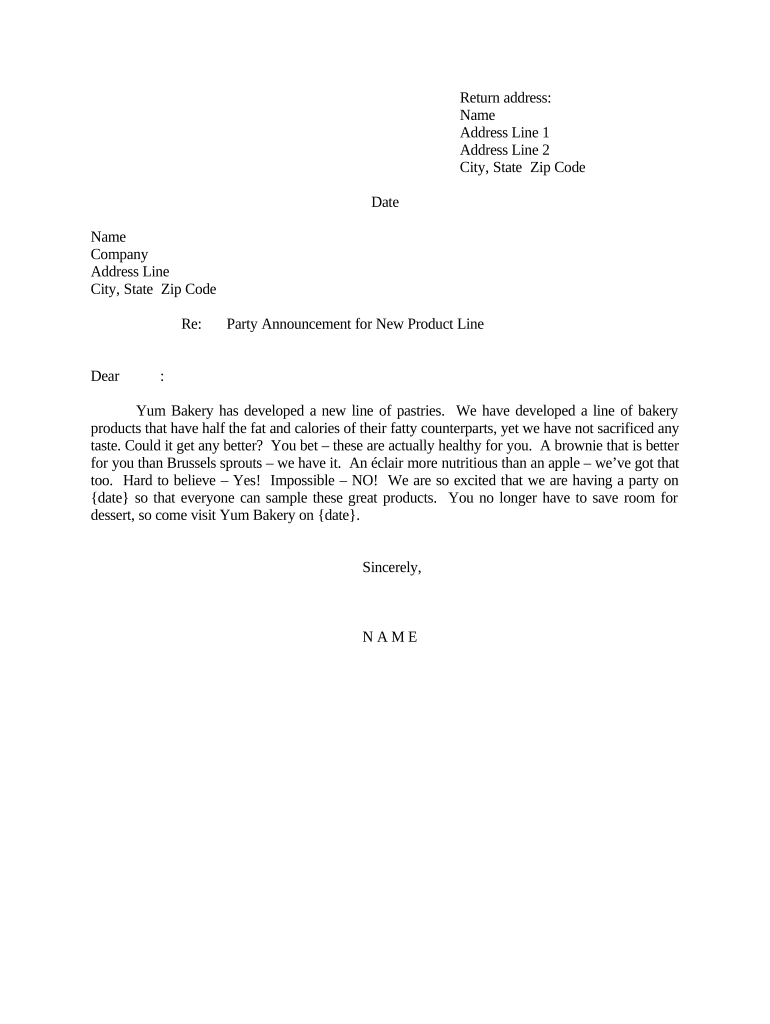
Party Announcement for New Product Line

This template is fully customizable. Edit the text, fill out the fields, and send it for signature. Give it a try!
Party Announcement for New Product Line

What the Party Announcement for New Product Line Is

A Party Announcement for New Product Line is a formal written notice used to inform stakeholders, partners, vendors, and internal teams about the launch details, responsibilities, and distribution plan for a new product line. It documents the product name, launch date, key contacts, signatory parties, approval status, and any attachments such as images, specifications, or promotional embargo rules to create a clear record of the announcement and assign accountability.

Why a Clear Announcement Matters and Its Legal Basis

A concise, well-documented announcement aligns internal teams, reduces distribution errors, and preserves a dated record of commitments; when executed electronically it can meet U.S. e-signature standards under ESIGN (15 U.S.C. ch. 96) and UETA where applicable.

Why a Clear Announcement Matters and Its Legal Basis

Who Typically Prepares and Receives This Announcement

The document is prepared by cross-functional teams and routed to stakeholders who require formal notification or sign-off.

  • Marketing and product teams coordinating launch timing, assets, and partner notices.
  • Sales and channel managers who must update partner portals and sales enablement materials.
  • Legal and compliance teams reviewing messaging, IP language, and regulatory disclosures.

Recipients vary by company size and industry; ensure distribution lists and signatory authority are confirmed before sending.

Who Signs and Approves the Announcement

Marketing Manager

Responsible for content accuracy, campaign timing, and distribution lists. Typically prepares the announcement, confirms marketing assets, and secures internal approvals prior to routing to external partners.

General Counsel

Reviews legal language, confirms IP and compliance considerations, and provides final signatory approval for public statements that may create contractual obligations or regulatory exposure.

Core Sections to Include in a Professional Announcement

A complete announcement includes identification, launch schedule, responsibilities, permitted distribution, legal disclaimers, and attachments to reduce ambiguity and support enforceability.

Header

Product name, version, and short description to clearly identify the item being announced.
Effective Date

Clearly state the launch or embargo lift date and time in the chosen time zone.

Approvals

List required approvers and signature blocks, including titles and delegated authority.

Distribution Rules

Specify permitted channels, embargo instructions, partner tiers, and geographic restrictions.

Attachments

Enumerate included assets (images, specs, pricing) and name file versions for traceability.

Legal Notice

Include required disclaimers, IP statements, and any regulatory language applicable to the product.

Required Information and Fields at a Glance

Company Name: Full legal name
Product Line: Exact marketed name
Launch Date: MM/DD/YYYY
Authorized Signers: Names and titles
Distribution List: Internal and external parties
Attachments: List with file versions

Step-by-Step: How to Complete the Announcement

Complete, review, sign, and distribute the announcement in a controlled sequence to ensure approvals and compliance are recorded.

  • 01
    Prepare: Draft content and attach assets.
  • 02
    Review: Legal and compliance review required.
  • 03
    Sign: Authorized parties apply signatures.
  • 04
    Distribute: Send to approved channels and partners.

Typical Routing and Approval Flow

A standard workflow moves the document from origin through review, signature, and distribution while capturing an audit trail for each step.

  • Initiate: Creator uploads announcement and assets.
  • Approve: Legal and product approvals collected in order.
  • Sign: Signatures captured electronically or in-person.
  • Archive: Store final package with audit trail.

How to Configure an Online Approval Workflow

Set these configuration items when creating a digital routing template to reduce manual steps and ensure consistent approval order.

Field Configuration
Approval Order Sequential signers enforced; automatic routing
Authentication Email link or SMS code for signer verification
Bulk Send Use for multiple recipients when messages are identical
Retention Automatic archival and export to enterprise storage

Digital Signing, File Formats, and Integrations

Choose a platform that supports common file formats, audit trails, and your integration needs to preserve legal evidence of execution.

  • File Formats: PDF, DOCX, and exported HTML
  • Integrations: CRM and storage connectors
  • Auth Methods: Email, SMS, or stronger MFA

Ensure chosen tools can produce a tamper-evident signed record and integrate with your storage or CRM systems for traceability.

Key Timing Items and Recommended Deadlines

Establish clear internal deadlines to allow review cycles and minimize last-minute changes that can lead to distribution errors.

Internal Review Deadline:

At least 14 days before launch

Legal Approval Deadline:

At least 7 days before launch

Partner Notification:

30–60 days prior for major partners

Embargo Lift:

Set exact time zone and timestamp

Post-Launch Follow-up:

Survey or corrections within 14 days

Milestones: From Draft to Public Release

Map milestone stages so each responsible party understands timing and deliverables at every step of the announcement lifecycle.

01

Draft Completion

Content and assets finalized by owner.

02

Compliance Review

Legal confirms required language and risks.

03

Executive Sign-off

Authorized signers approve final package.

04

Public Release

Distribution occurs according to embargo rules.

Common Mistakes to Avoid When Preparing the Announcement

  • Missing or inconsistent product names across assets leading to confusion among partners and customers about what was approved.
  • Failing to set or communicate embargo times clearly, causing premature public disclosures and potential contractual breaches.
  • Not confirming signatory authority, which can result in unsigned or later-disputed announcements and delayed launches.
  • Using outdated attachments or incorrect version numbers, creating disputes over which specifications were authorized for release.

Risks and Potential Consequences of Errors

Breach of Contract: Damages or remedial obligations
Regulatory Exposure: Fines or required corrections
Intellectual Property Risk: Unclear assignments or disclosures
Loss of Trust: Partner or customer erosion
Tax Reporting Issues: Incorrect incentive disclosures
Data Privacy: Unauthorized personal data sharing

eSignature Pricing Snapshot for Announcement Workflows

Compare common vendor pricing and capabilities relevant to announcement and distribution workflows; signNow appears first to show a representative starting point for self-service plans.

signNow DocuSign Adobe Sign PandaDoc HelloSign
Starting Price $8/user/mo $15/user/mo $14/user/mo $19/user/mo $15/user/mo
Free Trial 7-day free trial Varies by vendor Varies by vendor Varies by vendor Varies by vendor
Bulk Send Yes Yes Yes Yes No
Audit Trail Yes Yes Yes Yes Yes
HIPAA Compliant Yes Yes Yes No No

Real-World Examples and How Others Use This Announcement

Below are two brief customer examples showing practical uses and outcomes when announcements were processed electronically.

Martin Properties — Tim Martin

Martin Properties streamlined online execution for property-related product announcements.

  • He processed and executed documents online with full compliance.
  • The result was faster partner distribution and fewer version disputes while preserving a complete audit trail and mobile signing capability.

Xerox — Kodi-Marie Evans

Xerox integrated signing into its ERP to align approvals with launch workflows.

  • Integration with NetSuite automated approvals and asset versioning.
  • That approach reduced manual handoffs, ensured correct assets were distributed, and provided a centralized record for post-launch reconciliation.

Frequently Asked Questions About the Party Announcement

Answers to common operational and legal questions encountered when preparing, signing, and distributing product launch announcements.


Need help? Contact support

be ready to get more
Join over 28 million airSlate SignNow users