Establishing secure connection…Loading editor…Preparing document…

Sample Divorce Letter

This template is fully customizable. Edit the text, fill out the fields, and send it for signature. Give it a try!
Sample Divorce Letter

What a Sample Divorce Letter Is and When It’s Used

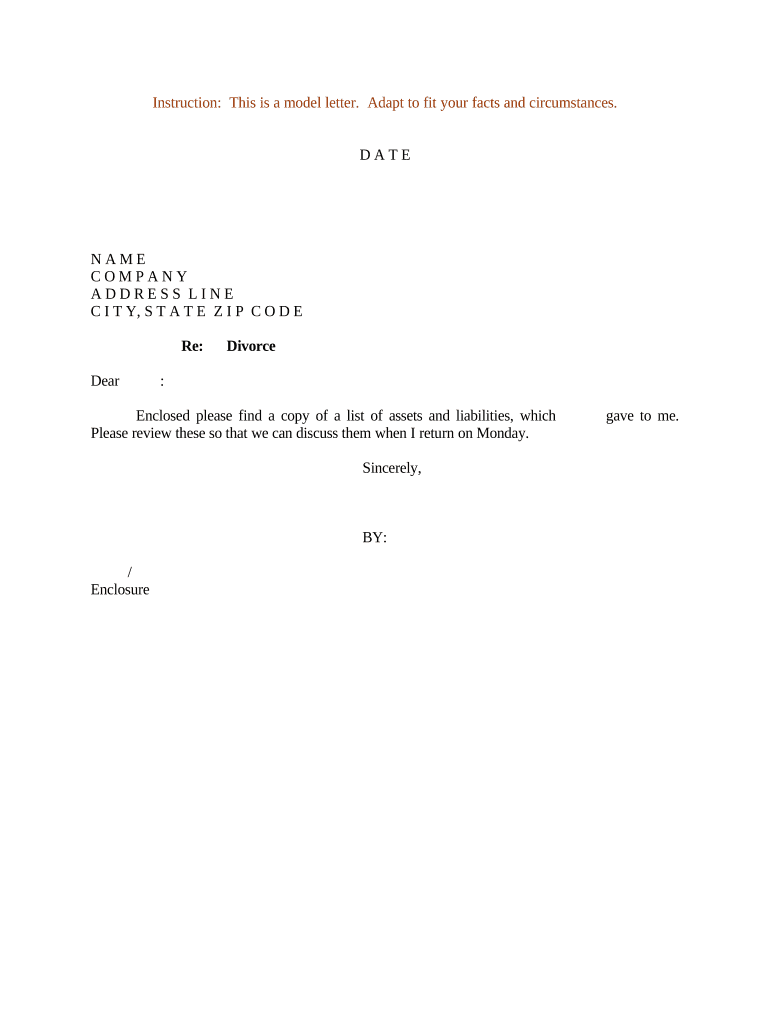
A Sample Divorce Letter is a written, formal notice used to communicate specific requests or statements related to a divorce—for example, terminating joint accounts, proposing property division, or documenting intent to seek legal relief. It is not a substitute for court filings or a divorce decree, but it helps create a clear record of communications between parties, counsel, or third parties such as banks and employers. Use it to document facts, set timelines, and provide evidence of notice in later proceedings.

Why a Clear Sample Divorce Letter Matters

A concise, properly formatted letter reduces ambiguity, establishes a written record, and helps third parties act on your instructions.

Why a Clear Sample Divorce Letter Matters

Who Typically Uses a Sample Divorce Letter

Common users include individuals managing separation logistics, attorneys preparing records, and institutions receiving orders or notices.

  • Self-represented parties notifying banks, employers, or insurers about account or benefit changes.
  • Attorneys documenting client instructions, service attempts, or settlement positions for court records.
  • Third-party administrators (banks, HR, insurers) that require written authorizations or instructions to act.

Tailor tone and detail to the recipient—formal for courts and institutions, succinct for personal notices.

Representative Signers and Preparers

Self-Represented Spouse

A person managing divorce-related tasks without counsel will use the letter to notify banks, employers, and utilities. Include clear identifiers, dates, and any account numbers; keep copies and proof of delivery to support later filings or motions.

Attorney

An attorney drafts letters to preserve client instructions, request interim relief, or document settlement offers. Letters from counsel typically include firm letterhead, client authorization, and a clear statement of requested action to reduce disputes about intent or scope.

Essential Parts of a Professional Sample Divorce Letter

A professional letter is short, factual, and structured so recipients can act. Include the following elements to improve clarity and enforceability.

Header

Sender and recipient names, mailing address, phone, and date—enables reliable identification and service tracking.
Subject Line

A concise subject indicating purpose, e.g., 'Notice of Intent to Divide Joint Accounts' or 'Request for Temporary Financial Support.'

Statement of Facts

Brief, chronological facts relevant to the request—dates, account numbers, prior communications, and material events.

Requested Action

Clear, specific instructions (close account, freeze card, redirect pay) with deadlines where appropriate to avoid ambiguity.

Attachments

List supporting documents such as bank statements, court case numbers, or power of attorney to substantiate the request.

Signature Block

Printed name, signature, and date. If signed by counsel, include bar number and firm contact details.

Step-by-Step: How to Prepare and Send the Letter

Follow these sequential steps to create a usable record and reduce objections from recipients.

  • 01
    Draft Facts: Summarize key dates and events accurately.
  • 02
    Specify Actions: State exactly what you want the recipient to do.
  • 03
    Attach Proof: Include documents that substantiate your claims.
  • 04
    Send & Record: Deliver via tracked mail or eDelivery and save proof of transmission.

How Electronic Delivery and Signing Works for Letters

Electronic workflows can speed delivery and create an auditable record when executed correctly under U.S. eSignature law.

  • Prepare Document: Create a final PDF or DOCX with fillable fields where needed.
  • Select Recipients: Provide full recipient contact details for delivery and authentication.
  • Sign Electronically: Sign with a legally recognized e-signature method.
  • Store Audit Trail: Retain timestamps, IP, and action logs for evidentiary use.

Typical Online Workflow Settings for the Sample Divorce Letter

Map fields and authentication to recipient needs and the sensitivity of the instruction.

Field Configuration
Full Name Field Required, single-line text
Case Number Field Optional, formatted text
Signature Field Required, date-stamped
Delivery Method Email with tracked link or registered mail

Technical Options for Secure Delivery and Signing

Choose a platform that supports required file formats and preserves an audit trail for legal proof.

  • File Formats: PDF, DOCX, HTML supported
  • Integrations: Salesforce, NetSuite, Google Workspace
  • Authentication: Email, SMS code, or advanced methods

Ensure the platform retains tamper-evident copies, shows signer attribution, and can export audit reports for court or institutional review.

Timing to Consider When Sending a Divorce Letter

Timelines vary by intended effect—notice to third parties, settlement negotiations, or evidence for court. Plan accordingly.

Immediate Notice:

Send promptly after separation to protect finances.

Response Window:

Allow 7–30 days depending on recipient policies.

Court Filing Deadline:

Filing deadlines vary by state and case type.

Service of Process:

Follow state rules for delivering legal notices.

Record Retention:

Keep proof of delivery indefinitely for disputes.

Key Milestones from Draft to Court Record

A typical sequence from drafting to evidence submission contains distinct checkpoints that affect admissibility and relief.

01

Drafting

Prepare a factual, dated document capturing material events.

02

Delivery

Use tracked or electronic delivery that produces proof.

03

Response Period

Allow a reasonable time for recipient reply or action.

04

Filing or Attachment

File copies with counsel or court as appropriate.

Common Mistakes to Avoid When Preparing the Letter

  • Using vague language that fails to specify the requested action or applicable account details, creating confusion.
  • Omitting identifiers such as case number or full account numbers, which slows institutional processing and verification.
  • Relying on informal delivery without tracking or receipt, leaving no proof of service or date of notice.
  • Assuming electronic execution is valid for all divorce-related documents without confirming court or institutional rules.

Risks and Consequences of an Incorrect or Incomplete Letter

Court Rejection: May be excluded as evidence
Service Defect: Could invalidate notice
Missed Deadlines: Loss of rights or relief
Financial Loss: Unprotected accounts may be depleted
Legal Fees: Increased attorney costs
Unintended Admissions: Statements may be used against you

Security and Compliance Considerations for Electronic Letters

Encryption: TLS 1.2/1.3 in transit; AES-256 at rest
Audit Trail: Timestamps, IP, and action logs retained
Legal Frameworks: Compliant with ESIGN (15 U.S.C. ch.96) and UETA
HIPAA: BAA required for protected health information
Certifications: SOC 2 Type II and ISO 27001 available
Access Controls: Role-based permissions and SSO support

Typical eSignature Pricing and Feature Comparison

Compare base pricing and select capabilities that matter for letters needing audit trails, HIPAA compliance, or high-volume delivery.

signNow DocuSign Adobe Sign PandaDoc HelloSign
Starting Price $8/user/mo $15/user/mo $14/user/mo $19/user/mo $15/user/mo
Free Trial 7-day free trial (no card) Varies by plan Varies by plan Varies by plan Varies by plan
Bulk Send Yes (Business Premium) Varies by plan Varies by plan Varies by plan Varies by plan
Audit Trail Yes Yes Yes Yes Yes
HIPAA Compliant Yes Yes Yes No No

Real-World Uses of a Sample Divorce Letter

Illustrative scenarios show practical deployment and outcomes when the letter is used correctly.

Bank Account Freeze

A spouse notified a bank of suspected misuse of joint funds and provided account details.

  • Bank placed a temporary hold pending documentation.
  • The hold preserved assets until temporary orders were entered and reduced the need for emergency motions.

Employer Benefit Change

An employee sent a dated letter asking payroll to stop spousal beneficiary contributions.

  • Employer required identity verification before changing records.
  • After verification, payroll adjusted benefits and the letter served as employer documentation during settlement.

Practical Tips for Accurate and Efficient Letters

Apply these best practices to produce a letter that third parties and courts can rely on without added clarification.

Be Specific
State exact account numbers, dates, and actions requested so recipients can implement instructions without follow-up.
Keep Records
Retain copies, delivery proofs, and any electronic audit logs to support later evidentiary needs.
Confirm Policies
Ask institutions about their internal form requirements before sending a standard letter to avoid rejection.
Limit Admissions
Avoid statements that could be construed as admissions of fault; stick to verifiable facts and requests.

Frequently Asked Questions and Common Issues

Answers to common questions about validity, notarization, delivery, and correcting mistakes when using a Sample Divorce Letter.


Need help? Contact support

be ready to get more
Join over 28 million airSlate SignNow users