Establishing secure connection…Loading editor…Preparing document…

Sample Letter for Foreclosed Home

This template is fully customizable. Edit the text, fill out the fields, and send it for signature. Give it a try!
Sample Letter for Foreclosed Home

What the Sample Letter for Foreclosed Home Is

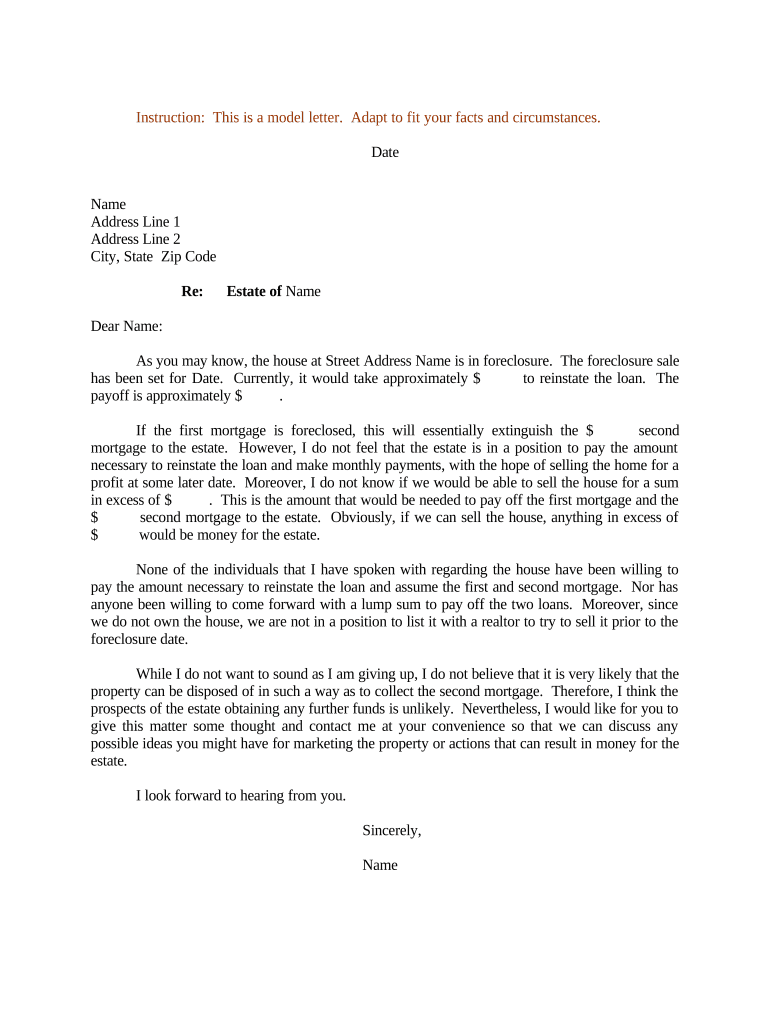
Sample Letter for Foreclosed Home is a standardized letter template used by former owners, tenants, or representatives to communicate about a property that has been foreclosed. It explains the sender’s relationship to the property, states relevant dates (foreclosure sale, notice of default, or eviction), and requests a specific outcome such as reinstatement, redemption instructions, account payoff details, or proof of sale. The letter helps create a written record for lenders, servicers, trustees, or court clerks and can be adapted for state-specific requirements; it does not replace legal advice from an attorney.

Why a Clear Foreclosure Letter Matters

Use the Sample Letter for Foreclosed Home to document your position, request specific information or remedies, and create an evidentiary trail that may assist legal counsel or housing counselors. A clear, dated letter helps ensure recipients process your inquiry consistently and establishes a written record.

Why a Clear Foreclosure Letter Matters

Who Typically Sends or Receives This Letter

Typical senders include former homeowners, tenants, estate representatives, and legal counsel addressing possession, payoff, or title questions.

  • Former homeowner seeking full payoff figures, reinstatement instructions, or documentation of the sale timeline
  • Tenant requesting notice of eviction, timelines for vacatur, or proof of ownership change
  • Estate representative or attorney asking for certified sale records, title transfer, or accounting

Step-by-step: Prepare and Send the Letter

Follow these steps to complete and send the Sample Letter for Foreclosed Home accurately and keep copies.

  • 01
    Gather Documents: Collect deed, foreclosure notice, account statements, and ID.
  • 02
    Draft Letter: State facts, desired remedy, and relevant dates clearly.
  • 03
    Send to Recipient: Mail certified or e-mail with delivery/read receipt; retain proof.
  • 04
    Follow Up: Request an acknowledgment and escalate to counsel if ignored.

Core Elements of a Professional Foreclosure Letter

A professional Sample Letter for Foreclosed Home should be concise, factual, dated, and supported by documentation to enable timely review and response.

Purpose

Explain why you are writing: to request payoff details, reinstatement, accounting, or to dispute the sale. Keep the opening sentence specific to guide administrative routing.
Facts

List chronological facts: account opening, default notices, modification attempts, sale or eviction dates, and any relevant communications. Use numbered items for clarity and ease of review.

Documentation

Attach copies of deed, mortgage statements, foreclosure notices, proof of payments, and any relevant correspondence. Originals may be requested later but provide legible copies now.

Remedy Requested

Specify the desired outcome: full payoff amount, reinstatement terms, corrected account balance, or confirmation of sale and disbursement. Provide deadlines for response if appropriate.

Delivery Method

State how you are sending the letter and request confirmation: certified mail, email with read receipt, or secure upload. Indicate that you retain proof of delivery.

Recordkeeping

Note that you will retain the correspondence and request written acknowledgment. This establishes a paper trail useful for loss-mitigation, legal proceedings, or title challenges.

Security and Compliance Considerations

Encryption in transit: TLS 1.2/1.3 in transit
Encryption at rest: AES-256 encryption for stored files
Audit trail: Timestamped events, IP, and email
HIPAA compliance: BAA available for covered entities
ESIGN/UETA compliance: Meets federal and state e-sign rules
Access controls: Role-based access and two-factor

Primary Risks and Consequences

Missed Deadlines: Loss of redemption rights
Wrong Recipient: No effective notice given
Name Mismatch: Verification delays or rejections
Insufficient Proof: Unable to prove delivery
Unverified E-sign: May be challenged in court
Legal Consequences: Foreclosure finality and eviction

Common Preparation Mistakes to Avoid

  • Using vague language that fails to identify the specific account, dates, or relief requested, which slows processing and may lead to denial.
  • Addressing the wrong party or using an out-of-date servicer address results in nondelivery and missed statutory deadlines for objections or reinstatement.
  • Submitting unsigned or improperly signed letters, or using initials where full signatures are required, can undermine evidentiary weight in disputes.
  • Failing to attach supporting documents like the mortgage statement or foreclosure notice forces follow-up requests and prolongs resolution timelines.

How the Letter Moves Through the System

Typical routing for a Sample Letter for Foreclosed Home and expected interactions with service providers and public offices.

  • Compose: Draft letter with facts and requested relief.
  • Attach: Include supporting documents as PDF copies.
  • Send: Deliver by certified mail or secure e-delivery.
  • Record: Keep copies and confirmation for your records.

Online Workflow Settings for the Letter

Configure an online letter workflow for editing, signing, and delivery to relevant parties with tracking.

Field Configuration
Signer Order Set sequential signing order for servicer, trustee, and seller.
Authentication Choose email plus SMS code for moderate assurance.
Attachments Require PDFs for deed, notice, and statements.
Delivery Receipt Enable certified mail emulation and retain delivery logs.

eSignature Pricing & Feature Snapshot for This Use Case

Compare common eSignature plan attributes relevant when submitting the Sample Letter for Foreclosed Home to select a compliant, auditable solution.

signNow DocuSign Adobe Sign PandaDoc HelloSign
Starting Price $8/user/mo $15/user/mo $14/user/mo $19/user/mo $15/user/mo
Free Trial 7-day free trial Varies Varies Varies Varies
Bulk Send Yes Yes Yes Yes No
Audit Trail Yes Yes Yes Yes Yes
HIPAA Compliant Yes Varies Varies Varies Varies

Key Deadlines and Response Expectations

Key deadlines and response expectations related to foreclosure correspondence and corrective actions vary by state and notice type.

Request payoff statement from servicer:

Allow 7–14 days for servicer response.

File written dispute with servicer:

Follow servicer dispute timelines; typically 30 days.

Identify reinstatement cutoff date for account:

Use foreclosure sale date to calculate reinstatement deadline.

Review eviction notice period per state:

Varies; often 10–30 days post-judgment depending on state.

Keep records for tax and title purposes:

Retain records at least 3 years for tax audits.

Milestones: From Letter Draft to Resolution

Sequential milestones from drafting to resolution when sending a foreclosure-related letter; track each stage and preserve proofs.

01

Draft and Attach Evidence

Prepare letter and include deed, notices, and statements.

02

Choose Delivery Method

Select certified mail or secure e-delivery and record tracking.

03

Obtain Acknowledgment

Request written or electronic confirmation of receipt.

04

Escalate or File

If unaddressed, consult counsel or file appropriate pleadings.

Digital Signing and Platform Requirements

Verify platform features for secure e-signing, audit trails, and document storage before completing e-submission and signer authentication.

  • Authentication: Email, SMS code, or KBA options available
  • File Formats: PDF and DOCX support with embedded audit trails
  • Integrations: Connect to CRMs and cloud storage platforms

Two Illustrative Use Cases

Real-world examples show how the Sample Letter for Foreclosed Home resolves information gaps and preserves rights.

Homeowner Redemption Inquiry

A former homeowner sent the letter requesting a detailed payoff and reinstatement amount after receiving a notice of sale but before the redemption period expired.

  • Servicer responded with accurate figures within seven days
  • The homeowner used the figures to secure short-term financing and filed a reinstatement payment, which halted the sale. Retaining certified mail proof and attached account statements proved decisive when disputing later accounting discrepancies.

Estate Title Clarification

An estate representative sent the letter to obtain certified sale documentation and disbursement information after a trustee sale, while preparing probate filings and title transfer paperwork.

  • County clerk provided recorded sale documents
  • With certified records attached, the estate attorney resolved discrepancies in proceeds accounting and updated title records. The written request simplified communication between trustee, county recorder, and beneficiaries during probate administration.

Practical Tips to Make Your Letter Work

Practical tips to ensure your Sample Letter for Foreclosed Home is effective, clear, and legally useful.

Be concise, factual, and chronological
Write in plain language, list events chronologically, avoid emotional statements, and stick to verifiable facts. Chronological clarity expedites internal review and reduces scope for misinterpretation by servicers or courts.
Attach clear, legible supporting documents
Provide photocopies of mortgage statements, notices, payments, and any correspondence. Mark attachments and reference them in the letter to avoid confusion and facilitate faster processing.
Keep delivery records and acknowledgments
Use certified mail, delivery confirmation, or secure e-delivery. Save tracking numbers, delivery receipts, and screenshot confirmations. These records support disputes, reinstatement claims, and title inquiries.
Consult an attorney for complex foreclosure issues
If bankruptcy, irregular sale procedures, or chain-of-title concerns exist, seek legal counsel promptly. Time-sensitive remedies and statutory defenses may require filings or negotiations beyond a letter.

Roles That Typically Sign or Submit the Letter

Former Homeowner

A former homeowner may use this letter to request payoff statements, reinstatement terms, or documentation of the sale. The letter should reference account numbers and attached evidence; keep copies and request written acknowledgment to preserve rights.

Estate Representative

An estate representative or attorney often requests certified sale records, beneficiary disbursement statements, or title transfer documents. Including probate case numbers and contact information for the attorney accelerates processing and reduces follow-up inquiries.

How to Update or Revise a Submitted Letter

Process for updating or revising the Sample Letter for Foreclosed Home: use version control, date each edition, and track resubmissions.

01

Identify Changes:

Note edited sections and reason for change.
02

Update Date:

Enter MM/DD/YYYY and increase version number.
03

Attach Evidence:

Add supporting documents explaining new facts.
04

Resend Recipient:

Send revised letter with 'Revised' noted.
05

Record Delivery:

Keep proof of both original and revised deliveries.
06

Retain Versions:

Archive all versions for at least three years.

How a Letter Differs from a Court Filing

Comparing the Sample Letter for Foreclosed Home with a formal court complaint helps determine whether to begin informal resolution or initiate litigation.

Criteria Sample Letter for Foreclosed Home Court complaint
Formality informal correspondence formal legal pleading
Legal Effect evidence of request initiates legal case
Filing Required yes, in most cases
Notarization generally not required often required or sworn

Frequently Asked Questions and Practical Answers

Common questions about using and validating a Sample Letter for Foreclosed Home, and practical answers for next steps.


Need help? Contact support

be ready to get more
Join over 28 million airSlate SignNow users