Establishing secure connection…Loading editor…Preparing document…

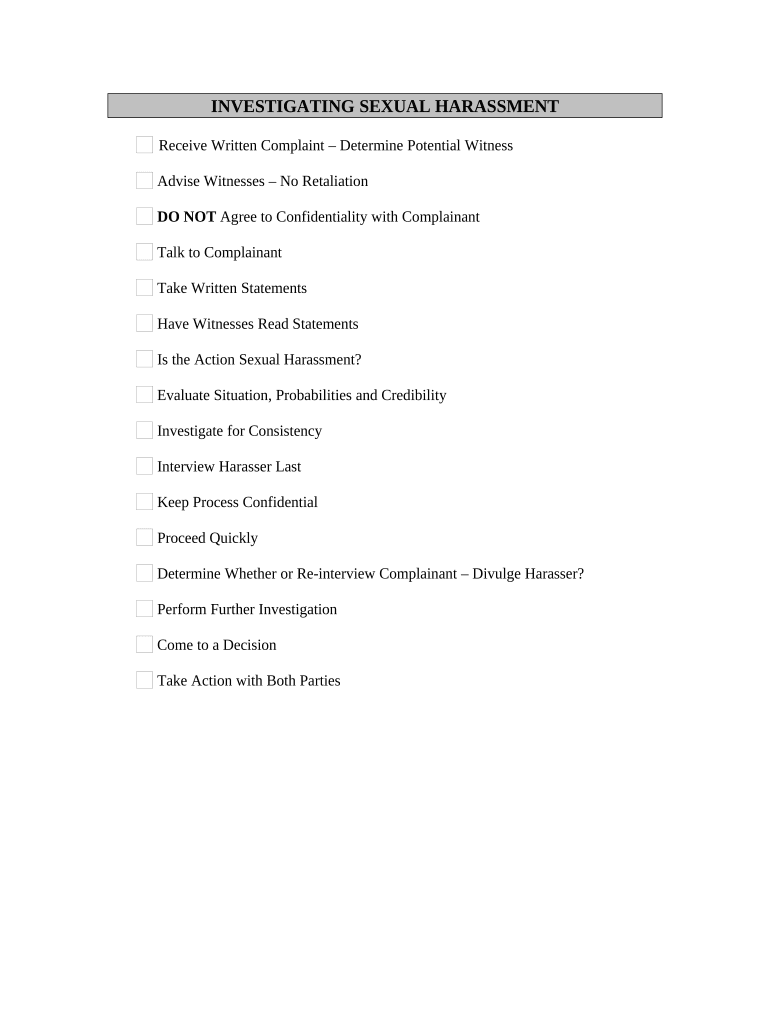
Investigating Sexual Harassment Procedures

This template is fully customizable. Edit the text, fill out the fields, and send it for signature. Give it a try!
Investigating Sexual Harassment Procedures

What the Investigating Sexual Harassment Procedures document covers

An Investigating Sexual Harassment Procedures document is a formal policy and step-by-step template used by employers to receive, assess, and resolve allegations of sexual harassment. It defines intake channels, confidentiality safeguards, investigator roles, evidence collection and interview protocols, timelines for initial response and final findings, and procedures for remedial action and appeals. The document aligns workplace practice with applicable federal and state employment laws, supports consistent decision making, and provides a written record that may be needed for regulatory inquiries, internal audits, or litigation.

Why maintaining clear investigation procedures matters

Clear procedures reduce legal risk, protect complainants and respondents, and promote workplace fairness while documenting compliance with employment law expectations.

Why maintaining clear investigation procedures matters

Who typically prepares and follows these procedures

Human resources teams, in-house counsel, and organizational leaders commonly draft and implement investigation procedures.

  • HR managers and investigators who handle intake, evidence, and corrective actions.
  • In-house and external attorneys who advise on compliance, risk and legal privilege.
  • People leaders and executives responsible for enforcement and organizational training.

Key roles involved in an investigation

HR Director

Oversees policy adoption, assigns investigators, and ensures timely compliance. The HR Director coordinates training, monitors trends, and liaises with legal counsel to reduce organizational liability.

Company Counsel

Provides legal guidance on privilege, regulatory reporting, and discipline. Counsel advises on evidence handling, mandated disclosures, and when to involve outside counsel for impartial review.

Core sections every professional procedure should include

A complete procedures document organizes intake, investigative steps, rights and privacy protections, decision criteria, and post-investigation actions in clear, reproducible sections.

Intake and Reporting

Explain multiple reporting channels, confidentiality limits, and how to document an allegation from initial complaint through case file creation.
Investigator Assignment

Define impartiality standards, conflict-of-interest checks, and qualifications required for internal or external investigators.

Evidence Collection

Specify secure preservation practices for emails, messages, CCTV, and documents, and procedures for collecting statements and digital evidence.

Interview Protocols

Outline witness interview order, recording permissions, note-taking standards, and accommodations for trauma-informed questioning.

Findings and Analysis

Provide criteria for credibility assessments, burden of proof standard, and documentation required to support factual findings.

Remedy and Appeals

Describe corrective measures, disciplinary options, confidentiality in remedies, and an appeals or review process for either party.

Step-by-step process to complete the procedures document

Follow a defined sequence: intake, acknowledge, investigate, decide, and close to ensure consistent, defensible outcomes.

  • 01
    Intake: Record complaint, assign case number, and secure initial evidence.
  • 02
    Acknowledgement: Notify complainant and respondent of receipt and interim protections.
  • 03
    Investigation: Collect evidence, interview witnesses, and document findings.
  • 04
    Decision & Closure: Reach findings, document rationale, and implement remedies or discipline.

How electronic workflows typically route an investigation file

Digital workflows standardize routing, reduce manual handoffs, and create an audit trail for every step in the investigation.

  • Upload Intake Form: Submit complaint and attachments to secure case folder.
  • Assign Investigator: Trigger role-based assignment and access controls.
  • Evidence Collection: Collect files with tamper-evident storage and versioning.
  • Final Report: Generate signed findings and archive the case file.

Recommended digital workflow settings

Configure automation to preserve evidence integrity and reduce administrative delays while limiting access to authorized roles only.

Intake Form Fields Require name, date, location, and summary; set mandatory validation.
Acknowledgement Template Auto-send receipt within 48 hours with privacy notice.
Investigator Assignment Rule Auto-assign based on location or conflict checks.
Authentication Level Require MFA for investigator and legal reviewer signers.
Retention Tagging Apply retention label at case closure for consistent archiving.

Technical considerations for online completion and storage

Use a secure platform that enforces access controls, audit trails, and encrypted storage for investigation files.

  • Access Controls: Role-based permissions limit visibility.
  • Encryption: TLS in transit and AES-256 at rest.
  • Supported Formats: PDF, DOCX, and common image files.

Essential security and record elements to capture

Confidentiality: Limit access to need-to-know.
Audit Trail: Record timestamps and user actions.
Evidence Log: Track file source and custody.
Encryption Standards: TLS 1.2/1.3; AES-256 at rest
Authentication: MFA for investigators and reviewers
BAA Availability: Required for HIPAA-related records

Common mistakes to avoid when preparing procedures

  • Vague definitions of prohibited conduct that make consistent enforcement difficult and increase legal exposure.
  • Failing to document interim measures (e.g., no-contact orders) which weakens ability to show prompt protective action.
  • Overbroad distribution of case materials that undermines confidentiality and can create unnecessary retaliation claims.
  • Missing timelines for acknowledgement or closure that cause stakeholder frustration and regulatory scrutiny.

Potential legal and operational risks from flawed procedures

Regulatory Exposure: EEOC or state agency investigations
Civil Liability: Lawsuits claiming negligence or discrimination
Retaliation Claims: Failure to protect complainant
Evidence Spoliation: Lost or altered records
Operational Disruption: Low morale and turnover
Reputational Harm: Public disclosures and media risk

Typical timelines and response expectations

Timely responses help manage risk and preserve evidence; document and follow clear deadlines for each stage of an investigation.

Initial Acknowledgement:

Acknowledge receipt within 48–72 business hours of complaint.

Interim Protections:

Implement workplace protections immediately upon credible concern.

Investigation Start:

Begin investigative activities within 5–10 business days when feasible.

Investigation Duration:

Aim to complete fact-finding within 30–60 days, documenting any extensions.

Final Report Delivery:

Provide findings and actions in writing to relevant parties once complete.

Key milestones from complaint to closure

Track milestones in a single timeline to show diligence and to document any extensions or delays.

01

Complaint Received

Case opened with unique identifier and intake summary recorded.

02

Acknowledgement Sent

Notifies parties of process, confidentiality limits, and expected timelines.

03

Interviews Conducted

Witness statements and evidence are collected and logged.

04

Findings Issued

Conclusions and remedial actions are formally documented and implemented.

eSignature vendor comparison relevant to investigation workflows

Compare vendor pricing and compliance features when selecting an eSignature provider for confidential investigation records.

signNow DocuSign Adobe Sign PandaDoc HelloSign
Starting Price $8/user/mo $15/user/mo $14/user/mo $19/user/mo $15/user/mo
Free Trial 7-day trial Varies by vendor Varies by vendor Varies by vendor Varies by vendor
Bulk Send Yes Yes Yes Yes No
Audit Trail Yes Yes Yes Yes Yes
HIPAA Compliant Yes Yes Yes No No

Real-world examples of policy use

Organizations use consistent procedures to handle allegations while protecting confidentiality and evidentiary integrity.

Optica Ventures

A mid-size firm standardized intake forms to reduce response time and ensure impartial assignment

  • Centralized intake shortened case routing by two days on average
  • By documenting steps and preserving audit trails, the company improved internal compliance reporting and reduced repeated follow-up requests from legal counsel.

Fertility Centers of Illinois

A healthcare provider adapted procedures to protect patient privacy and comply with HIPAA

  • Investigations integrate BAA-covered storage for medical records
  • The organization used secure eSignature and role-based access to maintain confidentiality while allowing clinicians and counsel controlled review of relevant documents.

Practical tips for accurate and efficient completion

Adopt consistent formats and automation to reduce errors and speed case resolution while preserving legal defensibility.

Use standardized intake templates
Structured forms reduce missing data and make it easier to compare cases and compile metrics for compliance monitoring.
Document every step
Time-stamped notes, preserved evidence files, and documented contact attempts strengthen credibility and support later review.
Limit distribution
Share case materials only with individuals who have a clear need-to-know to preserve confidentiality and privilege where applicable.
Review and update annually
Ensure procedures reflect legal developments, training requirements, and lessons from prior investigations.

Frequently asked questions about investigations and electronic procedures

Answers address common legal, technical, and procedural questions employers encounter when using written or electronic investigation procedures.


Need help? Contact support

be ready to get more
Join over 28 million airSlate SignNow users