Case Caption
Full court caption and case number at top of the document so the clerk and parties can immediately identify the matter and associate filings with the correct docket.
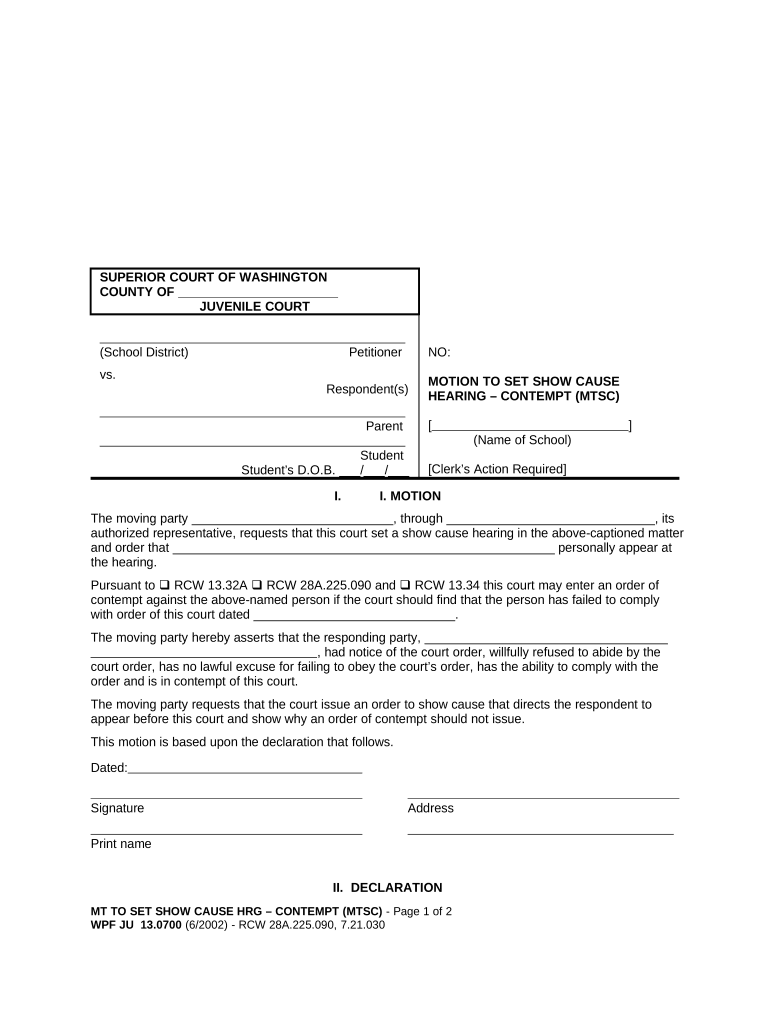
A Show Cause Hearing establishes a formal opportunity to contest proposed relief or sanctions, preserves procedural fairness, and creates an evidentiary record. Properly prepared notices and proofs of service reduce the risk of default orders and preserve appellate rights.

Stakeholders across courts and agencies prepare or respond to show cause proceedings; preparation differs by role and purpose.
Judges or administrative law judges preside over show cause hearings, evaluate procedural compliance, rule on admissibility, and enter orders based on the record created at the hearing.
The individual or entity ordered to appear; responsible for submitting timely responses, producing required documents, and attending the hearing to contest or explain the facts or legal basis.
Full court caption and case number at top of the document so the clerk and parties can immediately identify the matter and associate filings with the correct docket.
A concise statement directing the party to appear and explain why the requested relief should not be granted, including the date, time, and location of the hearing.
A factual summary that explains the basis for the order to show cause, listing dates, actions, and specific conduct the moving party alleges.
Cite the statute, rule, or court authority supporting the requested relief so the responding party understands the legal standard to address at the hearing.
Numbered exhibit list describing each supporting document or declaration to be offered at the hearing, with copies attached or lodged per local rules.
A statement of how and when the notice was served or must be served, and the deadline for a responsive submission to avoid default.
| Setting | Recommended value |
|---|---|
| Document Template | Use a reusable template with required fields pre-placed. |
| Authentication Level | Email plus SMS code for named parties; stronger ID for high-risk matters. |
| Signing Order | Mover signs, then respondent or counsel signs when required. |
| Retention Policy | Retain audit trail and signed PDF for the retention period. |
Confirm the court or agency accepts electronic filings and whether eSignatures meet local authentication rules.
File the notice in time to meet local court cutoff and calendaring requirements.
Service is typically required several days before the hearing; many courts expect 14–21 days notice for contested matters.
Some courts permit written responses before the hearing; check local civil or administrative rules for exact timing.
Confirm date and time with the clerk and opposing counsel after the notice is filed.
File proposed orders or transcripts promptly as required by local rules.
Mover files the order to show cause with the clerk and requests a hearing date.
Submit proof that all required parties received the notice per local procedure.
Exchange exhibits, declarations, and witness lists and resolve evidentiary disputes if possible.
Court conducts the hearing and issues an order based on the record and applicable law.
Tim Martin's team moved from paper to online processing for property enforcement documents to meet scheduling demands.
Dan Rotelli evaluated platforms for strict compliance needs and selected solutions with SOC 2 coverage.
| signNow | DocuSign | Adobe Sign | PandaDoc | HelloSign | |
|---|---|---|---|---|---|
| Starting Price | $8/user/mo | $15/user/mo | $14/user/mo | $19/user/mo | $15/user/mo |
| Free Trial | 7-day trial | Varies by plan | Varies by plan | Varies by plan | Varies by plan |
| Bulk Send | Yes | Varies by plan | Varies by plan | Varies by plan | Varies by plan |
| Audit Trail | Yes | Yes | Yes | Yes | Yes |
| HIPAA Compliant | Yes | Varies by plan | Varies by plan | No | No |
| Envelope Cap | No cap | 100 envelopes/user/year | Varies | Varies | Varies |