Establishing secure connection…Loading editor…Preparing document…

Connecticut Small Estate Affidavit

This template is fully customizable. Edit the text, fill out the fields, and send it for signature. Give it a try!
Connecticut Small Estate Affidavit

What the Connecticut Small Estate Affidavit Is

The Connecticut Small Estate Affidavit is a sworn, written statement used by eligible claimants to collect or transfer certain assets of a deceased person without a full formal probate proceeding when statutory conditions are satisfied. It typically identifies the decedent, lists includable assets, states the claimant's relationship or entitlement, and provides supporting documentation for custodians such as banks, insurers, or registrars to release funds or transfer title. Acceptance practices vary by institution and state law, so the affidavit functions as a streamlined alternative to probate when applicable.

Why Use a Small Estate Affidavit in Connecticut

A Connecticut Small Estate Affidavit expedites asset transfer, reduces probate costs, and offers custodians documented authority to release property when estate value and statutory criteria are met, making small-administration matters simpler and less expensive for heirs and creditors.

Why Use a Small Estate Affidavit in Connecticut

Who Typically Uses This Affidavit

Typical users include beneficiaries, surviving spouses, small creditors, and estate administrators seeking simplified asset transfer without full probate.

  • Individual beneficiaries collecting bank accounts or personal property from the decedent's estate
  • Surviving spouse managing household accounts and small assets for immediate needs
  • Funeral homes and creditors asserting short-term claims under statutory limits

Core Sections You’ll Find on a Professional Affidavit

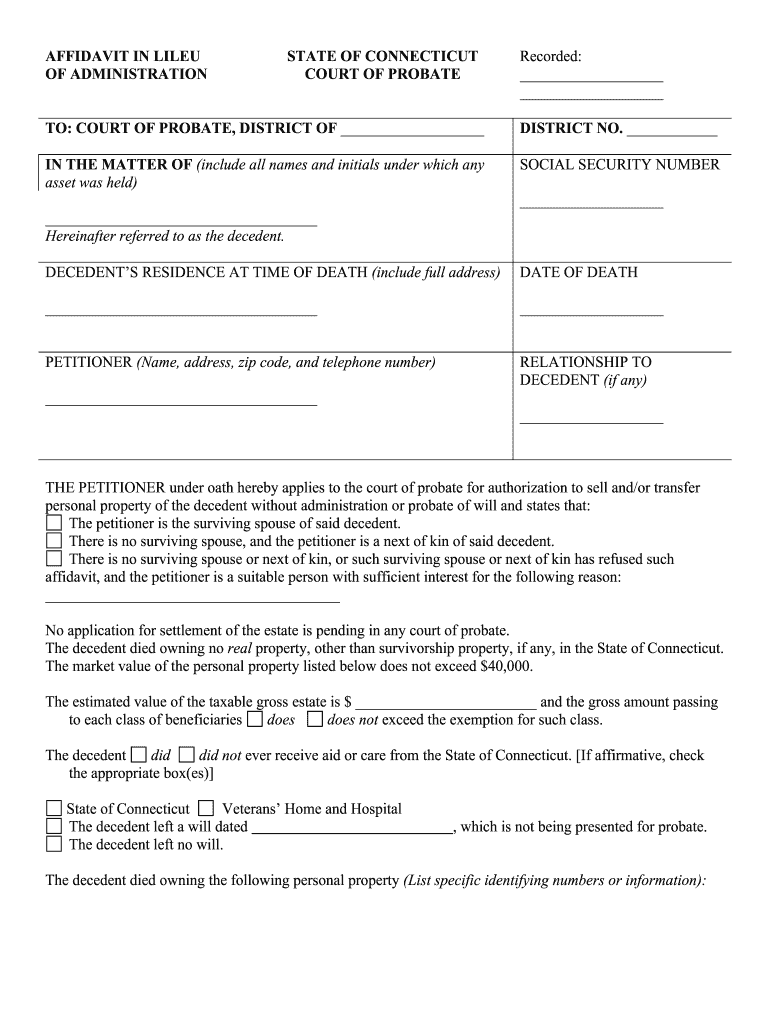
A well-crafted Connecticut Small Estate Affidavit groups claimant details, decedent identifiers, an itemized asset list, a statement of entitlement, the sworn affidavit text, and a notary/acknowledgment block.

Claimant Details

Provide claimant name, address, contact information, and relationship to the decedent. Clear claimant identity helps custodians contact the requester and supports lawful release of assets to the proper person.
Decedent Information

Include the decedent's full legal name, last known address, date of death, and identifying details. Accurate decedent identifiers reduce mismatched records and speed verification with institutions.

Asset Inventory

Itemize accounts, personal property, and other includable assets with account numbers, institution names, and estimated values. Attach statements, titles, or receipts when available to substantiate amounts.

Entitlement Statement

Explicitly state the legal basis for the claim (example: surviving spouse, named beneficiary, or unpaid creditor) and briefly summarize facts that support entitlement to the listed assets.

Affidavit Declaration

A sworn declaration under penalty of perjury where the claimant affirms the facts. Include statute references when available and date the affidavit to establish a clear effective date.

Acknowledgment/Notary

Space for notarial acknowledgement or remote online notarization language. Include notary details and any required witness lines to match recipient acceptance standards.

Step-by-Step: Preparing and Submitting the Affidavit

Follow these steps to prepare and present a Connecticut Small Estate Affidavit to third parties and registries.

  • 01
    Gather Documents: Collect death certificate, proof of relationship, asset statements, and creditor notices.
  • 02
    Confirm Eligibility: Verify estate value meets state threshold and identify includable assets.
  • 03
    Complete Affidavit: Enter decedent information, inventory assets, and state claimant entitlement.
  • 04
    Notarize & Submit: Sign before a notary and present to banks or registrars per instructions.

Typical Processing Workflow with Custodians

Overview of the typical workflow when using a Connecticut Small Estate Affidavit to collect assets from custodians.

  • Prepare Packet: Affidavit, death certificate, account statements attached.
  • Notarize: Execute before a notary or RON per statute.
  • Present to Custodian: Submit to bank, insurer, or registrar for review.
  • Receive Release: Custodian issues signed funds, transfers title, or declines.

Digital Workflow Settings to Collect the Affidavit

Configure a digital workflow to collect signatures, attach documents, and route the Connecticut Small Estate Affidavit to recipients.

Field Configuration
Signer Order Allow single signer; claimant signs first
Authentication Email link or SMS code; use ID verification for banks
Attachments Require PDF of death certificate and statements
Notary Enable RON or require in-person notary per recipient

Technical Considerations for eFiling and eSigning

The affidavit can be completed on paper or via an eSignature platform supporting notarization and secure attachments.

  • Formats: PDF and Word DOCX files supported
  • Integrations: Works with Google Workspace, Box, and NetSuite
  • Notary Support: Supports RON when accepted by recipient

Comparing eSignature Providers for This Affidavit

Common eSignature providers and pricing considerations when preparing and executing the Connecticut Small Estate Affidavit.

signNow DocuSign Adobe Sign PandaDoc HelloSign
Starting Price $8/user/mo $15/user/mo $14/user/mo $19/user/mo $15/user/mo
Free Trial 7-day free trial Varies Varies Varies Varies
Bulk Send Yes (Premium) Yes Yes Yes Varies
Audit Trail Yes Yes Yes Yes Yes
HIPAA Compliant Yes Yes Yes No No
Envelope Cap No cap 100 envelopes/user/year Varies Varies Varies

Security and Compliance Considerations

Encryption (Transit): TLS 1.2 and 1.3 encryption in transit
Encryption (At Rest): AES-256 encryption for stored data
SOC 2 Type II: SOC 2 Type II attestation available
ISO 27001: ISO 27001 certified information security
HIPAA: HIPAA-compliant; BAA required for PHI
ESIGN / UETA: Compliant with ESIGN and UETA laws

Key Risks and Penalty Areas

Perjury Risk: Criminal penalty for false statements
Rejection: Banks may refuse to release funds
Delay: Probate may be required instead
Creditor Claims: Unresolved debts may attach assets
Contested Estate: Court litigation possible
Tax Consequences: Potential reporting and withholding issues

Common Preparation Mistakes to Avoid

  • Incomplete identities, such as missing middle names or mismatched birth dates, often lead institutions to reject affidavits and request formal probate or additional documentation.
  • Failure to attach a certified death certificate and current account statements is a common cause of delayed releases or refusals by banks and title companies.
  • Using overly broad or vague asset descriptions weakens the affidavit's effectiveness and increases the chance recipients will demand court authority.
  • Not confirming statutory thresholds in advance can result in wasted effort if the estate exceeds the small-estate limit and formal probate becomes necessary.

Timelines and Processing Expectations

Typical timelines and expectations when submitting a Connecticut Small Estate Affidavit to custodians and registries.

Submission Timing:

Submit as soon as practical after death; early filing avoids liens.

Bank Review:

Institutions commonly take 10–30 business days to verify documents.

Notary Retention:

Keep notarized originals until release and then for recordkeeping.

Contested Claims:

Disputes may extend process to several months or require probate.

Statute Limits:

Check state law for small-estate thresholds before proceeding.

Best Practices to Maximize Acceptance

Best practices to increase acceptance and reduce disputes when using a Small Estate Affidavit in Connecticut.

Confirm statutory threshold and eligible assets
Verify the state's small estate threshold and which property types are includable. Confirm whether real property, vehicles, bank accounts, or refunds qualify. Misapplying the statute can force probate and raise costs.
Attach certified supporting documents
Include a certified death certificate, recent account statements, and proofs of relationship such as marriage certificates or a will excerpt. Lack of clear documentation is the primary cause of custodian refusal.
Use notarization or RON accepted by recipient
Execute in the presence of an accepted notary or use a RON workflow only if the recipient accepts remote notarization and identity-proofing standards to avoid rejection.
Keep a complete audit trail and copies
Maintain originals and certified copies plus a documented chain of communications with custodians. Record dates, delivery methods, and responses to protect against later contests or audits.

Practical Examples of How Affidavits Are Used

Realistic scenarios where a Small Estate Affidavit resolves routine asset transfers without full probate.

Local Bank Release

A decedent left modest checking and savings accounts that naming and small balances made formal probate impractical.

  • Affidavit met statutory threshold and acceptance.
  • The claimant presented a notarized affidavit with a certified death certificate and account statements; the bank released funds after 18 days, avoiding probate costs and providing a clear record of distribution for tax and recordkeeping purposes.

Vehicle Title Transfer

An adult child needed to transfer title of a single vehicle after a parent's death and avoid a full probate administration.

  • Affidavit satisfied DMV transfer requirements.
  • After completing the affidavit and attaching the vehicle title and death certificate, the DMV issued a new title in the claimant's name within weeks, removing administrative burden and eliminating the need for lawyer-assisted probate.

Frequently Asked Questions and Troubleshooting

Common questions about using, signing, and filing the Connecticut Small Estate Affidavit and how to avoid processing problems.


Need help? Contact support

be ready to get more
Join over 28 million airSlate SignNow users