Establishing secure connection…Loading editor…Preparing document…

Notice of Non-Adverse Possession

This template is fully customizable. Edit the text, fill out the fields, and send it for signature. Give it a try!
Notice of Non-Adverse Possession

What a Notice of Non-Adverse Possession Is

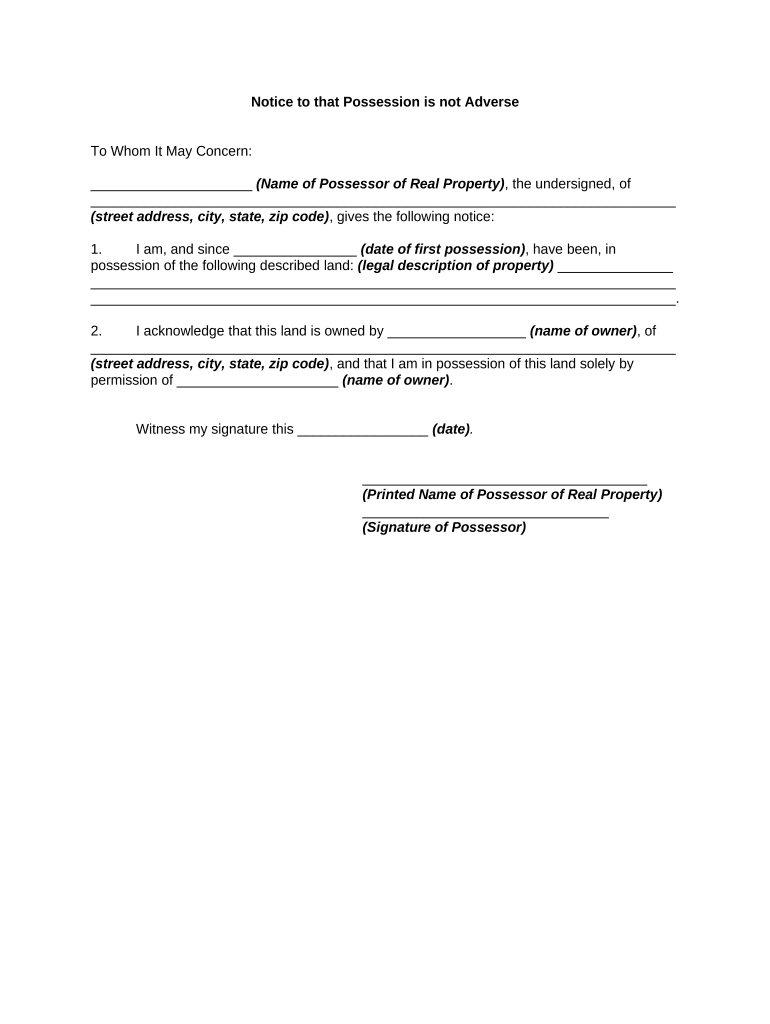
A Notice of Non-Adverse Possession is a written declaration filed by a landowner or record title holder to clarify that occupation, use, or physical improvements by another party are not intended to create an adverse possession claim. The notice documents the owner’s active assertion of title and records that any occupier’s presence is permissive or temporary. It is typically prepared when neighbors, tenants, contractors, or utility providers use or access property in ways that could later be asserted as hostile, exclusive, or continuous. The document helps preserve legal rights and reduce boundary dispute risk.

Why you might serve a Notice of Non-Adverse Possession

Issuing this notice preserves the record owner’s rights by creating contemporaneous evidence that possession was not hostile or intended to ripen into title. It reduces factual ambiguity, supports title insurance defenses, and can deter later claims that occupancy met adverse possession elements.

Why you might serve a Notice of Non-Adverse Possession

Who prepares and relies on this notice

Use of the notice helps build a contemporaneous record that courts and title insurers may consider if possession or boundaries are disputed later.

  • Property owners who want to protect title and clarify permitted access to neighbors or contractors.
  • Title companies and closing agents when underwriting or clearing title issues before transfer.
  • Real estate attorneys and surveyors preparing boundary affidavits or assisting disputed-property clients.

Core elements to include in a professional notice

A clear, well-structured notice minimizes ambiguity and supports later legal or title examinations when disputes arise.

Caption

Identify the document as a Notice of Non-Adverse Possession and reference county, state, and parcel identifiers so it is easily located in public records.
Property Description

Provide a precise legal description or assessor parcel number (APN) and a concise street address to eliminate confusion about the affected land.

Statement of Ownership

Declare the record title holder and clarify the nature of the owner’s interest (fee simple, leasehold, etc.) to show standing to file the notice.

Occupancy Facts

Describe who is occupying or using the property, when permissive use began, and whether access was granted orally or in writing to establish context.

Non-Adverse Assertion

Explicitly state that any current or past possession is permissive, not hostile, and not intended to establish a claim of title by adverse possession.

Signatures

Include signature blocks for the record owner and notary acknowledgment (if required), with dated signatures and printed names for verification.

Step-by-step process to prepare and file the notice

Follow these practical steps to create a defensible, recordable notice.

  • 01
    Gather records: Collect deed, survey, APN, and any prior written permissions.
  • 02
    Draft notice: Use precise property and occupant descriptions; include explicit non-adverse language.
  • 03
    Sign and notarize: Owner signs; obtain in-person or remote notarization per state law.
  • 04
    Record and serve: Record with the county recorder and deliver copies to occupants and title insurer.

Where the notice travels after you sign it

A recorded notice creates a public entry and should also be delivered directly to interested parties to maximize its evidentiary value.

  • County Recorder: Record the notice with the county recorder where the property is located for public notice.
  • Occupant Delivery: Deliver a signed copy to the current occupant by certified mail or personal service.
  • Title Company: Provide a copy to your insurer or any title company involved in pending transactions.
  • Retain Originals: Keep a notarized original and recorded copy in your files for future reference.

Typical e‑filing workflow settings

Configure your digital workflow to support authentication, notarization, and recording in sequence to avoid processing delays.

Field Configuration
Authentication Email plus SMS one‑time password for signer verification
Notarization Use remote online notarization if state permits; otherwise, schedule in person
Recording Package Generate a single PDF with notary certificate and owner signature page
Delivery Send recorded PDF to occupant, title company, and retain copy

Digital signing and technical considerations

Choose a solution that produces tamper-evident PDFs, preserves audit trails, and can output the recorded package required by your county recorder.

  • File Formats: PDF and DOCX supported
  • Integrations: Works with Google Workspace and NetSuite
  • Notary Support: Supports RON where permitted

Security and compliance items to note

In-transit Encryption: TLS 1.2/1.3
At-rest Encryption: AES-256
Certifications: SOC 2 Type II, ISO 27001
HIPAA Support: BAA available
E-signature Law: ESIGN and UETA compliance
Audit Trail: Timestamps, IP, action log

Risks if the notice is incorrect or omitted

Loss of Evidence: Weakened defense against adverse possession
Title Exceptions: Potential title insurer exceptions
Increased Litigation: Higher legal fees and contested suits
Recorder Rejection: Improper format may delay recording
Authentication Gaps: Missing notarization can reduce probative value
Statute Risks: State law may permit title claims if unaddressed

Common preparation mistakes to avoid

  • Using an imprecise or colloquial property description instead of the legal description or APN which can cause recorder rejection or ambiguity.
  • Failing to include the owner’s exact legal name and signature, creating inconsistency with the recorded deed or title chain.
  • Not notarizing per state requirements or using incorrect notary wording, which can reduce the notice’s legal weight.
  • Neglecting to deliver the recorded notice to occupants and insurers, losing the deterrent and evidentiary benefits of direct service.

Timing considerations and recording expectations

Timely recording and delivery help preserve rights; some technical requirements, like RON retention, impose specific timeframes for evidence preservation.

Record Promptly:

Record as soon as the document is signed and notarized to create public notice.

Deliver to Occupant:

Serve occupants promptly, using certified mail or personal delivery, to build contemporaneous proof.

RON Retention:

If notarized remotely retain A/V session per state rules, often 5–10 years

Title Review:

Provide recorded notice to title insurers before closing to avoid exceptions

Statute Variance:

Responding deadlines and limitations vary by state; consult local counsel

eSignature vendor comparison for preparing and executing the notice

Common eSignature plans vary by price, notarization and bulk-send support, and HIPAA options; choose a provider that supports notarization workflows if RON is required.

signNow DocuSign Adobe Sign PandaDoc HelloSign
Starting Price $8/user/mo $15/user/mo $14/user/mo $19/user/mo $15/user/mo
Free Trial 7-day free trial Varies by plan Varies by plan Varies by plan Varies by plan
Bulk Send Yes Yes Yes Yes No
Audit Trail Yes Yes Yes Yes Yes
HIPAA Compliant Yes Yes Yes No No

Frequently asked questions and practical answers

Answers to common questions about drafting, recording, notarization, and challenges specific to Notices of Non-Adverse Possession.


Need help? Contact support

be ready to get more
Join over 28 million airSlate SignNow users