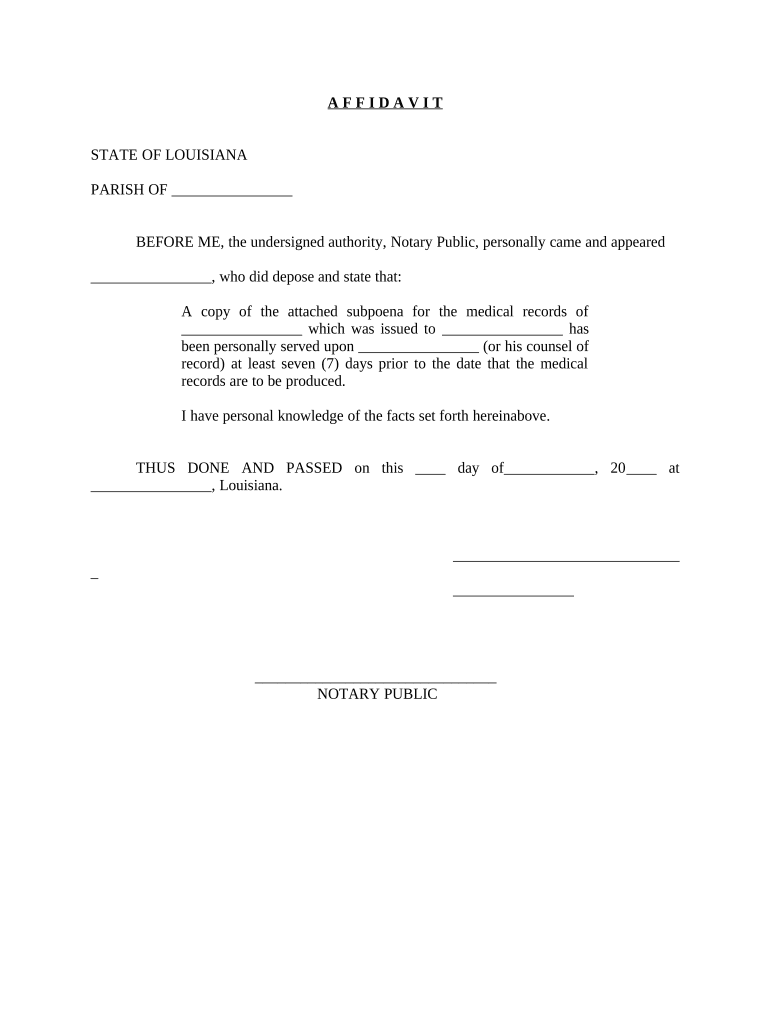
Louisiana Repo Affidavit
What the Louisiana Repo Affidavit Is and When It Applies
Why a Clear, Accurate Repo Affidavit Matters
A properly prepared Louisiana Repo Affidavit creates documentary evidence of lawful possession and the circumstances of repossession; it supports lienholder actions and limits liability exposure.
Who Typically Prepares and Uses This Affidavit
Typical preparers include lenders, repossession agencies, in-house recovery teams, and attorneys involved in secured transactions.
- Lenders and servicers who hold the security interest and need a record for title transfer, sale, or litigation.
- Licensed repossession agents who document the taking of property and maintain chain-of-custody for custody and sale processes.
- Lawyers and claims professionals who rely on sworn statements to support post-repossession actions and defend against debtor claims.
The affidavit serves multiple recipients: courts, titling agencies, auction houses, insurers, and internal audit functions.
Stepwise Completion: Preparing a Compliant Repo Affidavit
-
01Gather Documents: Collect contract, payment history, and prior notice records.
-
02Verify Identity: Confirm affiant ID and signatory authority.
-
03Record Details: Enter accurate VIN, odometer, location, and time.
-
04Sign and Notarize: Affiant signs under oath; obtain required notarization and witnesses.
How to Set Up an Online Completion Workflow
| Field | Configuration |
|---|---|
| Identity Check | Use government ID capture and name match verification. |
| Evidence Attachment | Allow photos, GPS metadata, and towing receipts as attachments. |
| Reviewer Approval | Set a reviewer role with conditional approval steps. |
| Finalization | Lock fields after notarization to prevent edits. |
Routine: From Field Report to Filed Affidavit
-
Prepare: Affiant completes affidavit and uploads supporting files.
-
Review: Compliance or legal reviews content and attachments.
-
Notarize: Notary or RON completes acknowledgment where required.
-
Distribute: Send copies to lienholder, title service, and law enforcement.
Digital Signing and Submission Requirements
Ensure the chosen platform supports notarization, tamper-evident PDFs, audit trails, and secure attachments before e-submission.
- File Formats: PDF/A and DOCX attachments accepted.
- Authentication: Email + SMS or advanced signer authentication options.
- Audit Trail: Capture IP, timestamps, and action history.
Platforms integrating identity proofing, long-term document integrity, and optional remote notarization reduce processing friction and support admissibility.
Timing Considerations and Typical Deadlines
Immediate Documentation:
Prepare affidavit as soon as repossession concludes.
Notice Periods:
Follow state notice windows for sale or disposition.
Title Transfer:
Provide affidavit to title/auction services promptly.
Record Retention:
Keep originals for statutory retention periods.
Court Filings:
File affidavits where required for litigation or estoppel.
Key Milestones From Repossession to Sale
Repossession Completed
Affiant documents facts and secures property custody.
Affidavit Finalized
Notarize and attach evidence and chain-of-custody records.
Notice to Debtor
Deliver required disposition and redemption notices.
Disposition/Sale
Sell at auction or private sale per governing law.
Common Preparation Errors to Avoid
- Incomplete identifiers or missing VINs that delay title transfer.
- Failure to attach photos, GPS data, or towing receipts to support the affidavit.
- Using inconsistent names for parties that complicate legal or auction processing.
- Not obtaining required notarization or required witness attestations before distribution.
Potential Legal and Financial Consequences
Real-World Examples of Affidavit Use
Lender Recovery
A mid‑sized lender documents repossession and disposition
- VIN, GPS photo, and tow receipt attached
- The affidavit and evidence enabled clean title transfer and cleared a dispute over alleged wrongful seizure by the debtor.
Repossession Agency
An agency uses standardized digital affidavits with attachments
- Remote notarization used where permitted
- Standardization cut processing time and produced consistent evidentiary records for auctions and court filings.
eSignature Vendor Pricing and Feature Snapshot
| signNow | DocuSign | Adobe Sign | PandaDoc | HelloSign | |
|---|---|---|---|---|---|
| Starting Price | $8/user/mo | $15/user/mo | $14/user/mo | $19/user/mo | $15/user/mo |
| Free Trial | 7-day free trial | Varies | Varies | Varies | Varies |
| Bulk Send | Yes (Premium) | Yes | Yes | Yes | No |
| Audit Trail | Yes | Yes | Yes | Yes | Yes |
| HIPAA Compliant | Yes | Yes | Yes | No | No |
| Envelope Cap | No cap | 100 envelopes/user/year | Varies | Varies | Varies |
Frequently Asked Questions About Louisiana Repo Affidavits
-
When is notarization required?
Notarization is commonly required to authenticate the affiant’s oath; Louisiana additionally often requires witnesses for certain affidavits. Confirm with local notary rules and the jurisdiction receiving the affidavit.
-
Can I e-sign the affidavit?
Electronic signatures are generally valid under ESIGN (15 U.S.C. ch. 96) and UETA where adopted; verify that the receiving party accepts eSigned affidavits and whether remote notarization (RON) is permitted in that state.
-
What if the VIN is missing?
Missing or incorrect property identifiers delay title and sale. Include secondary identifiers (plate, serial) and document why VIN is unavailable to avoid rejection.
-
How long must records be kept?
Retain affidavits for the active loan term plus at least three years; follow IRS, HIPAA, and state-specific retention rules where applicable and increase retention for title or tax records.
-
Who can notarize the affidavit?
A commissioned notary public can notarize; where allowed, RON may be used with required identity proofing and recording. Confirm state notary commission guidance.
-
What if a debtor disputes the repossession?
Maintain complete evidence package (affidavit, photos, GPS, tow receipts, notices). Proper documentation reduces exposure and supports defense in court or administrative hearings.