Corporate Identity
Full legal name and EIN of the corporation, including state of incorporation and principal business address to avoid identification errors.
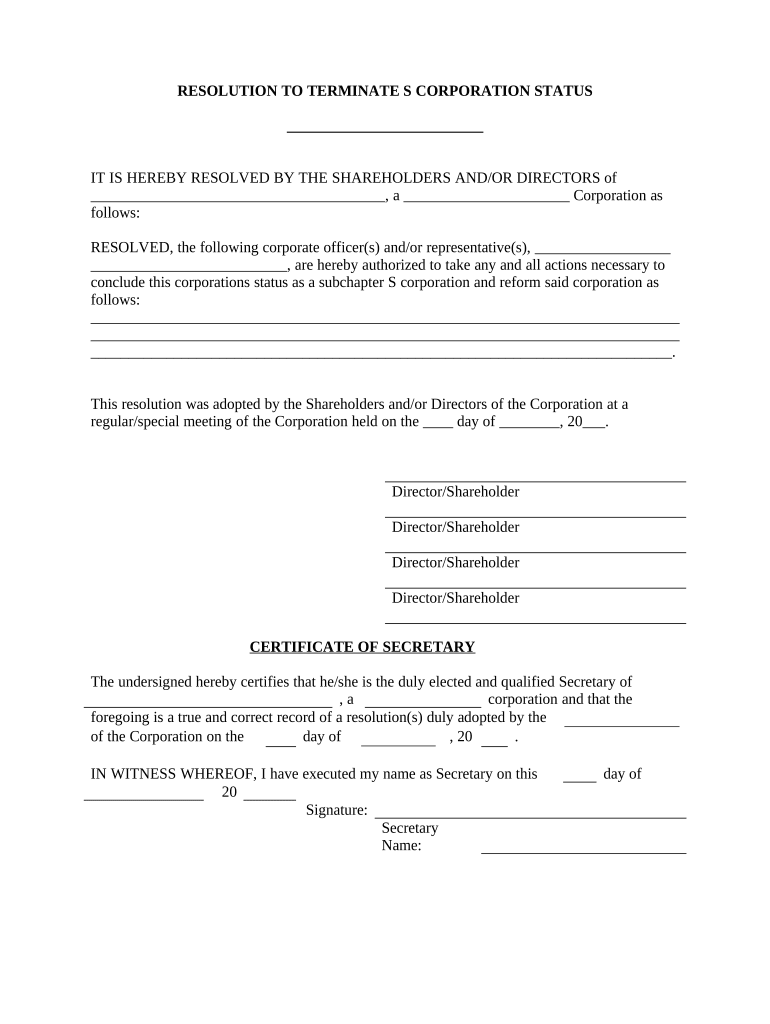
A written resolution creates an auditable record of shareholder approval and the specified effective date, which helps avoid confusion with tax authorities and among owners.

After adoption, the resolution should be signed, dated, and retained in the corporate minute book and provided to tax or state filing processes as applicable.
Full legal name and EIN of the corporation, including state of incorporation and principal business address to avoid identification errors.
Brief background statements explaining the reason for terminating S status and any tax or business considerations that led to the decision.
Clear operative language stating the shareholders’ decision to revoke or terminate the S election and naming the effective date.
Record of the vote or written consents, including percentages voting for and against, to show compliance with bylaws and tax rules.
Express authorization for named officers to notify the IRS, amend corporate filings, and take all necessary administrative actions.
Reference to the meeting minutes or written consents where the action was approved and instructions for retaining the executed resolution.
| Field | Configuration |
|---|---|
| Signature Fields | Place signature, title, and date fields for each signer; require all fields. |
| Authentication | Use email verification or SMS code; consider stronger options for high-risk transactions. |
| Notarization | Enable RON workflow if notarization is required by state law or company policy. |
| Storage | Save completed PDF/A copy in the corporate document management system. |
Ensure the chosen platform provides tamper-evident signed PDFs, long-term storage options, and export to your records system.
Specify MM/DD/YYYY so tax preparers can determine the correct reporting period.
Notify shareholders promptly after approval to preserve consent records.
File any required IRS statement or notice in time for tax filings in the affected year.
Check state filing windows if articles must be amended to reflect tax classification change.
Retention timelines begin on the effective date or the date the action was approved.
Document board/shareholder approval and enter minutes with vote details.
Obtain officer signatures and date the executed resolution.
Prepare and deliver any required IRS statement or attachment for the applicable tax year.
File amendments or state forms if jurisdictional rules require amendment to corporate filings.
| signNow | DocuSign | Adobe Sign | PandaDoc | HelloSign | |
|---|---|---|---|---|---|
| Starting Price | $8/user/mo | $15/user/mo | $14/user/mo | $19/user/mo | $15/user/mo |
| Free Trial | 7-day free trial | No free trial | No free trial | Yes, limited | Yes, limited |
| Bulk Send | Yes | Yes | Yes | Yes | No |
| Audit Trail | Yes | Yes | Yes | Yes | Yes |
| HIPAA Compliant | Yes | Yes | Yes | No | No |
The board chair or president often signs to confirm the board’s action; include a 2–3 sentence role description and note that this signature authorizes officers to act on the resolution.
The corporate secretary typically certifies the resolution and records minute book details; the secretary’s certification supports the authenticity of the corporate record.