Establishing secure connection…Loading editor…Preparing document…

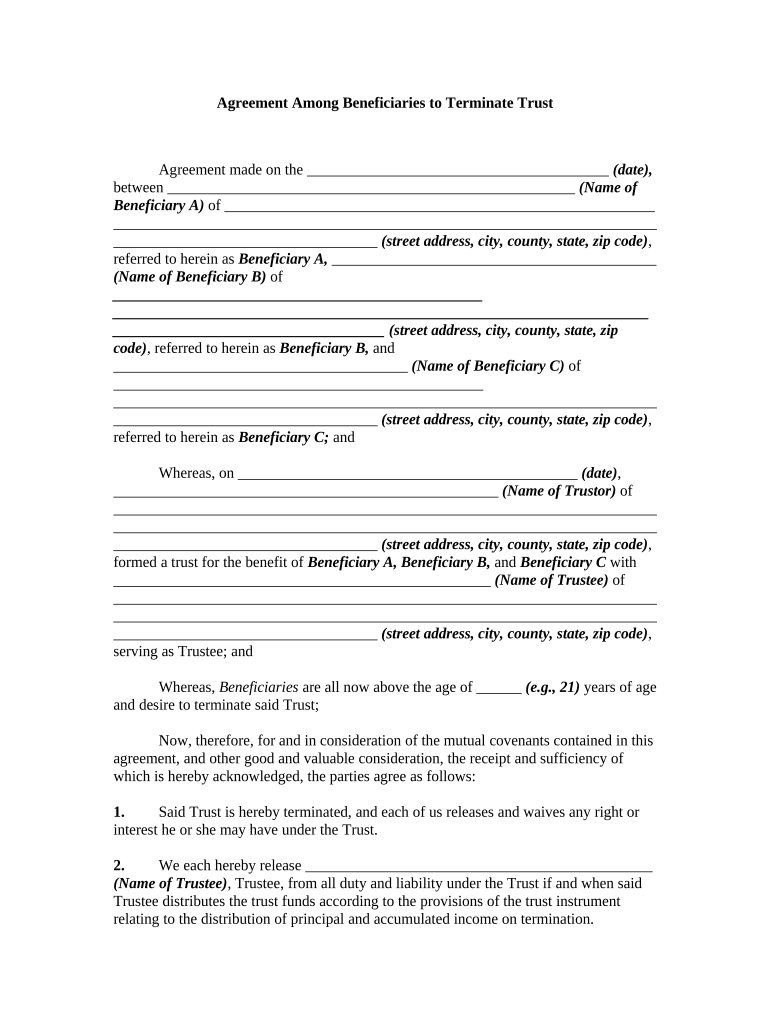
Agreement Among Beneficiaries to Terminate Trust

This template is fully customizable. Edit the text, fill out the fields, and send it for signature. Give it a try!
Agreement Among Beneficiaries to Terminate Trust

What the Agreement Among Beneficiaries to Terminate Trust Is

An Agreement Among Beneficiaries to Terminate Trust is a signed written instrument in which all current beneficiaries of a revocable or irrevocable trust agree to end the trust and distribute its assets directly to the beneficiaries, rather than continuing trust administration. The document identifies the trust, confirms unanimous beneficiary consent, describes agreed distributions, and includes release language for the trustee. Where electronic signing is used, the parties should ensure compliance with ESIGN (15 U.S.C. ch. 96) and applicable state UETA provisions to preserve enforceability.

Why beneficiaries use a termination agreement

Terminating a trust by beneficiary agreement can simplify administration, reduce ongoing trustee duties, and expedite distribution of assets when all beneficiaries agree; it also limits future trustee liability when properly documented and executed under governing law.

Why beneficiaries use a termination agreement

Who typically prepares or signs this agreement

The agreement is most often used when all beneficiaries and the trustee agree that keeping the trust active is unnecessary or burdensome.

  • Individual beneficiaries who prefer direct ownership and simpler asset management.
  • Corporate or professional trustees seeking to conclude administration and limit ongoing fiduciary duties.
  • Estate attorneys or fiduciary advisors assisting clients with consensual trust wind-ups.

Involving counsel and confirming statutory authority under the trust instrument reduces disputes and improves the chance that courts and third parties will accept the termination.

Primary signer roles

Beneficiary — Individual

A named beneficiary signs to accept distribution terms and to release claims against the trustee; the signature attests to consent and may be used to prove intent under ESIGN and UETA standards.

Trustee — Corporate Trustee

The trustee signs to acknowledge the decision, deliver assets, and record the accounting required by the trust instrument and governing law; corporate trustees may also require board or internal approval documentation.

Step-by-step: executing a beneficiary termination agreement

Follow these sequential steps to prepare, approve, and finalize a beneficiary agreement to terminate a trust.

  • 01
    Gather Documents: Collect the trust instrument, most recent accounting, and asset schedules.
  • 02
    Confirm Authority: Verify that the trust permits termination by beneficiary consent or that state law allows it.
  • 03
    Draft Agreement: Prepare clear distribution, release, and effective date provisions reflecting unanimous consent.
  • 04
    Execute and Record: Sign (and notarize if required), then transfer assets and retain copies for records.

How electronic completion and routing typically work

Electronic workflows speed execution while preserving evidence of consent; ensure chosen authentication meets the transaction's risk level.

  • Upload Document: Sender uploads the agreement and places signature/date fields.
  • Add Signers: Enter each beneficiary and trustee email address and specify signing order if needed.
  • Authenticate Signers: Use email link, SMS code, or stronger methods depending on required assurance.
  • Capture Audit Trail: Platform records timestamps, IP addresses, and actions for evidentiary support.

Essential components to include in a professional agreement

A complete termination agreement reduces ambiguity and supports enforceability; include precise identifiers, consent language, distribution mechanics, and confirmation of authority.

Trust Identification

Full trust name, original execution date, and trustee name so the agreement clearly applies to the correct instrument and avoids misunderstandings during asset transfer.
Unanimous Consent

A clear recital that all current beneficiaries consent to termination, including signature blocks for each beneficiary and space for entity titles or representative capacity.

Distribution Plan

Detailed allocation of cash and specific assets, procedures for valuation, and a process for handling unresolved claims or assets that cannot be distributed immediately.

Trustee Release

Language describing releases or limitations on trustee liability after distribution, subject to statutory exceptions and any retained obligations.

Effective and Transfer Dates

State the effective date of termination and the schedule or conditions for property transfer to beneficiaries to trigger vesting and tax events.

Governing Law

Specify the state law governing interpretation and enforcement; this affects notarization, witness requirements, and dispute resolution.

Supporting documents and export formats to include

Collect and preserve related documentation to support transfers, tax reporting, and potential future inquiries about the termination.

Trust Instrument Copy

Attach a certified copy of the trust instrument or cite the recording location so third parties can verify trustee authority and distribution powers.

Asset Schedules

Provide current schedules listing bank accounts, securities, real property, and titled assets with account numbers or parcel identifiers for clear transfer instructions.

Accountings and Tax Records

Include the latest trustee accounting and any tax filings or tax-basis documentation necessary for beneficiary tax reporting and cost basis calculations.

Signed Releases

Collect signed releases and acknowledgements from beneficiaries to document acceptance of distributions and reduce future disputes.

Practical best practices for clean termination

These practices reduce litigation risk and ensure transfers are accepted by custodians, title companies, and tax authorities.

Verify Beneficiary Capacity and Identity
Confirm each beneficiary's legal capacity and identity using government ID or entity documentation; mismatched names may trigger custodian holds or require corrective affidavits.
Document Trustee Approvals
If a corporate trustee or multiple trustees exist, retain board minutes or internal approvals showing authority to execute the termination agreement.
Coordinate with Asset Holders
Notify banks, brokerage firms, and title companies early to confirm required transfer forms, deed preparation, or beneficiary distribution processes they require.
Preserve Audit Trail for eSignatures
Use an e-signature solution that records timestamps, signer authentication steps, and a certificate of completion to support enforceability under ESIGN and UETA.

Timing considerations and statutory deadlines

Certain timelines affect tax reporting, retention, and potential court involvement; plan steps to comply with these deadlines.

Effective Date:

Choose and record the termination effective date in MM/DD/YYYY format to determine tax and transfer timing.

Transfer Execution:

Complete transfers and title changes promptly after the effective date to avoid interim fiduciary obligations.

Tax Reporting Window:

Coordinate distributions with beneficiaries' tax reporting obligations for the relevant tax year.

Notary or Witness Timing:

If notarization or witnesses are required, have signatures notarized or witnessed at execution to meet state formalities.

Record Retention Start:

Begin retention counting from the effective date or date of final distribution, as applicable.

Key milestones from preparation to final transfer

A concise milestone sequence helps stakeholders track progress from agreement draft to completed transfers.

01

Draft and Review

Prepare the agreement and circulate for beneficiary and trustee review.

02

Legal and Tax Check

Confirm legal authority and tax consequences with counsel or advisor.

03

Execution and Authentication

All parties sign, notarize if required, and capture an electronic audit trail.

04

Asset Transfer Completion

Initiate transfers, update title records, and confirm receipt by beneficiaries or custodians.

Common preparation and execution pitfalls

  • Failing to obtain unanimous beneficiary consent can render the termination void or subject to later challenge, requiring court intervention.
  • Using imprecise distribution language (e.g., 'split equally') without method for valuation or rounding can create disputes over non-cash assets.
  • Not verifying trustee authority or required approvals for a corporate trustee may delay transfers and expose the trustee to liability.
  • Omitting required notarization or witnesses under state law for certain transfers can prevent title companies or banks from accepting documents.

Security and compliance essentials to protect the record

Encryption: AES-256 at rest; TLS 1.2/1.3 in transit
Audit Trail: Complete timestamp and activity logs
Access Controls: Role-based permissions for viewers and signers
Authentication: Email, SMS, or stronger methods
HIPAA BAA: BAA available when PHI is involved
Retention Options: Exportable signed PDF and certificate

Short risks and legal consequences to note

Invalid Termination: Agreement may be void
Tax Exposure: Unexpected tax liability
Breach Claims: Beneficiary lawsuits possible
Custody Rejection: Banks may refuse transfers
Title Issues: Deed defects or delays
Recordkeeping Failure: Loss of evidence for intent

Typical eSignature workflow settings for this agreement

Configure workflow settings to match the transaction's complexity and required signer assurance level.

Field Configuration
Signing Order Specify sequential order when trustee approval precedes beneficiary signatures
Authentication Use email + SMS or stronger methods for high-value transfers
Attachments Require attached trust instrument and accounting before final signature
Certificate Enable completion certificate with timestamps and IP data

Technical and integration considerations for eSubmission

Choose a platform that supports required authentication, audit trails, and export formats for legal records.

  • Document Formats: PDF, DOCX supported for signed outputs
  • Integrations: Common integrations include NetSuite, Salesforce, Microsoft 365, and Google Workspace
  • Security Standards: Look for TLS 1.2/1.3, AES-256, SOC 2, and HIPAA BAA options

Ensure the platform can export a tamper-evident signed PDF plus an audit trail to preserve evidence of intent, consent, and attribution under ESIGN and state UETA rules.

Comparing eSignature vendors for trust termination workflows

Basic pricing and feature availability across common eSignature vendors; signNow is listed first per platform comparison conventions.

signNow DocuSign Adobe Sign PandaDoc HelloSign
Starting Price $8/user/mo $15/user/mo $14/user/mo $19/user/mo $15/user/mo
Free Trial 7-day free trial Varies Varies Varies Varies
Bulk Send Yes Yes Yes Yes Yes
Audit Trail Yes Yes Yes Yes Yes
HIPAA Compliant Yes Yes Yes No No

Real-world examples of beneficiary terminations

Two concise scenarios illustrate common ways beneficiaries use a termination agreement to simplify administration.

Estate Closure — Siblings

Three siblings jointly decide to terminate a family trust to avoid ongoing trustee fees.

  • Agreement sets specific percentages and a valuation method for real property.
  • After execution and transfers, siblings record deeds and update account titles; retaining the signed agreement and accounting evidence prevents later title or tax disputes.

Small Trust — All Beneficiaries Agree

A small trust holding bank accounts and stocks is subject to unanimous beneficiary consent to terminate.

  • Parties draft a distribution schedule and include a trustee release.
  • The trustee executes transfers, beneficiaries accept distributions, and signed releases and transfer confirmations are stored with tax records.

Frequently asked questions about terminating a trust by beneficiary agreement

Answers to common questions about authority, notarization, tax consequences, and electronic signing for Agreement Among Beneficiaries to Terminate Trust.


Need help? Contact support

be ready to get more
Join over 28 million airSlate SignNow users