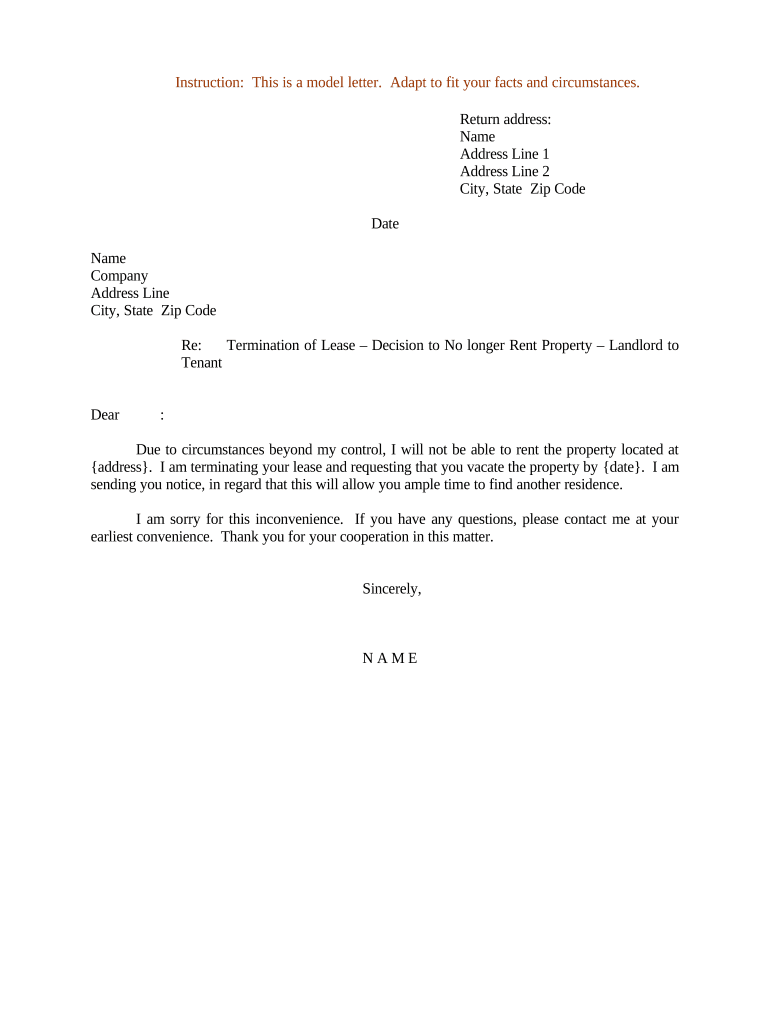
Termination of Lease
What the Termination of Lease document is
Why a clear Termination of Lease matters
Using a formal Termination of Lease provides clear notice of intent, creates an evidentiary record of the termination date and obligations, and reduces misunderstandings. It helps preserve legal rights, supports security-deposit accounting, and documents agreed remedies or move-out responsibilities for enforcement if needed.
Who typically prepares or signs this form
Landlords, tenants, property managers, and attorneys commonly use a Termination of Lease to document ending occupancy and related obligations.
- Individual residential tenants ending a month-to-month or fixed-term lease early.
- Property managers and landlords formalizing move-out dates and deposit handling.
- Commercial lessees terminating a lease for relocation, default, or mutual agreement.
Stepwise process to prepare and finalize a termination notice
-
01Identify Parties: List full legal names and contact information.
-
02Specify Premises: Include full street address and unit number.
-
03State Termination: State the exact effective date using MM/DD/YYYY.
-
04Signature: Have authorized signatories sign and date the document.
How the termination notice is routed and recorded
-
Sender: Uploads form and specifies signers and routing order.
-
Authentication: Choose email, SMS code, or stronger ID verification.
-
Signer: Reviews terms, signs electronically, and receives copy.
-
Record: Platform captures audit trail and stores signed file.
Setting up an online workflow for Termination of Lease
| Field | Configuration |
|---|---|
| Signer Authentication | Email or SMS code; upgrade to KBA if needed. |
| Conditional Fields | Show rent proration only when applicable. |
| Templates | Save reusable termination template for consistency. |
| Notifications | Auto-notify landlord and tenant on signature completion. |
Delivery and proof options to consider
Digital and paper distribution options affect proof of delivery and enforceability; choose consistent methods aligned with state notice rules.
- Email Delivery: Fast, time-stamped, accepted in most states.
- Certified Mail: Provides USPS proof of mailing and delivery.
- In-Person Handover: Immediate receipt but requires documented acknowledgment.
Typical notice periods and processing expectations
Standard Notice Periods:
Residential month-to-month often requires 30 days' written notice.
Commercial Leases:
Commercial agreements follow contract terms, which may require longer notice.
Processing Time:
Allow 3–10 business days for delivery and administrative processing.
Security Deposit Return:
State deadlines vary; many require itemized deductions within 14–45 days.
Late Fees:
Final rent due dates and late fees follow lease terms.
Key milestones from notice to final record
Notice Delivered
Landlord or tenant delivers written termination notice; date triggers next steps.
Move-Out Inspection
Schedule inspection on or shortly after termination date to document condition.
Final Accounting
Itemize deductions, unpaid rent, and return or dispute deposit.
Record Retention
Store executed document and evidence per retention policy and statute.
Common mistakes to avoid when preparing a termination
- Failing to state the effective termination date precisely can create ambiguity about possession and rent obligations, leading to disputes and potential double-rent claims.
- Not providing proper delivery proof or using an informal email without consent risks the notice being deemed ineffective under state landlord-tenant law.
- Neglecting to document move-out condition and inspection dates makes it harder to justify security deposit deductions in small claims or court proceedings.
- Assuming electronic signatures are valid without confirming ESIGN/UETA applicability or exceptions for specific document types can cause enforceability challenges.
Potential risks and legal consequences of errors
Comparison of common eSignature options for Termination of Lease workflows
| signNow | DocuSign | Adobe Sign | PandaDoc | HelloSign | |
|---|---|---|---|---|---|
| Starting Price | $8/user/mo | $15/user/mo | $14/user/mo | $19/user/mo | $15/user/mo |
| Free Trial | 7-day free trial | Varies by vendor | Varies by vendor | Varies by vendor | Varies by vendor |
| Bulk Send | Yes (premium) | Varies by plan | Varies by plan | Varies by plan | Varies by plan |
| Audit Trail | Yes | Yes | Yes | Yes | Yes |
| HIPAA Compliant | Yes (BAA) | Varies by plan | Varies by plan | Varies by plan | Varies by plan |
| Envelope Cap | No cap | 100 envelopes/user/year | Varies by plan | Varies by plan | Varies by plan |
Real-world examples of digital lease terminations
Martin Properties
Martin Properties centralized termination processing to reduce in-person steps and to standardize notice and deposit handling across units.
- Cut administrative turnaround time substantially.
- I can process and execute all of these documents online with 100% compliance and built-in security. Whether on mobile or working offline, I can get forms back to their necessary parties efficiently.
Optica Ventures
Optica Ventures implemented digital termination notices to improve customer experience and reduce processing time for lease closeouts.
- Improved customer satisfaction and speed.
- The interface is simple and easy-to-use for our team; more importantly, it is just as easy for our customers. Implementation reduced in-person signings and standardized procedures across their leasing workflow.
Frequently asked questions about Termination of Lease
-
Can a Termination be e-signed?
Yes; electronic signatures generally satisfy the ESIGN Act (15 U.S.C. ch. 96) and UETA when parties consent and intent are clear. Exceptions include wills, certain court filings, and notices of eviction or foreclosure, which may require paper, notarization, or state-specific procedures.
-
Is notarization or witness required?
Not typically for a termination notice; notarization is not usually required to end a lease. However, some parties include notarization for additional evidentiary weight, and state or contract terms may demand notarized acknowledgements in specific circumstances.
-
What if tenant refuses to leave?
If a tenant refuses to vacate after a valid Termination of Lease, the landlord must follow statutory eviction procedures rather than self-help. Initiate unlawful detainer or eviction actions under local landlord-tenant law and provide required notices per jurisdiction.
-
Can the termination be revoked?
Parties may mutually agree to rescind a Termination of Lease if both consent and execute a written revocation or amendment. Unilateral revocation may be impossible if notice statutes or lease terms have already triggered possession changes or third-party rights.
-
How should I prove delivery?
Use traceable methods: certified mail with return receipt, courier records, email with read receipts when contractually accepted, or platform audit trails showing timestamp, IP, and signer attribution. Retain proof to support enforcement or defense against claims.
-
When can deposit be withheld?
Yes, to the extent allowed by the lease and state law. Document and itemize charges, provide required notices, and calculate prorations. Failure to follow statutory notice and accounting rules can trigger penalties or require full deposit restitution.