Establishing secure connection…Loading editor…Preparing document…

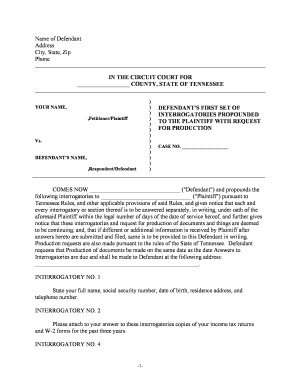
Tennessee Defendant's First Set of Interrogatories

This template is fully customizable. Edit the text, fill out the fields, and send it for signature. Give it a try!
Tennessee Defendant's First Set of Interrogatories

What the Tennessee Defendant's First Set of Interrogatories Is

The Tennessee Defendant's First Set of Interrogatories is a formal discovery document served by a defendant to a plaintiff (or vice versa) used to obtain written answers under oath about facts, witnesses, documents, and theories relevant to a civil case. It typically follows the complaint and initial disclosures and asks specific questions that must be answered within the time limits set by the rules of civil procedure. Responses and any objections become part of the case record and may later be used at motion practice or trial if properly preserved and authenticated.

Why these Interrogatories Matter to Case Preparation

Well‑drafted interrogatories narrow disputes, lock in an opponent's factual positions, and identify witnesses and documents early in litigation, improving efficiency and strategic planning.

Why these Interrogatories Matter to Case Preparation

Who Typically Prepares and Responds

Parties and counsel use interrogatories at the start of discovery to develop the factual record without depositions.

  • Defense attorneys use targeted interrogatories to probe liability theories and affirmative defenses.
  • Civil litigants (individuals or organizations) respond under oath with counsel review and necessary objections.
  • Paralegals and litigation support teams prepare exhibits and compile responsive documents referenced in answers.

Coordinated drafting and timely responses reduce motion practice and preserve issues for trial preparation.

Essential Parts of a Professional First Set of Interrogatories

A complete set includes identifying headings, definitions and instructions, numbered interrogatories grouped by topic, spaces for signature and verification, a certificate of service, and a reference list of attached exhibits or documents responsive to particular questions.

Caption

Case caption with court, docket number, party names, and identifying information for the responding party.
Definitions

Clear definitions for terms used throughout the interrogatories to avoid ambiguity and preserve objections to vague terms.

Instructions

Guidance on how to answer, time frame covered by requests, and instructions for producing related documents.

Numbered Questions

Sequentially numbered interrogatories grouped by subject matter to facilitate tracking and specific responses.

Verification

Signature block and verification clause where the respondent attests under penalty of perjury to the truth of answers.

Certificate of Service

Statement confirming how and when the interrogatories were served on the opposing party.

Step-by-Step: Completing the First Set of Interrogatories

Follow this sequence to prepare, review, and serve answers that comply with procedure and protect client interests.

  • 01
    Review the Questions: Read all interrogatories and definitions before drafting responses.
  • 02
    Collect Documents: Locate exhibits and documents referenced by each question.
  • 03
    Draft Answers: Respond clearly, cite exhibits, and state objections where applicable.
  • 04
    Verify and Serve: Sign verification, assemble certificate of service, and serve within the deadline.

How Electronic Preparation and Service Works

Digital workflows streamline drafting, internal review, signature, and service while preserving an audit trail required for admissibility and chain of custody.

  • Draft Online: Upload document and place fillable fields for answers and verification.
  • Review Internally: Share with counsel and support staff for edits and privilege logs.
  • Sign Electronically: Apply verified eSignatures to the verification block for attribution.
  • Serve and Archive: Serve according to rules and save an audit trail and final PDF.

Configure a Digital Workflow for the Interrogatories

Set up the document workflow to control who edits, reviews, signs, and serves the interrogatories.

Field Configuration
Answer Fields Make multiline text fields required where narrative answers are expected
Verification Block Require signer authentication and date field at signature
Attachment Field Allow document upload for exhibits and privilege logs
Audit Trail Enable full action logging for compliance and evidentiary chain

Technical Considerations for eSubmission and Service

Choose a platform that supports secure signing, authentication options, and audit trails to meet procedural and evidentiary needs.

  • Authentication: Email, SMS, or advanced signer verification
  • Encryption: TLS in transit; AES‑256 at rest
  • File Formats: PDF/A and DOCX support for archiving

Confirm the chosen method of electronic service is accepted by the court or opposing counsel, and preserve signed copies and logs for the record.

Typical Deadlines and Timing Expectations

Deadlines for answering interrogatories vary by jurisdiction; observe federal and local rules to avoid waiver or sanctions.

Federal Rule of Civil Procedure:

Usually 30 days to answer after service in federal cases

Tennessee Civil Practice:

Commonly follows similar 30‑day timelines; confirm local rule exceptions

Requests for Extension:

Parties may stipulate or seek court-ordered extensions before expiration

Service vs. Filing Dates:

Deadlines run from the date of proper service, not filing with the court

Late Responses:

May lead to motions to compel or sanctions if not timely and not excused

Key Milestones from Service to Resolution

A typical discovery timeline highlights the main stages from initial service through dispute resolution and preservation for trial.

01

Service of Interrogatories

Document is transmitted to opposing party and clock for response begins.

02

Response Deadline

Responding party compiles answers and objections by the deadline.

03

Meet and Confer

Parties attempt to resolve disputes about scope or objections informally.

04

Motion to Compel

If disputes persist, a motion may be filed to compel full answers.

Common Mistakes to Avoid

  • Failing to read definitions and instructions, which can lead to incomplete or inconsistent answers.
  • Providing unsigned or unverified answers that lack the required verification under penalty of perjury.
  • Overbroad objections without stating whether any responsive information is being produced.
  • Missing the service deadline or failing to serve a proper certificate of service.

Penalties and Risks for Incorrect or Late Responses

Motion Practice: Court may grant motions to compel; additional briefing and hearings increase cost.
Sanctions: Monetary or evidentiary sanctions may be imposed for discovery violations.
Adverse Inference: Court can draw negative inferences from withheld or destroyed evidence.
Waiver: Late or deficient answers can be treated as waiver of certain defenses.
Privilege Risks: Improper privilege logs can result in disclosure or loss of protection.
Cost Increase: Added attorney and court costs from dispute resolution and motion work.

Security and Compliance Considerations

In Transit: TLS 1.2 / 1.3
At Rest: AES‑256 encryption
Audit Trail: Detailed timestamp and IP logging
HIPAA Support: BAA available where PHI is involved
Regulatory Fit: ESIGN and UETA compliance
Access Controls: Role-based permissions and SSO options

eSignature Pricing and Feature Snapshot Relevant to Interrogatories

Compare starting costs and core capabilities that matter for preparing, signing, and archiving discovery documents; signNow is listed first for parity.

signNow DocuSign Adobe Sign PandaDoc HelloSign
Starting Price $8/user/mo $15/user/mo $14/user/mo $19/user/mo $15/user/mo
Free Trial 7-day free trial Varies by plan Varies by plan Varies by plan Varies by plan
Bulk Send Yes (Business Premium+) Yes Yes Yes No
Audit Trail Yes Yes Yes Yes Yes
HIPAA Compliant Yes Yes Yes No No

Frequently Asked Questions About Interrogatories and Electronic Responses

Answers to common legal and procedural questions about preparing, verifying, and serving the Tennessee Defendant's First Set of Interrogatories.


Need help? Contact support

be ready to get more
Join over 28 million airSlate SignNow users