Establishing secure connection…Loading editor…Preparing document…

Transfer on Death Deed

This template is fully customizable. Edit the text, fill out the fields, and send it for signature. Give it a try!
Transfer on Death Deed

What a Transfer on Death Deed Is and how it works

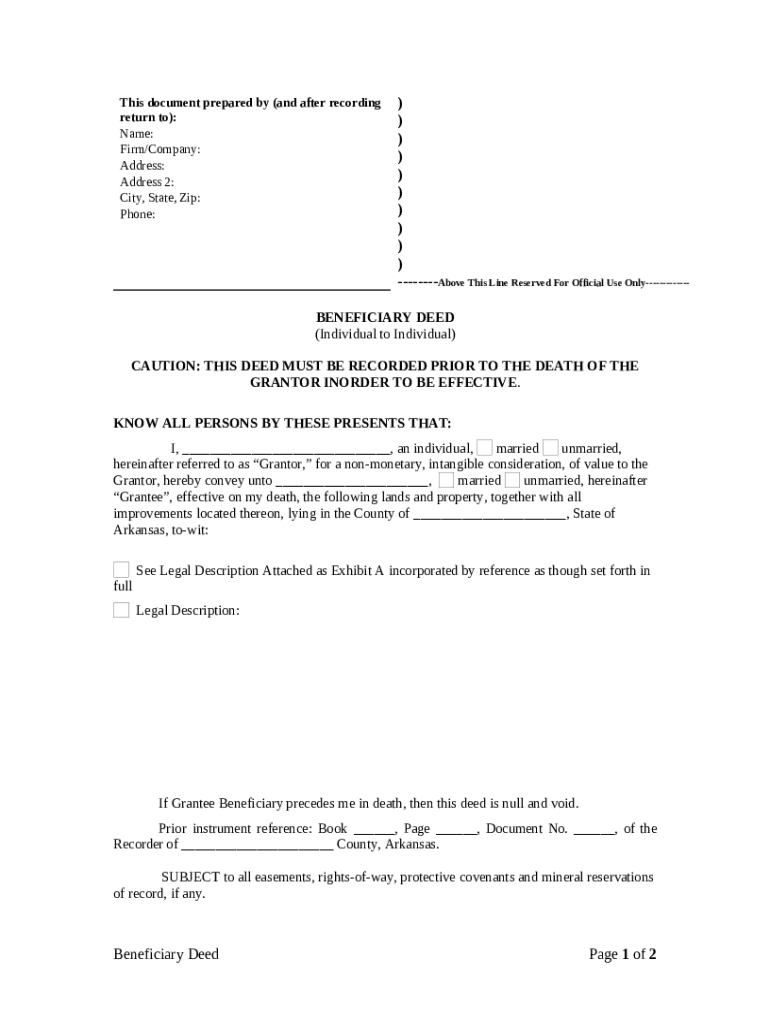
A Transfer on Death Deed (TOD Deed) is a legal instrument that allows a property owner to name one or more beneficiaries to receive real property automatically upon the owner's death without probate. The grantor retains full ownership, use, and control during life and can revoke or amend the TOD Deed at any time while competent. Once the grantor dies, the beneficiary records an affidavit of death and the recorded TOD Deed in the county recorder's office to transfer title. Requirements and recording practices vary by state and county.

Why people choose a Transfer on Death Deed

A TOD Deed can avoid probate, reduce administration time, and preserve privacy because transfer occurs by recording rather than court supervision. It keeps the grantor in control during life, requires relatively low upfront cost, and can be revoked without beneficiary consent while the grantor is alive.

Why people choose a Transfer on Death Deed

Who commonly completes a Transfer on Death Deed

Typical users include individual property owners and small estate planners who want a simple, nonprobate transfer mechanism.

  • Retiring homeowners seeking quick transfer at death without probate; often single-owner properties or second homes.
  • Estate planning attorneys preparing targeted nonprobate transfers as part of a broader plan for low-complexity estates.
  • Adult children or beneficiaries named to receive property who want clarity on post-death title procedures.

Primary roles and signatory authority

Grantor

The property owner who executes the TOD Deed. The grantor retains full title and may sell, mortgage, or revoke the deed during life; signature authority lies solely with the grantor while competent.

Beneficiary

The named transferee who receives title only upon the grantor's death. Beneficiaries have no ownership rights before death and cannot encumber the property absent grantor action.

Essential legal and property details to include

Legal description: Full recorded description
Grantor ID: Full legal name
Beneficiary ID: Full legal name
Parcel number: County APN
Notary block: Notary acknowledgement
Recording county: County name

Key legal risks and consequences

Invalid execution: Deed may be void
Mortgage issues: Lender may object
Creditor claims: Subject to debts
Tax exposure: Potential estate taxes
Title defects: Clouded title risk
Revocation disputes: Competing claims possible

Common mistakes to avoid when preparing a TOD Deed

  • Using an incomplete legal description or P.O. box for the property instead of the recorded parcel description, which can prevent recording.
  • Naming beneficiaries imprecisely (nicknames or incomplete names) that create ambiguity and require court clarification.
  • Failing to consider existing mortgages or liens; a TOD Deed does not eliminate debts attached to the property.
  • Assuming the TOD Deed overrides a will without reconciling estate documents; conflicting instruments can lead to litigation.

Real-world Transfer on Death Deed scenarios

Two concise examples illustrate when a TOD Deed is practical and where additional planning is prudent.

Single-Owner Home

An elderly homeowner with a single-title residence executes a TOD Deed naming an adult child as beneficiary to avoid probate.

  • The child receives title after a death affidavit is recorded.
  • The process avoided probate costs and court delay; however, the grantor confirmed mortgage status and updated homeowner insurance to reflect survivor responsibilities.

Blended-Family Complexity

A grantor with children from two marriages considers a TOD Deed but hesitates due to competing expectations.

  • The deed would bypass probate and give immediate title to named beneficiary.
  • The grantor consulted counsel and instead used a revocable trust to balance competing inheritances and reduce future litigable disputes.

Step-by-step: completing a Transfer on Death Deed

Follow these sequential steps to prepare, sign, and record a TOD Deed; consult an attorney for complex estates or mortgage issues.

  • 01
    Confirm eligibility: Verify your state permits TOD Deeds and that the property is eligible.
  • 02
    Prepare deed: Use the county-approved form or attorney-drafted deed with full legal description.
  • 03
    Execute with notary: Sign before a notary and comply with witness requirements if applicable.
  • 04
    Record deed: File the deed with the county recorder where the property is located.

How title passes after the grantor’s death

Understand the post-death process so beneficiaries know how and when to obtain recorded title.

  • Death occurs: Grantor dies while holding title.
  • Affidavit of death: Beneficiary obtains death certificate and files affidavit.
  • Recording step: Affidavit and TOD Deed recorded with county recorder.
  • Title transfers: Recorder updates title to beneficiary.

Core elements that a professional TOD Deed includes

A well-drafted TOD Deed contains clear identification, precise property description, revocation language, and compliant execution clauses to ensure recording and enforceability.

Clear beneficiary

Full legal name and contact details reduce ambiguity and help the recorder identify the correct transferee when the grantor dies.

Precise legal description

Use the exact recorded legal description or parcel number from the last deed or county assessor to avoid recording rejection or title defects.

Revocation clause

State that the grantor may revoke or amend the deed during life; this preserves control and avoids unintended transfers.

Notary and witness block

Include the county-specific acknowledgement format and witness lines when state law requires witnesses for deeds to be recordable.

Practical tips for accurate TOD Deed completion

Follow these best practices to reduce the risk of recording errors and later disputes; small details often determine enforceability.

Verify county recording requirements
Check the recorder’s format, fee schedule, and whether the county accepts e-recording or requires a paper original; compliance avoids rejection and delays.
Confirm mortgage covenants
Contact the mortgage lender to understand how a TOD Deed affects loan acceleration clauses, due-on-sale provisions, or servicer protocols to prevent unintended defaults.
Use full legal names consistently
Enter legal names exactly as they appear on government IDs for grantor and beneficiaries to prevent ambiguity and to streamline post-death title transfer.
Maintain a clear record copy
Keep the executed original and a recorded copy in a secure location and provide copies to beneficiaries and your attorney to reduce disputes after death.

Key milestones from execution to post-death transfer

Track these stages to ensure enforceability and to prepare beneficiaries for required actions after the grantor’s death.

01

Execution and notarization

Sign and notarize the TOD Deed to meet state recording prerequisites.

02

Record promptly

Record the deed promptly to notify title chains and reduce ambiguity; some recommend immediate recording.

03

Retain original

Keep the original executed deed in secure storage; provide certified copies to beneficiaries as needed.

04

Post-death recording

After death, beneficiary files affidavit and recorded TOD Deed to effectuate title transfer.

Timing considerations and typical recording expectations

While a TOD Deed takes effect at death, timing matters for recording, lender notices, and tax reporting; act early on logistics.

Execution timing:

Execute and notarize before death to ensure a valid instrument.

Recording timing:

Record the TOD Deed while grantor is alive or immediately after execution.

Post-death filing:

Beneficiary should record affidavit and death certificate promptly after probate-related delays are unnecessary.

Mortgage notice:

Notify lender upon grantor death; servicing may require documentation.

Tax reporting:

Coordinate with tax counsel for basis adjustments and estate reporting as required.

Additional clauses and safeguards to include

Consider adding these clauses and cross-references to reduce disputes and improve clarity for title examiners and recorders.

Contingent beneficiary

Name alternate beneficiaries in case the primary beneficiary predeceases the grantor to avoid intestacy or unintended heirs.
Survivorship requirement

Specify survival period (for example, 30 or 60 days) that a beneficiary must outlive the grantor to take title, preventing immediate transfer to descendants.

Successor trustee reference

If part of a trust plan, cross-reference trust documents to clarify whether property should flow into a trust at death.

Mortgage subordinate language

Clarify that TOD Deed does not release mortgage obligations and that the beneficiary inherits subject to outstanding liens.

Recordation instructions

Include county recorder details and preferred indexing name to minimize indexing errors that delay title updates.

Conflict clause

State that the TOD Deed is intended to operate outside the will regarding the named property to reduce interpretive conflict.

Checklist for completing and storing the TOD Deed

Use this compact checklist to confirm each administrative step before and after execution.

01

Confirm state law:

Check if TOD deeds are recognized.
02

Obtain legal description:

Copy from prior deed or assessor.
03

Prepare deed document:

Use county form or attorney draft.
04

Sign with notary:

Complete acknowledgement per state rules.
05

Record in county:

Submit to recorder with fees.
06

Share copies:

Provide beneficiaries and counsel copies.

Electronic signing and recordation considerations

Many jurisdictions and recorders accept digitally signed or electronically notarized documents, but acceptance varies by county and state.

  • E-signature legality: ESIGN and UETA permit e-signatures generally
  • E-recording availability: County e-recording differs by jurisdiction
  • RON notaries: Remote notarization rules vary

Typical digital workflow for preparing and signing a TOD Deed

Configure your online workflow to collect notarization, signature, and a recordable original if required by the county recorder.

Field Configuration
Document upload PDF/A preferred for e-recording
Signature fields Place grantor signature and date
Notary block Add state-specific acknowledgement
Record copy step Generate printable original for county

How a TOD Deed compares with other transfer methods

Compare common transfer instruments to decide which fits your goals; columns show high-level differences in probate and flexibility.

Criteria Transfer on Death Deed Revocable Trust
Probate required
Upfront cost low moderate
Privacy higher higher
Flexibility limited high

eSignature pricing and capability snapshot for TOD Deed workflows

These vendor entries show starting price and core capabilities relevant to signing and notarizing deeds; signNow appears first per vendor ordering rules.

signNow DocuSign Adobe Sign PandaDoc HelloSign
Starting Price $8/user/mo $15/user/mo $14/user/mo $19/user/mo $15/user/mo
Free Trial 7-day free trial Varies by offer Varies by offer Varies by offer Varies by offer
Bulk Send Yes Yes Yes Yes Yes
Audit Trail Yes Yes Yes Yes Yes
HIPAA Compliant Yes Varies by plan Varies by plan No No
Envelope Cap No envelope cap 100 envelopes/user/year Varies by plan Varies by plan Varies by plan

Frequently asked questions about Transfer on Death Deeds

Answers to common legal and practical questions about preparing, executing, and recording a TOD Deed in the United States.


Need help? Contact support

be ready to get more
Join over 28 million airSlate SignNow users