Establishing secure connection…Loading editor…Preparing document…

Unclaimed Property Contract

This template is fully customizable. Edit the text, fill out the fields, and send it for signature. Give it a try!
Unclaimed Property Contract

What an Unclaimed Property Contract Covers

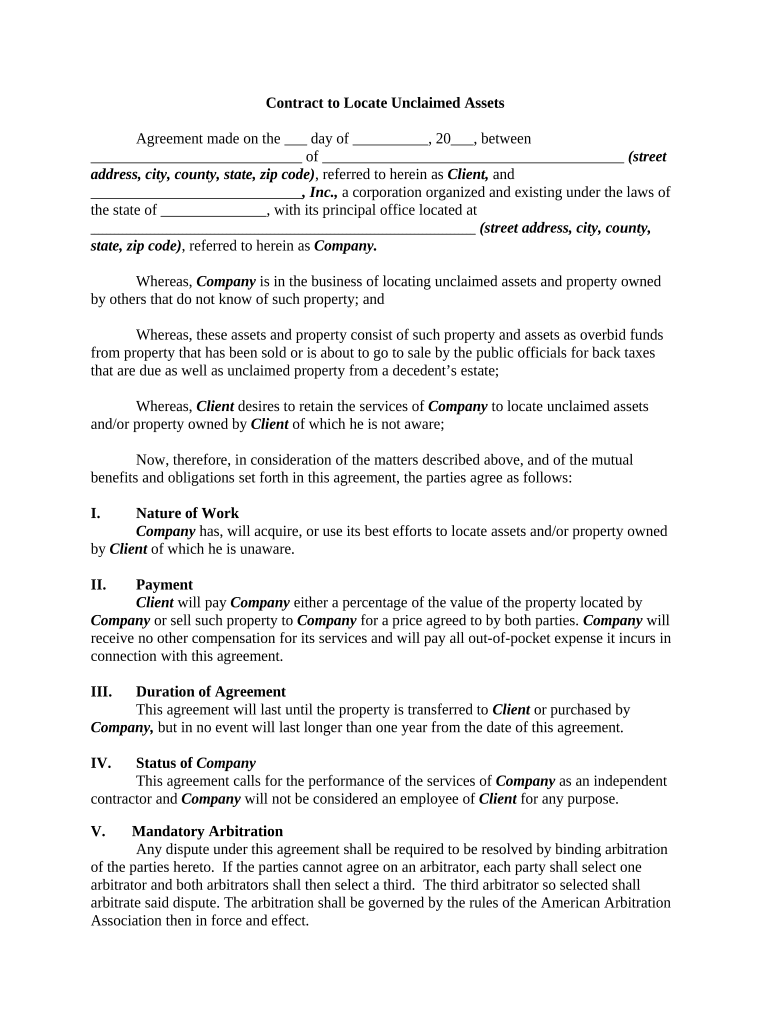
An Unclaimed Property Contract documents the transfer, claim, or custody instructions for property that a holder cannot locate or that a claimant asserts ownership of. Commonly used by companies, custodians, and state unclaimed property programs, the contract records the property description, claimant identity, chain of custody, and any consideration or fees. It clarifies responsibilities for verification, notarization, tax reporting, and record retention, and it provides the written evidence required for submission to state abandoned property administrators or for resolving disputes between holder and claimant.

Why a Clear Contract Matters for Unclaimed Property

A properly drafted Unclaimed Property Contract reduces disputes, documents claimant authorization, and supports compliance with state escheat rules and federal recordkeeping obligations such as ESIGN and UETA. Precision in identity, dates, and signatures helps prevent delays, tax withholding errors, and potential civil penalties.

Why a Clear Contract Matters for Unclaimed Property

Who Typically Prepares or Signs This Contract

Organizations and individuals take different roles in unclaimed property workflows; the contract connects holders, claimants, and regulators.

  • Corporate holders and finance teams responsible for reporting and remitting unclaimed accounts to the state.
  • Third-party administrators and law firms that manage claims, verification, and filings on behalf of holders.
  • Individual claimants, estate representatives, or payees asserting entitlement to the property described in the agreement.

Drafting and signature authority usually rests with a named company officer or authorized agent; claimants must provide ID and any required sworn statements.

Essential Sections to Include in the Contract

A professional Unclaimed Property Contract is concise but complete; include identity, property details, verification steps, and signature attestation to ensure enforceability and smooth processing.

Parties

Full legal names and roles of the holder, claimant, and any agent, plus legal entity type and primary contact information for notice.
Property Description

Precise description of property (account number, last payment date, security type, physical item details) and current location or custody status.

Claimant Authorization

Statement that the claimant affirms ownership, authority to receive funds or property, and consents to any required verifications or background checks.

Representations & Warranties

Mutual statements about accuracy of information, authority to sign, absence of competing claims, and intention to comply with tax withholding obligations.

Consideration & Fees

Any fee arrangement, reimbursement for costs, or allocation of taxes and withholding; specify totals, percentages, or waived-fee conditions.

Governing Law & Signatures

Choice of governing state law, dispute resolution method, signature blocks, and any notarization or witness requirements necessary for filing.

Step-by-Step: Completing the Unclaimed Property Contract

Follow these steps to prepare, verify, and execute the contract accurately for holder, claimant, or state submission.

  • 01
    Prepare document: Populate parties, full property details, and supporting attachments.
  • 02
    Verify identity: Collect government ID, TIN/EIN, or corporate documentation before signature.
  • 03
    Authenticate signing: Use appropriate signer authentication and include notarization if required.
  • 04
    Retain records: Archive executed contract and evidence for the required retention period.

How to Set Up a Digital Signing Workflow

Configure a simple eSignature workflow that captures identity, timestamp, and a tamper-evident audit trail for each contract.

Field Configuration
Upload Template Use PDF or DOCX; lock required fields before sending.
Signature Fields Place signature, date, initials, and checkbox fields for attestations.
Authentication Enable email, SMS code, or ID verification per risk level.
Routing & Retention Set sequential routing and save completed PDF with audit trail.

Typical Execution Flow for an Electronic Contract

An eSigning flow reduces friction while preserving legal evidence; these four actions describe a standard path from preparation to archive.

  • Prepare: Upload document and add required fields.
  • Invite signer: Send secure email link or bulk distribution.
  • Authenticate: Use email, SMS, or stronger KBA as needed.
  • Complete: Signed file and audit trail are generated and stored.

Technical and Integration Considerations

Select a platform that supports secure signatures, tamper-evident PDFs, and integrations with your existing systems.

  • File formats: Supports PDF, DOCX, and HTML inputs.
  • Integrations: Salesforce, NetSuite, Google Workspace, Microsoft 365 supported.
  • Authentication: Email, SMS, KBA, and optional advanced ID checks.

Ensure the chosen solution can produce an audit trail, retain signed copies, and meet any BAA or 21 CFR Part 11 requirements applicable to your industry or state filings.

Common Preparation Errors to Avoid

  • Incomplete claimant identity documentation, such as missing government ID or mismatched name and TIN, which delays verification and may trigger withholding.
  • Vague property description that omits account numbers, dates, or instrument identifiers, leading to disputes about the asset in question.
  • Missing or improper notarization and witness signatures when state rules require them, resulting in claim rejection or additional proofs.
  • Failure to retain or produce an audit trail and executed PDFs, which complicates audits and state inquiries.

Potential Consequences of an Incorrect Contract

Filing Penalties: State fines may apply
Interest Charges: Interest may accrue on owed funds
Criminal Risk: Fraud charges for intentional misrepresentation
Tax Withholding: Backup withholding if TIN missing
Claim Denial: Claim may be rejected by holder/state
Statute Limit: Late claims may be time-barred

Timing Considerations and Typical Deadlines

Timelines vary by holder and state; plan for verification, notarization, and any state-specific submission windows when preparing the contract.

Claim Submission:

Submit per holder or state instructions; some states require annual reporting cycles.

Identity Verification:

Complete ID checks before signing to avoid processing delays.

Notary Completion:

Schedule notarization early; mobile notaries may add travel time.

Tax Reporting:

Allow time to collect TINs to prevent backup withholding complications.

Record Retention:

Archive executed contracts immediately to meet retention requirements.

Key Milestones From Draft to Filing

A sequential timeline helps coordinate parties, notarization, and any state submission or remittance steps.

01

Draft and Review

Prepare contract language and attach evidence of ownership.

02

Identity Verification

Collect IDs, TIN/EIN, and supporting documents.

03

Execution and Notarization

Sign, witness, and notarize if state or holder requires.

04

Submission & Archive

Send to holder or state and store signed copies.

Practical Examples from Organizations Using eSignatures

Organizations across industries use electronic workflows to manage property transfers, claims, and verification steps efficiently.

Martin Properties — Real Estate

Martin Properties moved property-related forms online to avoid in-person signings.

  • They used mobile signing on-site for convenience.
  • "I can process and execute all of these documents online with 100% compliance and built-in security," says Tim Martin, Founder, describing faster turnaround and consistent recordkeeping across transactions.

Fertility Centers of Illinois — Healthcare

A healthcare provider standardized consent and release forms for asset transfers.

  • The team relied on secure workflows and audit trails.
  • John Butler, Founder at Fertility Centers of Illinois, highlights the API and support for compliant record retention and secure sharing of signed documents.

Comparing eSignature Options for Unclaimed Property Workflows

Vendor pricing and core capabilities differ; select a plan that meets volume, compliance, and authentication needs without assuming envelope caps or hidden fees.

signNow DocuSign Adobe Sign PandaDoc HelloSign
Starting Price $8/user/mo $15/user/mo $14/user/mo $19/user/mo $15/user/mo
Free Trial 7-day free trial Varies Varies Varies Varies
Bulk Send Yes Yes Yes Yes No
Audit Trail Yes Yes Yes Yes Yes
HIPAA Compliant Yes Yes Yes No No

FAQs and Troubleshooting for Unclaimed Property Contracts

Answers to common questions about eSigning, notarization, authentication, and recordkeeping for Unclaimed Property Contracts.


Need help? Contact support

be ready to get more
Join over 28 million airSlate SignNow users