Establishing secure connection…Loading editor…Preparing document…

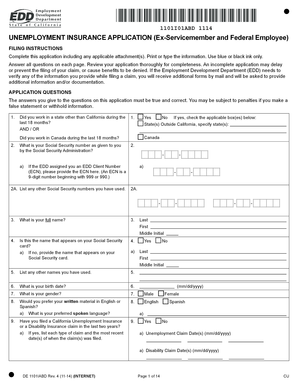
Unemployment Insurance Application for Ex-Servicemembers and Federal Employees

This template is fully customizable. Edit the text, fill out the fields, and send it for signature. Give it a try!
Unemployment Insurance Application for Ex-Servicemembers and Federal Employees

What this unemployment insurance application covers

The Unemployment Insurance Application for Ex-Servicemembers and Federal Employees is a standardized claim and benefit intake form used to request state unemployment benefits after federal or military service separation. It collects employment history, service dates, separation reason, federal employment details, and veteran status to determine eligibility under state unemployment statutes and federal exceptions. Agencies use the form to verify service-related separations, apply any special reemployment protections, and calculate benefit amounts. Applicants should complete it promptly and attach supporting documentation such as separation orders and SF-8 or SF-50 records.

Why accurate completion matters

Provides a consistent record for state agencies to assess eligibility, apply veteran or federal employee exceptions, and document separation causes. Accurate completion reduces processing delays and minimizes documentation requests while preserving reemployment rights where applicable under federal and state law.

Why accurate completion matters

Who typically completes this application

This application is completed by separated servicemembers, federal employees, and their representatives when seeking state unemployment benefits tied to federal service separation.

  • Ex-servicemembers filing after honorable or involuntary separation, providing DD-214 or separation orders as proof.
  • Federal employees separated due to position elimination, furlough, or reduction-in-force, attaching SF-50 or agency notice.
  • Veterans’ service representatives, transition assistance offices, and authorized agents completing on behalf of claimants.

Core elements every professional application should include

A complete application includes claimant identity, employment history, separation documentation, federal employment verification, signature, and consent for electronic processing to support eligibility determinations.

Claimant Identity

Provide full legal name, Social Security number or ITIN, current contact information, and government-issued ID scans. Exact matching with agency records prevents identity verification delays and supports timely benefit evaluation.
Service Records

Attach DD-214 or other military separation documents showing character of service, service dates, and separation reason. These records determine veteran status and may affect eligibility under state or federal reemployment rules.

Federal Employment Proof

Include SF-50, agency separation letters, or payroll documentation showing job title, pay grade, and separation details. Federal employment verification clarifies civilian service duration and informs benefit calculation methods.

Separation Reason

Clearly state the cause of separation—layoff, reduction-in-force, disability retirement, or misconduct. The stated reason directly influences eligibility determinations, administrative waiting periods, and possible employer chargebacks.

Consent & Signature

Provide explicit consent to process records electronically, initial required disclosures where applicable, and sign with date. Electronic signatures that meet ESIGN/UETA standards establish intent and retention requirements for the record.

Supporting Attachments

Include any separation orders, medical retirement paperwork, final pay statements, and correspondence. Clear, labeled attachments reduce queries from adjudicators and significantly shorten average adjudication timelines.

Step-by-step: complete the application

Follow these steps to complete the Unemployment Insurance Application for Ex-Servicemembers and Federal Employees accurately and without common delays.

  • 01
    Gather Documents: Collect DD-214, SF-50, separation letter, recent paystubs, and identification before starting.
  • 02
    Complete Personal Info: Enter legal name, SSN or ITIN, current address, and contact phone or email.
  • 03
    Employment History: List federal and military employers, dates of service, job titles, and separation reasons.
  • 04
    Attach Evidence: Upload separation orders and SF-50 or SF-8 scans; redact unrelated sensitive data.

Where to send the completed application and what follows

Process steps for submission and agency processing from upload through determination, highlighting verification and notification stages for applicants.

  • Upload Document: Use state portal or secure upload to submit completed application and evidence.
  • Acknowledge Receipt: Keep confirmation number or email for tracking and appeals.
  • Identity Verification: Agency may request additional IDs or conduct verification calls.
  • Determination Notice: Receive award, denial, or request for more information with instructions.

Technical and platform considerations for digital submission

Use secure online portals or accepted eSignature platforms to submit forms; ensure authentication and data encryption are enabled.

  • Formats: PDF and DOCX supported.
  • Integrations: Connects with NetSuite and Salesforce.
  • Authentication: SMS code, email link, or KBA.

Timing and deadline considerations for filings and related obligations

Key filing deadlines and timelines for benefits, verifications, and tax reporting that applicants should track when submitting this unemployment claim.

Initial claim filing date requirement:

File as soon as possible after separation to start benefit clock and avoid delays.

Submit required documents within 30 days:

States often request supporting evidence within 30 days; respond promptly to avoid denial.

Appeal deadline and instructions vary by state:

Appeals timelines differ; submit appeal notices within state-specified period, often ten to thirty days.

Tax reporting obligations and 1099 issuance:

Unemployment benefits may be taxable; states or payers issue Form 1099-G for benefits paid.

Claimant record retention and recommended duration:

Keep copies of filed forms and evidence at least three years; longer retention may be advisable.

Penalties and common risks to avoid

Delayed Benefits: Processing delays and lost income.
Documentation Rejection: Missing ID or DD-214 causes rejection.
Tax Withholding: Incorrect SSN triggers backup withholding.
Appeal Risk: Late filings reduce chances of reversal.
Fraud Investigations: False statements may lead to penalties.
Employer Charges: Benefit charges may affect agency records.

Security and compliance details for electronic submissions

Encryption in Transit: TLS 1.2/1.3 protects data transmission.
Encryption at Rest: AES-256 encrypts stored records.
HIPAA Compliance: BAA required for protected health data.
ESIGN & UETA: E-signatures comply with ESIGN and UETA.
Audit Trail: Detailed logs include timestamps and IPs.
Access Controls: Role-based permissions and multi-factor options.

Representative examples of completed claims

Real-world examples show how veterans and federal employees complete claims and how agencies process them with digital records and secure authentication.

Veteran Claim Filed Online

An Army veteran completed the unemployment application online immediately after receiving DD-214 following an involuntary separation.

  • Uploaded DD-214 and SF-50 to verify service.
  • State agency used the attached records to confirm eligibility within two weeks, issued interim benefits, and provided reemployment resources. Accurate uploads reduced correspondence and shortened adjudication compared with manual mail submissions.

Federal Employee Claim

A displaced federal employee filed the form, attaching SF-50 and agency separation notice to document position elimination and eligibility.

  • Received interim benefits pending final verification.
  • The agency cross-checked the SF-50 with payroll records, resolved a name discrepancy, and finalized benefit payments within four weeks. The claimant retained digital receipts for tax reporting and potential appeals.

eSignature pricing and feature comparison relevant to this application

Comparison of starting prices and core features across eSignature vendors relevant to filing and signing this unemployment application.

signNow DocuSign Adobe Sign PandaDoc HelloSign
Starting Price $8/user/mo $15/user/mo $14/user/mo $19/user/mo $15/user/mo
Free Trial 7-day free trial Trial available Trial available Trial available Trial available
Bulk Send Yes Yes Yes Yes No
Audit Trail Yes Yes Yes Yes Yes
HIPAA Compliant Yes Yes Yes No No
Envelope Cap No cap 100 envelopes/user/year Plan-dependent Plan-dependent Plan-dependent

Frequently asked questions about filing and e-submission

Answers to frequent issues and clarifications about completing, submitting, and validating the Unemployment Insurance Application for Ex-Servicemembers and Federal Employees.


Need help? Contact support

be ready to get more
Join over 28 million airSlate SignNow users