Establishing secure connection…Loading editor…Preparing document…

Letter Requesting Approval of Final Judgment in Unlawful Entry and Detainer

This template is fully customizable. Edit the text, fill out the fields, and send it for signature. Give it a try!
Letter Requesting Approval of Final Judgment in Unlawful Entry and Detainer

What this letter is and when it’s used

A Letter Requesting Approval of Final Judgment in Unlawful Entry and Detainer is a formal court-facing letter filed or submitted after an unlawful entry and detainer action (commonly called an eviction). The letter asks the court clerk or judge to enter or approve the final judgment terms, confirm the judgment amount or possession order, and permit downstream enforcement such as issuance of a writ of possession or execution on monetary judgment. Depending on jurisdiction this document may accompany an affidavit of service, proposed judgment form, or settlement memorandum and must track the case caption and docket identifiers precisely.

Why a clear approval request matters

A concise, correctly framed letter creates an official record, speeds clerk review, and reduces the chance of procedural rejection. It clarifies the relief sought and the legal basis for judgment approval, facilitating timely enforcement.

Why a clear approval request matters

Core parts of an effective approval letter

A professional letter follows a predictable structure so court staff and judges can verify the request quickly and apply the correct docket entry.

Case Caption

Include court name, county, case number, and party names as they appear on pleadings to ensure correct docket placement and record matching.
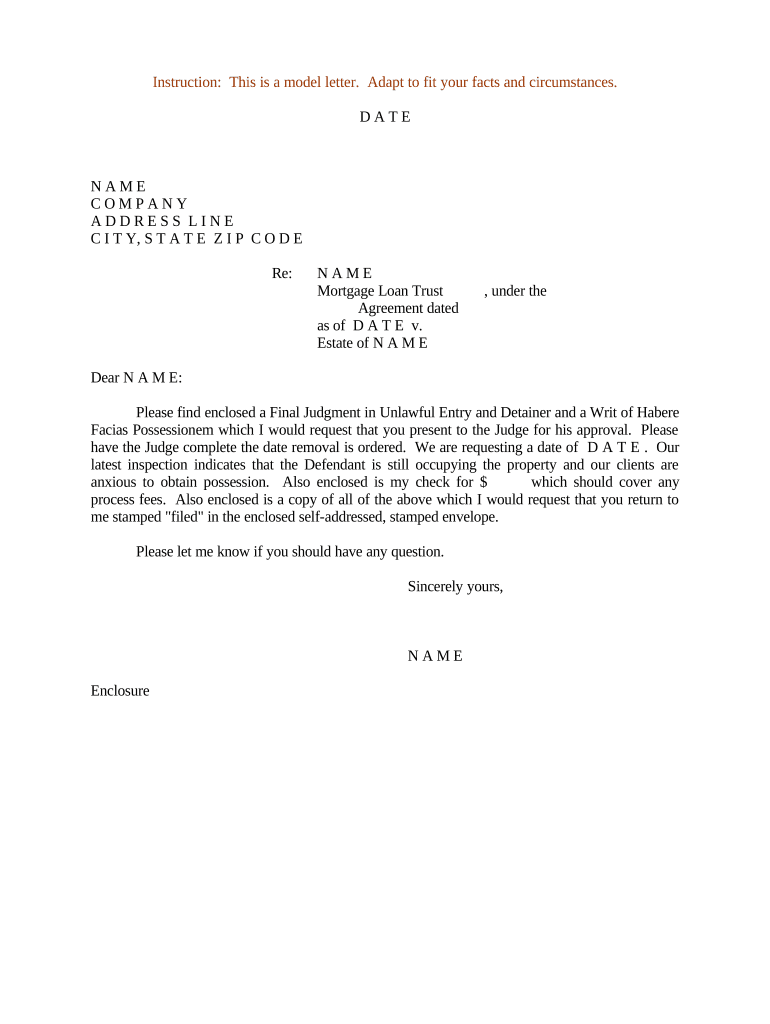
Statement of Relief

State precisely what you request—entry of final judgment, amount due, writ of possession, or stay—and cite the judgment or agreement supporting the request.

Procedural Basis

Reference the controlling pleadings, hearing date, default or settlement status, and any local rule or code section authorizing final judgment entry.

Supporting Attachments

List and attach copies of the proposed judgment, affidavit of service, proof of notice, hearing minutes, and any consent or settlement documents.

Signature Block

Provide counsel or party name, bar number if applicable, mailing address, telephone, email, and a handwritten or electronic signature with date.

Certificate of Service

Confirm how and when other parties were served with the request, specifying method, date, and recipient to satisfy service rules.

Step-by-step: preparing and submitting the letter

Follow these steps in sequence to minimize clerical delays and ensure enforceability.

  • 01
    Assemble documents: Gather judgment, affidavits, proposed order.
  • 02
    Draft letter: State case caption, relief requested, and attachments.
  • 03
    Sign and date: Include counsel or party signature and contact information.
  • 04
    File or submit: File with clerk or submit per local e-filing rules.

Configuring an online version for e-submission

When completing and sending electronically, set up fields and authentication to match court and evidentiary needs.

Field Configuration
Signature Method E-signature with audit trail or scanned wet signature as required by court
Authentication Email link or two-factor for attorney signers; stronger ID for notarized exhibits
Attachments Attach PDF proposed judgment, affidavits, proof of service
Notifications Enable recipient and sender email confirmations and receipt logs

Where the letter goes and who acts on it

Understand routing so you can predict processing steps and approximate timing.

  • File with Clerk: Submit letter and attachments to the court clerk for docketing.
  • Clerk Review: Clerk confirms completeness and assigns judge or calendared action.
  • Judge Action: Judge signs, denies, or sets a hearing for the proposed judgment.
  • Enforcement: Clerk issues writs or judgment entries for enforcement once approved.

Common eSignature pricing and feature comparison

Annual pricing and features vary by plan; signNow is listed first for direct comparison against other widely used vendors.

signNow DocuSign Adobe Sign PandaDoc HelloSign
Starting Price $8/user/mo $15/user/mo $14/user/mo $19/user/mo $15/user/mo
Free Trial 7-day free trial Trial available Trial available Trial available Trial available
Bulk Send Yes Yes Yes Yes Yes
Audit Trail Yes Yes Yes Yes Yes
HIPAA Compliant Yes Yes Yes No No

Who commonly prepares and files this letter

Different parties may prepare and submit the approval request depending on representation and case posture.

  • Landlords and property owners preparing enforcement paperwork or confirming settlement terms.
  • Attorneys or legal clinics drafting the request and ensuring compliance with local rules.
  • Property managers or authorized agents who handle filings and coordinate service and enforcement.

Choose the preparer aligned with the case status—self-represented parties should follow local clerk guidance; counsel should confirm procedural requirements.

Real-world examples of usage

These short examples show how organizations used a structured approval letter to complete eviction-related enforcement efficiently.

Optica Ventures LLC

A private landlord executed settlement terms and submitted a concise approval letter

  • The clerk entered judgment without a hearing
  • The firm emphasized accurate case numbers and attached the proposed judgment, which reduced processing time and enabled prompt writ issuance.

Martin Properties

A property manager used an approval letter after default judgment

  • Staff included affidavit of service and rent ledger
  • The clear relief request and complete attachments allowed the clerk to docket the final judgment and trigger standard enforcement steps quickly.

Practical tips for accurate completion

Follow these practices to avoid clerical returns and enforcement delays.

Match all identifiers exactly
Ensure names, case numbers, and court identifiers match pleadings and the proposed judgment exactly; clerks often reject inconsistencies and return filings for correction.
Attach clear supporting proof
Include affidavit of service, judgment form, rent ledger, or settlement agreement; missing supporting documents commonly delay approval or require supplemental filings.
Use the court’s preferred format
Check local civil or county rules for required header wording, signature format, or specific proposed judgment templates to ensure compliance with clerk expectations.
Preserve delivery records
Keep electronic receipts, certified mail tracking, or server logs for any e-service; proof of notice is often required before enforcement instruments are issued.

Common preparation errors to avoid

  • Omitting docket number or using a prior-case number, which causes misfiling and administrative delay.
  • Failing to attach the proposed judgment or affidavit of service, prompting clerk return or request for supplemental documents.
  • Using ambiguous relief language like 'enter appropriate judgment' instead of specifying amounts or possession details.
  • Relying on unsigned or undated signature blocks that the clerk will not accept as valid filing.

Risks of incorrect or incomplete letters

Filing Rejection: Court may refuse docketing
Enforcement Delay: Writs or execution postponed
Additional Costs: Extra filing or attorney fees
Service Challenges: Improper notice risks nullified relief
Appeal Exposure: Procedural defects may be grounds for appeal
Record Gaps: Incomplete evidence weakens enforcement

Essential information to include on the letter

Case Number: Exact docket identifier
Court Name: Full court caption
Plaintiff: Full legal name
Defendant: Full legal name
Judgment Date: Date judgment was entered
Requested Relief: Clear remedy requested

Technical considerations for electronic submission

Ensure your e-submission method meets court rules for format, signatures, and evidence preservation.

  • File Formats: PDF/A preferred
  • Integrations: Works with NetSuite, Salesforce
  • Authentication: Email link or two-factor

Confirm the receiving court’s e-filing portal accepts your chosen file types and that audit trails or notarizations meet any local evidentiary standards.

Frequently asked questions and practical answers

Answers to common procedural and technical questions when preparing a final-judgment approval request.


Need help? Contact support

be ready to get more
Join over 28 million airSlate SignNow users