Establishing secure connection…Loading editor…Preparing document…

Utah Release of Lien

This template is fully customizable. Edit the text, fill out the fields, and send it for signature. Give it a try!
Utah Release of Lien

What a Utah Release of Lien Is and when it’s used

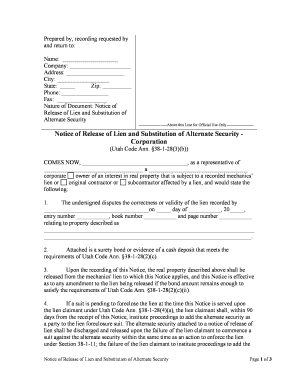
A Utah Release of Lien is a recordable instrument used to remove or discharge a previously recorded lien against real or personal property in Utah, including mechanic’s liens, UCC-1 financing statement terminations, and satisfaction of judgment. The document identifies the original lien instrument, parties, property description, and a clear declaration that the lien has been satisfied or released. Once properly executed and accepted by the county recorder or filing office, the release clears the public record so title, financing, or sale transactions can proceed without the encumbrance.

Why a timely Release of Lien matters

A properly executed release restores clear title, removes encumbrances that block sales or refinances, and documents satisfaction of obligations for all parties involved.

Why a timely Release of Lien matters

Typical parties who prepare or request a release

Common users who prepare or request a Utah Release of Lien include the following.

  • Property owners and sellers — to clear title before sale or refinance and avoid closing delays.
  • Lenders and secured creditors — to document payoff and remove security interests from public records.
  • Contractors, subcontractors, and suppliers — to withdraw mechanic’s liens after payment or settlement is received.

Essential parts of a professional Utah Release of Lien

A complete release includes identification of the lien, precise release language, recording references, signatures, and any exhibits necessary to link the release to the original instrument.

Lien Identification

Reference the original lien instrument by recording book/page or instrument number and recording county to ensure the recorder links the release to the correct record.
Parties Named

List the lienholder (releasor) and the party whose interest is released (owner/debtor) using the exact legal names appearing on the original lien document.

Property Description

Include the same legal property description used in the original lien or the UCC collateral description to avoid ambiguity at recording.

Release Statement

Use clear language such as 'The undersigned hereby releases and cancels the lien recorded on [date] as instrument no. [#] and acknowledges that such lien is fully satisfied.'

Signatures & Notary

Provide the lienholder’s signature block and notary acknowledgment or jurat as required by the recorder; include printed names and dates for each signer.

Exhibits and Attachments

Attach copies or references to the original lien instrument, payoff statements, or releases of judgment for documentary linkage and to expedite processing.

Step-by-step: completing and recording a Utah Release of Lien

Use this ordered checklist to prepare, execute, and file a release correctly.

  • 01
    Identify Lien: Locate the recorded instrument and capture its recording details.
  • 02
    Confirm Payoff: Obtain written confirmation or payoff receipt from the lienholder.
  • 03
    Complete Form: Fill each field exactly and attach supporting documents.
  • 04
    Record & Distribute: Notarize if required, record with county recorder, and send copies to interested parties.

Common online workflow settings for eSigning and recording

Configure your digital workflow to match the execution and recording steps used by Utah county recorders.

Field Configuration
Authentication Method Email | SMS two-factor
Signature Order Lienholder first | Owner second
Document Format PDF/A | Flattened for recording
Retention Setting 7 years | Audit trail preserved

Digital execution and recording — typical flow

A concise flow shows how a release moves from draft to recorded instrument.

  • Upload Draft: Prepare the PDF and attach original lien reference.
  • Place Fields: Add signature, date, and notary blocks where required.
  • Invite Signers: Send secure signing links with required authentication.
  • Record File: Submit the notarized or certified PDF to the county recorder.

Technical capabilities to support eSigning and recording

Ensure your chosen platform exports recorder‑acceptable PDFs, preserves an audit trail, and supports required notary workflows.

  • PDF Compatibility: Export as PDF/A
  • Audit Trail: Timestamped, IP-addressed logs
  • Notary / RON Support: Audio-video and credentialing

Security and compliance features relevant to lien releases

Encryption in transit: TLS 1.2/1.3
Encryption at rest: AES-256
Regulatory standards: SOC 2 Type II
Healthcare readiness: HIPAA (BAA required)
eSignature law: ESIGN and UETA compliant
FDA / Records: 21 CFR Part 11 supported

Practical tips for accurate, efficient lien release processing

Follow these trusted practices to minimize rejections and downstream disputes when preparing a Utah Release of Lien.

Verify recorded references
Double-check instrument numbers, recording county, and original recording dates to ensure the release matches the existing record and will be accepted by the recorder.
Confirm signer authority
If an entity signs, include the signer’s title and evidence of corporate authority; mismatches may require corrective affidavits or re-execution.
Use notarization or RON correctly
Follow county notary acknowledgment formats; if using RON, confirm the county and state permit electronic acknowledgements for recordation.
Preserve audit evidence
Keep executed copies, audit trails, and any payoff or settlement documentation to prove satisfaction if title questions arise later.

Common preparation errors that cause recording delays

  • Referencing the wrong instrument number or county prevents matching to the original lien and causes rejection.
  • Using an informal or vague release statement that does not expressly cancel the recorded lien invites follow‑up questions.
  • Mismatched signer names or unsigned notary blocks lead county clerks to refuse filing or request corrected instruments.
  • Failing to attach necessary payoff or judgment satisfaction documentation slows title company and lender approvals.

Risks and consequences of an incorrect or missing release

Title Issues: Delays or denials of sale/closing
Financing Delays: Refinance may be blocked
Liability Exposure: Potential claims for wrongful release
Recording Rejection: County may refuse to record
Tax Impacts: Unclear records complicate tax reporting
Fraud Allegations: Improper signatures may prompt investigation

Realistic scenarios where a release is required

Two typical examples illustrate how releases clear title and resolve encumbrances in practice.

Commercial Sale

A buyer requires clear title before closing; seller obtains a lien release from the lienholder referencing the recorded instrument

  • release is notarized and recorded
  • after filing the title company issues a clean title report and closing proceeds on schedule.

Contractor Payment

A subcontractor receives final payment and provides an unconditional release tied to the project lien instrument

  • the general contractor records the release
  • the owner confirms removal of encumbrance and issues final payment.

Expected timing and processing stages

Timing from execution to public recording depends on notarization, county processing, and whether eRecording is used.

Execution Date:

Date the release is signed and notarized by the releasor.

Submission to Recorder:

File or eRecord with the county recorder; procedures vary locally.

Recording Processing:

County processing time varies; confirm local turnaround expectations.

Confirmation:

Obtain stamped instrument or recording receipt for title records.

Distribution:

Provide recorded copies to owner, lender, and title agent promptly.

Typical eSignature plan comparison for completing and sharing releases

Platform pricing and feature availability vary; signNow is shown first for easier vendor comparison across common capabilities.

signNow DocuSign Adobe Sign PandaDoc HelloSign
Starting Price $8/user/mo $15/user/mo $14/user/mo $19/user/mo $15/user/mo
Free Trial 7-day free trial Varies by vendor Varies by vendor Varies by vendor Varies by vendor
Bulk Send Yes Yes Yes Yes No
Audit Trail Yes Yes Yes Yes Yes
HIPAA Compliant Yes Yes Yes No No
Envelope Cap No envelope cap 100 envelopes/user/year Varies Varies Varies

Frequently asked questions about Utah Release of Lien execution and recording

Answers to common issues that arise during preparation, eSigning, notarization, and county recording.


Need help? Contact support

be ready to get more
Join over 28 million airSlate SignNow users