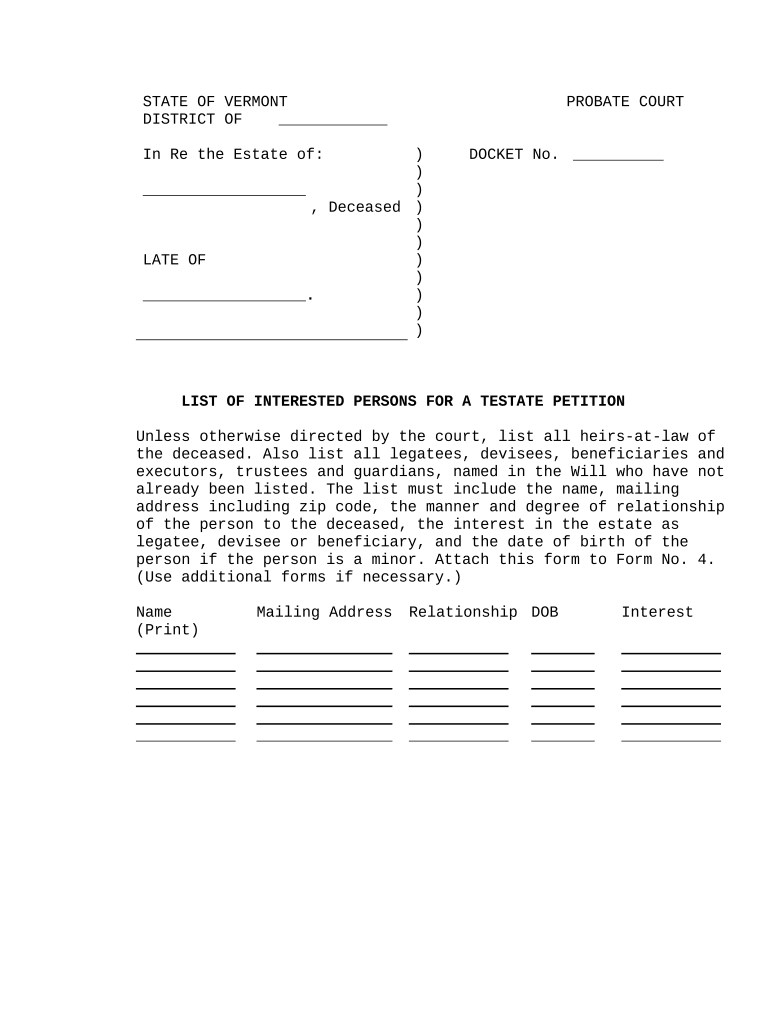
Vermont List of Interested Persons for Testate Petition
What the Vermont List of Interested Persons for Testate Petition is
Why a clear list of interested persons matters in probate
A complete and accurate list ensures statutory notice requirements are met, reduces the risk of delayed probate or objections, and helps the court and executor communicate with affected parties efficiently.
Who typically prepares and relies on this list
Executors, probate attorneys, and personal representatives usually prepare the list before filing a testate petition.
- Family members and beneficiaries who must be notified and may contest probate
- Probate attorneys responsible for ensuring legal notice and reducing exposure to later claims
- Court clerks and judges who use the list to authorize service and set hearings
Accurate preparation accelerates court processing and reduces the likelihood of contested notices or supplemental filings.
Step-by-step: assembling the list before filing
-
01Gather documents: Collect the will, codicils, and beneficiary designations.
-
02Identify parties: List heirs, beneficiaries, creditors, and known claimants.
-
03Verify contact details: Confirm current addresses and counsel information.
-
04Format and attach: Attach the list to the petition using the court’s preferred layout.
Set up your digital workflow for completing the list
| Field | Configuration |
|---|---|
| Document template | Use a court-compliant template to ensure required fields are present |
| Data collection | Collect names/addresses in a spreadsheet for import |
| Signature routing | Define who signs and the signing order for the petition and attachments |
| Audit trail | Enable logging of edits, uploads, and signature events for court records |
Typical routing and processing flow
-
Prepare list: Compile names, addresses, and representative contacts.
-
Attach to petition: Include the list as an exhibit to the probate petition.
-
File with court: Submit petition and list to the probate court clerk.
-
Serve interested persons: Provide notice per Vermont probate rules to all listed parties.
Digital tools and platform considerations
Use a platform that supports templates, audit trails, and secure delivery when preparing digital lists.
- File formats: PDF and DOCX are commonly accepted; confirm court preferences.
- Integrations: Connectors to case management, email, and cloud storage improve accuracy.
- Authentication: Strong signer authentication reduces risk of disputed attribution.
Keep export copies and an immutable audit trail to demonstrate who received notice and when.
Timing and typical probate milestones to expect
Petition filing:
File as soon as practicable after decedent’s death to start probate
Notice to interested parties:
Serve listed parties according to court-specified notice periods
Inventory and accounting:
Submit inventories per court schedule; timing varies by estate size
Objection window:
Courts set deadlines for contests after notice is served
Final distribution:
Distribution follows resolution of claims and court approval
Key processing stages from filing to distribution
File petition
Initiates the probate case and attaches the interested persons list
Service and notice
Court-directed notice is sent to every listed party
Claims and objections
Parties may file claims or contest the petition within set windows
Hearings and decree
Court resolves disputes and issues orders for distribution
Risks of an incomplete or inaccurate list
Common preparation errors to avoid
- Omitting current addresses for beneficiaries, which can require additional service and court filings and delay distribution.
- Listing incomplete or informal names (nicknames) that hinder proper service or make identity verification difficult.
- Failing to note representatives or counsel, which prevents efficient routing of legal notices and duplicate communications.
- Using inconsistent formats across filings, making it harder for court clerks to accept or process the petition quickly.
Comparison: eSignature pricing and core features
| signNow | DocuSign | Adobe Sign | PandaDoc | HelloSign | |
|---|---|---|---|---|---|
| Starting Price | $8/user/mo | $15/user/mo | $14/user/mo | $19/user/mo | $15/user/mo |
| Free Trial | 7-day free trial | Varies | Varies | Varies | Varies |
| Bulk Send | Yes | Yes | Yes | Yes | No |
| Audit Trail | Yes | Yes | Yes | Yes | Yes |
| HIPAA Compliant | Yes | Yes | Yes | No | No |
How organizations use electronic lists in practice
Optica Ventures (Brian Fitzgibbons)
The interface is simple and easy-to-use for our team; more importantly, it is just as easy for our customers.
- Process integration reduced turnaround time for estate notices by removing manual mail steps.
- The result was fewer service errors and clearer audit trails that simplified court clerk review and reduced re-notice requests.
Martin Properties (Tim Martin)
I can process and execute all of these documents online with 100% compliance and built-in security.
- Mobile signing eliminated in-person coordination for out-of-state heirs.
- This reduced delays and improved the executor’s ability to meet court scheduling and serve interested persons promptly.
Frequently asked questions about the list and filing
-
Can I e-sign the list?
In many cases yes, but wills and related testamentary documents can be exceptions to electronic signature rules. Verify that the petition and attachments meet Vermont probate procedures and any statutory exceptions to ESIGN or UETA before relying on electronic signatures.
-
What if an address is unknown?
Document your due diligence efforts and notify the court. Courts typically accept alternative service methods if good-faith attempts to locate an interested person are documented.
-
Do I need a notary for each signature?
Notarization requirements depend on the document and local court rules. Some filings require notarized affidavits or acknowledgements — confirm requirements with the probate clerk.
-
How do I prove service to the court?
Keep copies of mailed notices, delivery receipts, return receipts, or electronic delivery confirmations and include proof of service when filing case updates or final distributions.
-
When should I update the list?
Update the list before filing and supplement it if new interested parties are discovered; provide amended lists to the court per its procedures to maintain compliance.
-
How long must I keep these records?
Retain filed petitions, lists, proof of service, and audit trails for the life of the probate matter plus the applicable post-closure retention period; consult federal and state rules for specific retention periods.