Establishing secure connection…Loading editor…Preparing document…

Virginia Easement Rights

This template is fully customizable. Edit the text, fill out the fields, and send it for signature. Give it a try!
Virginia Easement Rights

What Virginia Easement Rights Cover

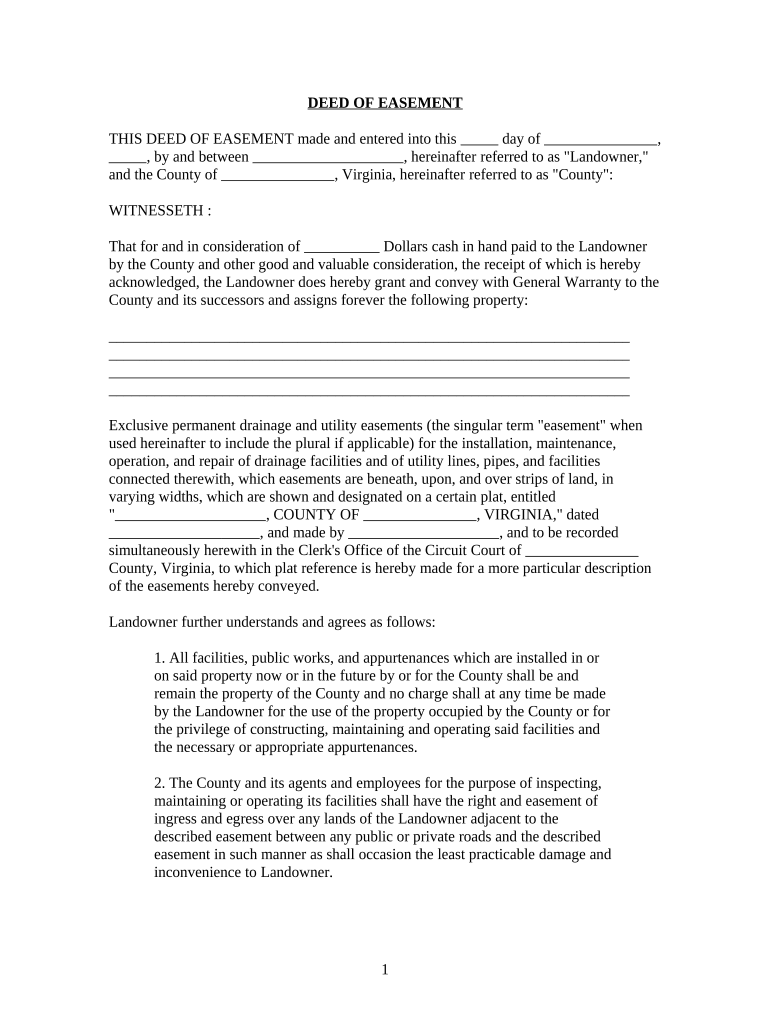
Virginia Easement Rights are legal instruments that establish a nonpossessory interest in land allowing one party limited use or access across another party's property. They typically identify the dominant and servient estates, state the easement's purpose and scope, specify duration or conditions, and record maintenance and liability responsibilities. In Virginia, easements can be created by express grant, reservation, implication, necessity, prescription, or by agreement and are commonly recorded in the county land records to provide constructive notice and bind subsequent owners. Proper drafting and recording protect title and reduce future disputes.

Why a Clear Easement Document Matters

A precise easement instrument defines permitted uses, allocates maintenance responsibility, preserves property value through public notice, and reduces litigation risk. Clear terms enable financing and development and help title companies underwrite transactions with confidence.

Why a Clear Easement Document Matters

Typical Parties Involved

Common users include property owners, developers, local governments, and professionals who handle land rights and access agreements.

  • Property owners and buyers executing or accepting access rights and documenting servitude obligations.
  • Developers and contractors securing temporary or permanent construction easements and work corridors.
  • Utilities, municipalities, and transportation agencies acquiring rights-of-way and maintenance access for infrastructure.

Who Signs and Why

Property Owner

Typically the fee simple owner who conveys or reserves the easement. Responsible for supplying an accurate legal description, consenting to recorded terms, and disclosing obligations that may affect title or future conveyances.

Easement Holder

The party receiving use rights — utilities, neighbors, or government entities. Must confirm grant language, scope, duration, and enforcement rights to ensure the easement meets operational needs and is assignable if required.

Elements of a Complete Virginia Easement Instrument

A professional Virginia Easement Rights document clearly allocates use, maintenance, liability, duration, access limits, and recording directions to reduce ambiguity and protect title.

Legal Description

Provide a metes-and-bounds description, parcel ID, or recorded-plat reference. Precise location language is essential to avoid boundary disputes and ensure correct recording.
Grant Language

Use explicit grant or reservation language stating the easement type, rights conveyed, limitations, and whether it is appurtenant or in gross to avoid misinterpretation.

Scope and Purpose

Define permitted uses, access points, vehicle or equipment restrictions, and any prohibited activities to limit future disagreements about allowed conduct.

Duration and Transfer

State whether the easement is perpetual, term-limited, or conditional; address assignment, release, and whether it runs with the land.

Maintenance and Liability

Allocate maintenance duties, cost-sharing, indemnity, and insurance obligations so parties understand ongoing responsibilities and risk allocation.

Recording & Maps

Specify recording instructions, attach a stamped plat or sketch, and reference book/page or instrument numbers for accurate public indexing.

Step-by-Step: Prepare, Sign, and Record

Follow these steps to prepare, execute, and record a Virginia easement instrument to ensure enforceability and proper public notice.

  • 01
    Gather documents: Title report, deed, survey, and parcel identifiers.
  • 02
    Draft easement: Use clear grant/reservation and scope language.
  • 03
    Execute and notarize: All parties sign before a notary or via RON where permitted.
  • 04
    Record instrument: File with county land records and obtain the recorded copy.

Configure an Online Signing Workflow

Customize online signing workflows to collect authorizations, apply authentication, and produce a recorded-ready PDF suitable for the county clerk.

Field Configuration
Field Placement Place signature, date, and initials fields at required locations.
Conditional Fields Show maintenance or insurance fields only when applicable.
Signer Authentication Require email, SMS code, or ID verification.
Template Saving Save as a reusable template for similar parcels or projects.

Document Flow from Draft to Public Record

This high-level flow shows how an easement instrument moves from draft to a recorded public record and how parties interact at each stage.

  • Prepare Document: Draft grant, attach survey, and assemble exhibits.
  • Assign Signers: List grantor and grantee with contact details.
  • Authenticate Signatures: Use ID check, SMS, or RON when required.
  • Record & Notify: File with county clerk and distribute stamped copies.

Technical and Platform Considerations for Electronic Execution

For electronic execution, confirm the platform supports required file formats, identity verification options, and provides an auditable certificate of completion.

  • File Formats: PDF and Word DOCX supported.
  • ID Verification: Email, SMS, KBA, or credential analysis.
  • Integrations: CRM, title services, and cloud storage connectors.

Timing and Typical Processing Expectations

Timing for recording and related tasks affects priority, notice, and potential prescriptive claims; plan each step to align with county processing schedules.

Record Promptly After Signing:

Record immediately to provide constructive notice to third parties.

County Clerk Processing Time:

Processing times vary; expect 1–14 business days typically.

Attach Required Exhibits:

Include any stamped survey or plat before filing.

Tax and Assessment Effects:

Recording may trigger reassessment or updated tax records.

Address Prescriptive Use Early:

Investigate continuous use claims with counsel promptly.

Common Risks and Consequences

Unrecorded Easement: May fail to bind future purchasers.
Imprecise Description: Leads to boundary disputes.
Wrong Grantee Name: Can invalidate or cloud title.
Missing Notarization: Recording rejection or later challenge.
Improper Authority: Unauthorized signatory voids the grant.
Zoning or Permit Conflicts: Local restrictions may limit intended uses.

Essential Information to Include

Grantor Name: Full name as recorded on title.
Grantee Name: Legal entity or individual name.
Parcel ID: County parcel identification number.
Legal Description: Metes-and-bounds from deed or plat.
Purpose: Express use and limitations described.
Signature Date: Enter as MM/DD/YYYY for recording.

Practical Tips for Accurate, Efficient Easement Preparation

Adopt these practices to minimize defects, speed recording, and reduce future disputes over access or maintenance obligations.

Use a current stamped survey
Attach a recent survey stamped by a licensed surveyor showing the easement corridor, monuments, and bearings. Surveys resolve description ambiguities and are often required by title underwriters.
Describe the easement scope precisely
Avoid vague phrases; state allowed activities, equipment limits, vehicle restrictions, and whether assignment is permitted. Precision reduces litigation and protects both parties' expectations.
Record promptly and verify indexing
File the executed instrument immediately and confirm the recorder indexed it under grantor, grantee, and parcel ID to ensure constructive notice and lender visibility.
Coordinate with title and lenders early
Obtain title company and lender requirements before execution. Lender consent or subordination clauses may be necessary to prevent closing delays or title exceptions.

How Electronic Workflows Help in Practice

Real-world examples show how electronic workflows and clear easement drafting reduce cycle times and title issues in property transactions.

Tim Martin, Martin Properties

A mid-sized property firm used remote electronic execution to finalize access agreements and easement grants across multiple counties.

  • Reduced turnaround time and removed travel delays.
  • I can process and execute all of these documents online with 100% compliance and built-in security. Whether on mobile or working offline, I can get forms back to their necessary parties efficiently.

Brian Fitzgibbons, Optica Ventures LLC

An investment firm standardized easement templates to simplify title commitments and coordination with surveyors during acquisitions.

  • Templates shortened attorney review cycles significantly.
  • The interface is simple and easy-to-use for our team; more importantly, it is just as easy for our customers.

eSignature Plan Comparison for Recorded Documents

Compare common eSignature plan attributes relevant to executing notarization-ready easements; signNow appears first for vendor parity in the table below.

signNow DocuSign Adobe Sign PandaDoc HelloSign
Starting Price $8/user/mo $15/user/mo $14/user/mo $19/user/mo $15/user/mo
Free Trial 7-day trial, no CC Varies by plan Varies by plan Varies by plan Varies by plan
Bulk Send Yes Yes Yes Yes No
Audit Trail Yes Yes Yes Yes Yes
HIPAA Compliant Yes Yes Yes No No
Envelope Cap No envelope cap 100 envelopes/user/year Varies by plan Varies by plan Varies by plan

Frequently Asked Questions

Answers to common questions about creating, signing, recording, and disputing Virginia easements, including electronic and notarization concerns.


Need help? Contact support

be ready to get more
Join over 28 million airSlate SignNow users