Establishing secure connection…Loading editor…Preparing document…

Voting Agreement

This template is fully customizable. Edit the text, fill out the fields, and send it for signature. Give it a try!
Voting Agreement

What a Voting Agreement Is and When It's Used

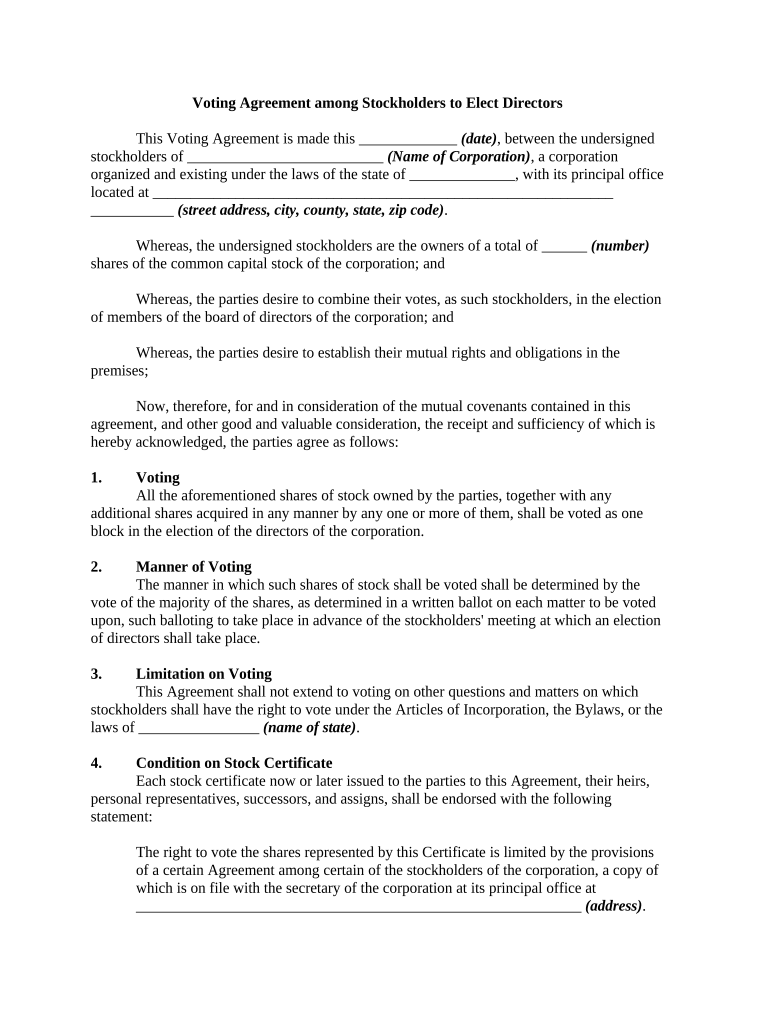
A Voting Agreement is a legally binding contract among shareholders, members, or stakeholders that allocates voting rights, sets voting procedures, and records commitments about how votes will be cast or proxies exercised. It commonly appears in shareholder governance, investor protections, joint ventures, and close corporation contexts. The agreement can define quorums, supermajority thresholds, proxy mechanics, transfer restrictions tied to voting, deadlock procedures, and amendment rules. Voting Agreements may be executed in writing or electronically where permitted by federal and state e‑signature law, so parties should confirm execution and retention requirements before signing.

Why a Voting Agreement Matters for Governance

A Voting Agreement clarifies control, reduces disputes, and protects minority or investor rights by fixing voting behavior and enforcement remedies. It provides predictability for corporate decisions and can prevent unexpected shifts in control during transfers or board elections.

Why a Voting Agreement Matters for Governance

Who Typically Prepares and Signs a Voting Agreement

Common participants include equity holders, company officers, investors, and in-house or external counsel; each has a defined role during negotiation and execution.

  • Founders and Shareholders — Founders use voting agreements to preserve strategic control and set rules for future transfers and board votes.
  • Investors and Venture Firms — Investors require voting commitments to protect governance rights, board composition, and exit safeguards.
  • Company Secretaries and Counsel — Corporate secretaries or counsel administer execution, confirm quorum rules, and ensure compliance with corporate bylaws.

Parties should coordinate with corporate records and the company’s bylaws to ensure consistency and enforceability across governance documents.

Core Elements Found in a Professional Voting Agreement

A robust Voting Agreement clearly allocates votes, defines procedures for proxies and meetings, and includes dispute resolution and amendment mechanisms tailored to the entity's governance needs.

Voting Allocation

Specifies how votes attach to shares or units, including class distinctions and any special voting rights or limitations applicable to particular securities.
Quorum & Thresholds

Defines quorum rules and voting thresholds for ordinary and extraordinary matters, such as simple majority, supermajority, or unanimous consent requirements.

Proxy Mechanics

Describes when proxies may be granted, how revocation works, permitted proxy forms, and whether proxies survive certain transfers or death.

Transfer Restrictions

Links voting obligations to transfer controls like rights of first refusal, buy‑sell provisions, or restraints preventing circumvention of voting commitments.

Deadlock Resolution

Includes tie‑breaking mechanisms such as independent director appointment, arbitration, buyout formulas, or escalation protocols to resolve stalemates.

Amendment & Term

Specifies procedures for amendment, required approvals to change voting terms, and the agreement’s effective and termination dates.

Stepwise Process to Complete and Execute a Voting Agreement

Follow these sequential steps to prepare, approve, and sign the Voting Agreement so it aligns with corporate records and legal requirements.

  • 01
    Draft Agreement: Prepare terms and align with bylaws.
  • 02
    Review with Counsel: Have counsel confirm enforceability.
  • 03
    Obtain Board/Shareholder Approvals: Follow internal approval processes.
  • 04
    Execute and File: Sign, date, and store originals.

Typical Electronic Execution Workflow for a Voting Agreement

Electronic execution follows a predictable flow; each step captures evidence needed to establish intent, attribution, and retention under U.S. e‑signature law.

  • Upload Document: Sender uploads final Voting Agreement PDF or DOCX.
  • Place Signature Fields: Add signature, date, and initial fields where required.
  • Add Signers: Enter signer names and email addresses accurately.
  • Collect Signatures: Signers authenticate and sign; system captures an audit trail.

Configuring an Electronic Signing Workflow for Voting Agreements

These settings match common governance requirements when using an eSignature platform for Voting Agreements.

Field Configuration
Authentication Level Email link or SMS code; use stronger ID proofing for high‑risk deals.
Signing Order Set sequential or parallel as required by parties.
Audit Trail Enable full IP, timestamp, and action history retention.
Document Locking Prevent edits after final signature to preserve integrity.

Technical Considerations for eSigning Voting Agreements

Choose platform features that satisfy legal evidence needs, access controls, and corporate recordkeeping obligations.

  • Formats Supported: PDF, DOCX, and standard export formats
  • Authentication Options: Email, SMS, KBA, or SSO
  • Audit Trail: IP, timestamps, and signature certificates

Ensure the selected platform supports your required integrations and compliance frameworks before execution and retention.

Security and Compliance Features to Expect

Encryption: TLS 1.2/1.3 in transit; AES‑256 at rest
Audit Trail: Complete IP and timestamped action log
Access Controls: Role‑based permissions and SSO
HIPAA Compatibility: BAA available when required
Regulatory Standards: SOC 2 Type II and ISO 27001
eSignature Law: ESIGN and UETA compliance

Common Legal Risks If a Voting Agreement Is Incorrect

Voided Provisions: Ambiguous terms may be unenforceable
Shareholder Disputes: Misstated allocations can trigger litigation
Regulatory Exposure: Public company filings may be affected
Tax Consequences: Incorrect share treatment can cause tax issues
Contractual Conflict: Inconsistency with bylaws creates uncertainty
Evidence Gaps: Poor execution undermines enforceability

Frequent Preparation Errors to Avoid

  • Leaving voting percentages or share classes vague, which causes interpretation disputes and costly clarifications.
  • Failing to align voting rules with corporate bylaws or operating agreements, creating internal conflicts upon enforcement.
  • Using informal proxy language or allowing oral commitments without written confirmation, reducing legal certainty at enforcement.
  • Omitting effective amendment or termination procedures, leaving parties unsure how to adjust the agreement later.

eSignature Vendor Comparison for Executing Voting Agreements

Comparison of typical starting prices and common feature availability across major eSignature providers. signNow is listed first per platform comparisons.

signNow DocuSign Adobe Sign PandaDoc HelloSign
Starting Price $8/user/mo $15/user/mo $14/user/mo $19/user/mo $15/user/mo
Free Trial 7-day trial Varies Varies Varies Varies
Bulk Send Yes Yes Yes Yes No
Audit Trail Yes Yes Yes Yes Yes
HIPAA Compliant Yes Yes Yes No No

Practical Tips for Drafting and Executing a Clear Voting Agreement

Adopt practices that reduce ambiguity and make post‑execution administration straightforward for in‑house teams and third parties.

Use Precise Definitions
Define share classes, voting thresholds, and triggering events with numeric specificity. Clear definitions prevent divergent interpretations and reduce litigation risk.
Align with Governing Documents
Ensure the agreement does not conflict with articles of incorporation, bylaws, or operating agreements; reconcile inconsistencies with formal amendments.
Capture Execution Evidence
Retain signatures, audit trails, and any authentication records (IP, timestamps, ID checks) to support attribution and intent under ESIGN and UETA.
Plan for Transfers
Include transfer and successor provisions describing how voting obligations survive transfers, death, or corporate reorganizations.

Typical Timing Items to Track When Using a Voting Agreement

Monitor timing for notices, proxy deadlines, and any state or corporate filing obligations that affect voting rights and enforcement.

Notice Periods:

Follow notice windows established by bylaws or statute; common ranges are 10–60 days before meetings.

Proxy Submission Deadline:

Set a clear cutoff tied to the meeting time to accept or revoke proxies.

Execution Date:

Confirm effective date in MM/DD/YYYY format to avoid ambiguity.

Recordkeeping Start:

Store executed copies and audit evidence immediately after signature.

Amendment Notice:

Provide the notice period required for any changes as set in the agreement.

FAQs and Troubleshooting for Voting Agreements

Answers to common questions about enforceability, electronic execution, notarization, revocation, and amendment of Voting Agreements.


Need help? Contact support

be ready to get more
Join over 28 million airSlate SignNow users