Establishing secure connection…Loading editor…Preparing document…

WA Appeal

This template is fully customizable. Edit the text, fill out the fields, and send it for signature. Give it a try!
WA Appeal

What a WA Appeal Is and when it's used

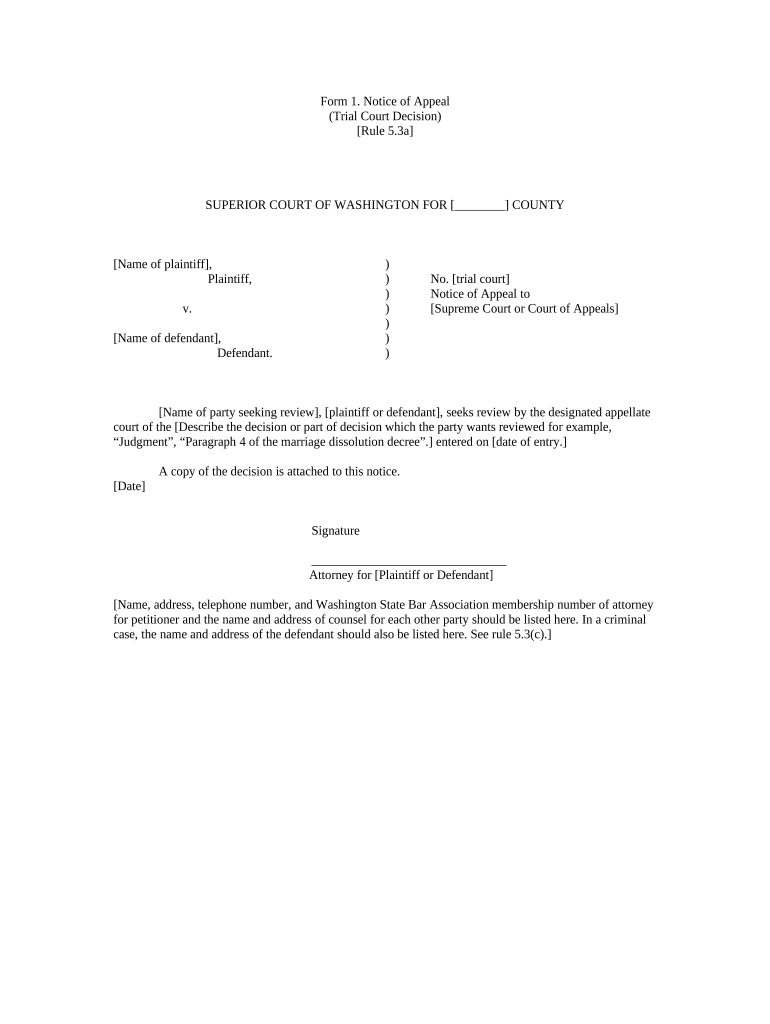
A WA Appeal is a formal written request to review and reverse or modify an administrative decision issued by a Washington state agency or local body. It typically sets out the appellant's identity, the decision being challenged, the factual and legal grounds for relief, and the remedy requested. Appeals follow agency-specific rules for timing, content, and service; many agencies accept electronic submissions and attachments but retain discrete procedural requirements. This guide explains the form's core parts, common filing paths, eSignature options, and practical steps to prepare a clear, compliant appeal.

Why filing a WA Appeal matters and its legal basis

Filing a WA Appeal preserves your right to administrative review, creates a formal record, and triggers agency procedures for reconsideration or hearing. Electronic execution and filing are generally permitted under the federal ESIGN Act (15 U.S.C. ch. 96) and state UETA frameworks where adopted, subject to agency exceptions and procedural rules.

Why filing a WA Appeal matters and its legal basis

Who prepares and who receives a WA Appeal

Appellants range from individuals to businesses and their legal representatives; agencies and adjudicators rely on properly completed appeals to determine jurisdiction and schedule hearings.

  • Individual appellants, filing pro se or with counsel — submit facts, relevant dates, and the remedy sought.
  • Business or organizational representatives — include authorized signer details and proof of authority when filing.
  • Agency hearing officers or clerks — receive the appeal, check for timeliness and completeness, and docket the matter.

Confirm the receiving office, filing method, and any required service on opposing parties before submitting to avoid procedural dismissal or delays.

Typical signatories and who can act on behalf of the appellant

Appellant — Individual

The named appellant or affected party signs when filing personally. The signature ties the appeal to the person who experienced the agency action and is used to verify identity, consent to electronic records under ESIGN/UETA, and to confirm the factual assertions in the pleading.

Authorized Representative — Attorney

A licensed attorney or designated representative signs when authorized in writing; include a retainer or authorization statement and contact details. Representatives should attach proof of authority if required by the agency's filing rules.

Security and compliance elements to include

Encryption: TLS 1.2/1.3 in transit
At-Rest Protection: AES-256 data encryption
Audit Trail: Timestamped signing record
HIPAA Support: BAA available on request
21 CFR Part 11: Compliant options exist
Certifications: SOC 2 Type II, ISO 27001

Key filing risks and potential consequences

Missed Deadline: Appeal dismissed
Improper Service: Process may be invalid
Incomplete Form: Agency may reject
Wrong Jurisdiction: Transferred or denied
Unauthorized Signer: Signature challenged
Unsupported Format: Attachments not accepted

Common preparation mistakes to avoid

  • Missing or unclear grounds: Failing to state the specific decision being appealed or the statutory basis can lead to dismissal for lack of specificity.
  • Incorrect dates or parties: Listing the wrong decision date or respondent can create service defects and delay resolution.
  • Unsigned or unsigned pages: Partial signatures or missing signature dates often cause agencies to return filings as incomplete.
  • Poorly organized exhibits: Large, unindexed attachments make review slow and can result in omission of critical evidence from the record.

Step-by-step: preparing and filing a WA Appeal

Follow these core steps to prepare a compliant appeal and reduce the risk of rejection.

  • 01
    Confirm deadline: Verify the agency's appeal period before starting
  • 02
    Complete form: Provide accurate facts, relief requested, and attachments
  • 03
    Sign and authenticate: Attach signature, authority documents, and eSignature evidence
  • 04
    File and serve: Submit to the agency and serve required parties

How the WA Appeal process typically proceeds

A standard workflow moves from filing to screening, possible briefing, and final decision; specific steps vary by agency.

  • Filing intake: Agency accepts and timestamps the appeal
  • Preliminary review: Clerk checks timeliness and completeness
  • Response and briefing: Agency or respondent may file a response
  • Decision or hearing: Hearing scheduled or written decision issued

How to preserve an authoritative record when you file

Choose file formats and attachments that maintain integrity and are accepted by the receiving agency; include metadata and a signing certificate where possible.

Accepted Formats

PDF, DOCX, or scanned TIFF with searchable text; retain originals

Signed Document

Include a visible signature and an underlying audit trail or certificate

Indexed Attachments

Number exhibits and reference them in the body

Retain Copies

Store a timestamped copy and service proof

Essential parts of a professional WA Appeal

A well-crafted appeal is concise, focused on jurisdictional and factual grounds, and accompanied by clear exhibits and signature evidence. Include a cover sheet with contact details and proof of service.

Caption

Case title, agency name, docket number if known, and parties identified clearly
Decision Reference

Exact date and description of the decision being appealed

Statement of Facts

Chronological, specific facts tied to exhibits and records

Legal Grounds

Statutes or regulations relied on and concise legal argument

Relief Requested

Clear statement of the remedy or relief sought from the agency

Attachments and Evidence

Supporting documents indexed and cross-referenced to the narrative

Amendments, corrections, and follow-up tasks

If you need to revise or supplement an appeal, follow agency rules for amendments and provide clear versioning.

01

File a supplement:

Attach a short cover describing new material
02

Correct clerical errors:

Submit an errata explaining the correction
03

Update contact details:

Notify agency and opposing parties in writing
04

Submit additional evidence:

Explain why the evidence is newly available or relevant
05

Request extension:

Follow agency motion rules for extensions
06

Confirm docketing:

Obtain agency confirmation of the filed amendment

Digital filing and eSubmission considerations

Before eSubmitting, confirm the agency's accepted file types, maximum file sizes, and any required authentication methods.

  • Formats Supported: PDF, DOCX, TIFF
  • Authentication: Email links, SMS codes, or agency login
  • Integrations: Common with cloud storage

Retain native files and export a signed PDF with an audit trail or certificate of completion; keep proof of transmission and service for your records.

Configuring an online appeal workflow

When using an eSignature or document workflow platform, configure fields and routing to match agency filing and service requirements.

Field Configuration
Document Upload Accept PDF/A and DOCX; enable attachments
Signer Authentication Email + optional SMS or KBA
Routing Order Appellant -> Representative -> Agency clerk
Retention Settings Store long-term signed PDF and audit trail

Paper filing versus eSubmission: key differences

Compare common acceptance, authentication, and proof-of-service differences between paper and electronic appeals.

Criteria Paper filing Electronic submission
Acceptance accepted in person accepted online by many agencies
Notarization required sometimes rarely
Proof of service stamped envelope platform service log
Filing speed slower faster

eSignature vendor comparison for preparing and signing appeals

Basic pricing and feature differences across common eSignature providers. signNow appears first for direct feature visibility; verify vendor plan details with providers before purchasing.

signNow DocuSign Adobe Sign PandaDoc HelloSign
Starting Price $8/user/mo $15/user/mo $14/user/mo $19/user/mo $15/user/mo
Free Trial 7-day trial Varies Varies Varies Varies
Bulk Send Yes Yes Yes Yes Yes
Audit Trail Yes Yes Yes Yes Yes
HIPAA Compliant Yes Yes Yes No No

Key milestones in the appeal lifecycle

A typical timeline runs from filing through response, possible hearing, and final decision; each stage may have statutory or agency-specific deadlines.

01

Filing the Notice

Submit the appeal and obtain a timestamped receipt

02

Agency Screening

Clerk confirms timeliness and completeness

03

Response or Briefing

Respondent or agency files an answer or response

04

Final Decision

Hearing or written decision issues per agency schedule

Typical procedural deadlines to check immediately

Confirm exact statutory or agency deadlines before filing; the sample items below are common checkpoints rather than universal rules.

Initial Filing Deadline:

Varies by agency; commonly 30 days from decision

Service on Respondent:

Usually simultaneous with filing or within a short statutory period

Reply or Response Deadline:

Often 14–30 days after service; check agency rules

Hearing Request Deadline:

May require separate request within the filing window

Final Decision Timeline:

Agency schedules vary widely; some statutes set specific calendar limits

Real-world examples of electronic signing in administrative workflows

Organizations across sectors share how digital signatures and centralized workflows reduced friction when preparing and submitting official documents.

Optica Ventures — Brian Fitzgibbons

Optica simplified customer-facing documents and reduced turnaround with electronic signing.

  • The interface is simple and easy-to-use for our team.
  • Brian Fitzgibbons reports the solution made it easier for customers to complete documents remotely, improving response times and reducing manual follow-up while preserving compliance controls.

Fertility Centers of Illinois — John Butler

Medical services centralized signatures and maintained compliance across locations.

  • The API and responsiveness were key to our workflows.
  • John Butler highlights the team's positive experience with the integration and support, noting reliable security and efficient execution across mobile and desktop channels.

Frequently asked questions about WA Appeals and electronic filing

Answers to common questions about deadlines, signatures, accepted formats, and what to do when an agency rejects a submission.


Need help? Contact support

be ready to get more
Join over 28 million airSlate SignNow users