Establishing secure connection…Loading editor…Preparing document…

Waiver and Release of Liability

This template is fully customizable. Edit the text, fill out the fields, and send it for signature. Give it a try!
Waiver and Release of Liability

What a Waiver and Release of Liability Is

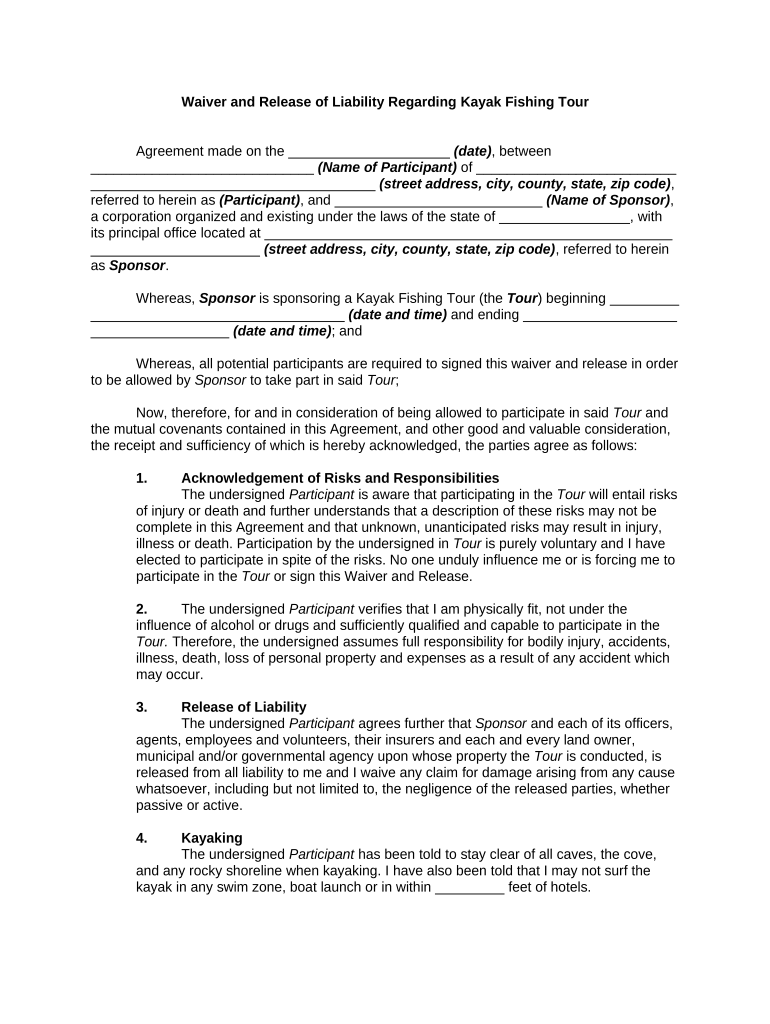
A Waiver and Release of Liability is a legal agreement in which a participant or claimant voluntarily gives up the right to pursue certain claims against an organizer, property owner, or service provider arising from specified activities or incidents. It typically describes the risks involved, identifies the parties, and states the scope of claims being released. In the United States these documents may be executed on paper or electronically; electronic signatures are generally enforceable under the ESIGN Act and UETA when intent, consent, attribution, and retention requirements are met.

Why a Clear Waiver Matters

A Waiver and Release of Liability clarifies risk allocation, documents informed consent, and reduces exposure to litigation by establishing the parties’ expectations. Properly drafted and executed, it strengthens defenses and aids claims handling while preserving key factual records.

Why a Clear Waiver Matters

Who Typically Uses This Document

Organizations and individuals who run activities with participant risk commonly use a Waiver and Release of Liability to document consent and limits.

  • Event organizers hosting recreational or athletic activities requiring participant acknowledgment of hazards.
  • Property owners and venues limiting premises liability for visitors, contractors, or vendors on site.
  • Service providers and instructors who perform potentially hazardous services such as training or tours.

Core Elements of a Professional Waiver and Release of Liability

A professional Waiver and Release of Liability includes clear scope, defined parties, risk disclosure, consideration, execution mechanics, and clauses that address enforceability and surviving obligations.

Scope

Describe precisely which activities, locations, and types of injury are covered; avoid blanket or unspecified references. Narrow, specific descriptions improve a court’s assessment of voluntariness and informed consent.
Consideration

State the consideration provided, whether monetary payment, participation privilege, or access to services. Courts look for explicit exchange; vague phrases like 'for good and valuable consideration' are weaker.

Assumption

Include an assumption of risk clause that explains known hazards and requires the signer acknowledge understanding; factual descriptions of hazards support enforceability and specify any protective measures or required equipment.

Indemnity

Where appropriate, include an indemnity clause allocating defense and indemnification obligations; ensure the clause is narrowly tailored and consistent with state law public policy limitations on indemnity.

Severability

Add severability language so that if one provision is unenforceable the remainder survives; this preserves the parties’ intent and reduces risk of total invalidation in litigation.

Execution

Specify signature method accepted (handwritten or electronic), required authentication level, date format, and whether notarization or witness signatures are required to validate execution under applicable state law.

Step-by-Step: Completing a Waiver and Release of Liability

Follow these steps to complete a Waiver and Release of Liability accurately and to establish clear evidence of consent and execution.

  • 01
    Prepare: Identify parties, activity, dates, and consideration.
  • 02
    Draft: Use precise risk descriptions and unambiguous waiver language.
  • 03
    Review: Confirm names, dates, and governing law are correct.
  • 04
    Execute: Obtain signature, date, and authentication evidence.

Execution Workflow for Electronic Waivers

Typical execution workflows show how to route, authenticate, sign, and store Waiver and Release of Liability documents for legal validity and auditability.

  • Upload: Add the PDF or DOCX template to the signing platform.
  • Place Fields: Insert signature, initials, date, and checkbox fields where needed.
  • Authenticate: Choose email, SMS code, or stronger signer verification.
  • Store: Export signed PDF with audit trail and certificate.

Platform Capabilities to Look For

Use platforms that support PDF, DOCX, and HTML templates, integrate with cloud storage, and meet compliance requirements for waivers.

  • File Formats: PDF, DOCX, and HTML supported.
  • Integrations: Salesforce, NetSuite, Google Workspace, Microsoft 365.
  • Security: TLS 1.2/1.3 and AES-256 encryption.

Best Practices to Improve Enforceability and Clarity

Adopt these best practices to increase the likelihood a Waiver and Release of Liability is enforceable, clear to signers, and defensible in disputes.

Plain Language and Specificity
Write risk descriptions and release scope in plain language, with concrete examples of covered activities and injuries. Courts review clarity and whether a reasonable person could understand the waiver’s effect; avoid legalese that obscures material terms.
Conspicuous Disclosure
Make key waiver clauses conspicuous with bold headings, adequate font size, and separate signature acknowledgment. Visible presentation reduces claims that the signer did not notice or understand critical release provisions.
Authentication and Audit Trail
Capture signer authentication, IP address, timestamps, and a certificate of completion. An audit trail demonstrating intent, attribution, and consent strengthens enforceability under ESIGN and supports admissibility in contested proceedings before and after signature events.
Legal Review and Local Law
Have counsel review waivers for state-specific enforceability, public policy exceptions, and necessary language adjustments. Local statutes and case law can materially change whether a particular waiver will be upheld in court.

Common Preparation Pitfalls to Avoid

  • Using broad, ambiguous language that fails to specify covered activities and harms increases the chance a court will find the waiver unenforceable.
  • Requesting a signature without capturing intent, consent, attribution, and retention weakens enforceability under ESIGN and UETA tests.
  • Failing to match signer name to government ID or omitting witness/notary information can create procedural grounds for challenge.
  • Distributing drafts at the last minute or using small font and dense paragraphs undermines informed consent and may be scrutinized.

Legal Risks and Consequences of Poorly Drafted Waivers

Voidability Risk: Unclear language may void release.
Public Policy Limits: Certain claims cannot be waived.
Negligence Exceptions: Gross negligence often not waived.
Insurance Gaps: Release does not substitute insurance coverage.
Form Errors: Missing dates or names invalidate form.
Legal Costs: Defense costs may still occur.

Timing and Deadlines to Watch

Key timing considerations affect validity, revocation, and recordkeeping for a Waiver and Release of Liability; follow these deadlines to reduce legal risk.

When to Sign:

Before participation or before entry to facility.

Effective Date Rule:

Specified effective date sets start of released period.

Revocation Window:

Consumer consent withdrawals require clear procedures; follow ESIGN disclosure.

Record Retention:

Retain signed copy and audit trail per retention rules.

Event Notice:

Provide risk information sufficiently before the event start.

eSignature Plan Comparison for Executing Waivers

Comparison of common eSignature plans and features relevant to executing a Waiver and Release of Liability documents; signNow is listed first for parity in this table.

signNow DocuSign Adobe Sign PandaDoc HelloSign
Starting Price $8/user/mo $15/user/mo $14/user/mo $19/user/mo $15/user/mo
Free Trial 7-day free trial Varies by vendor Varies by vendor Varies by vendor Varies by vendor
Bulk Send Yes Yes Yes Yes No
Audit Trail Yes Yes Yes Yes Yes
HIPAA Compliant Yes Yes Yes No No

Essential Data Elements and Security Considerations

Signer Identity: Full legal name matching government ID.
Activity Description: Clear description of activities and associated risks.
Effective Date: MM/DD/YYYY format; when release begins.
Consideration: Identify fee or benefit exchanged for release.
Governing Law: State jurisdiction that governs interpretation.
Signature Block: Signature, printed name, date, and contact.

Frequently Asked Questions About Waivers and E-signatures

Answers to common questions about drafting, executing, and enforcing a Waiver and Release of Liability, including eSignature and recordkeeping considerations.


Need help? Contact support

be ready to get more
Join over 28 million airSlate SignNow users