Establishing secure connection…Loading editor…Preparing document…

Washington Child Support Guidelines

This template is fully customizable. Edit the text, fill out the fields, and send it for signature. Give it a try!
Washington Child Support Guidelines

What the Washington Child Support Guidelines Cover

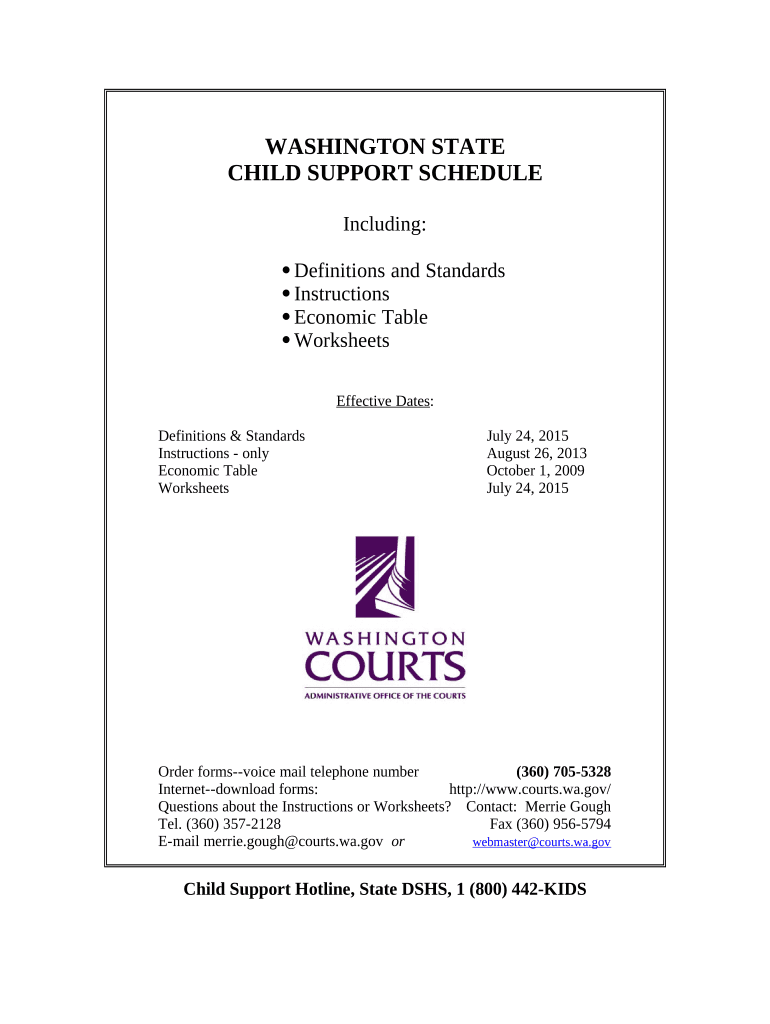
The Washington Child Support Guidelines are the statewide framework courts use to calculate child support amounts in Washington. They define gross and net income, allowable deductions, the basic support schedule by combined parental income and number of children, and standard adjustments for healthcare, childcare, parenting time, and extraordinary expenses. The Guidelines create a presumptive amount that judges apply in initial orders, modifications, and enforcement cases; courts may deviate when specific evidence shows the presumptive figure would be unjust or inappropriate under the circumstances.

Why the Guidelines Matter for Reliable Support Orders

Using the Washington Child Support Guidelines promotes consistency, transparency, and predictability in support calculations. Parties and courts benefit from a common methodology for income, deductions, and shared costs, which reduces disputes about calculation method and supports enforceable, defensible orders.

Why the Guidelines Matter for Reliable Support Orders

Who Commonly Relies on the Washington Guidelines

Parents, family law attorneys, judges, and county child support agencies rely on the Guidelines to calculate and review support obligations.

  • Parents who pay or receive support and need standardized calculations for budgeting and court compliance.
  • Family law attorneys preparing pleadings, proposing calculations, and arguing for or against deviations from presumptive amounts.
  • County child support agency staff and clerks generating administrative orders and managing enforcement tasks.

Primary Roles and Typical Needs

Payor Parent

Often needs accurate, documented income calculations and verified expense allocations to determine monthly obligation and to plan for withholding or wage assignment enforcement.

Recipient Parent

Typically requires precise support figures, proof of childcare and medical costs, and documentation to secure timely payments and to establish eligibility for enforcement remedies.

Essential Information Required by the Guidelines

Child's Legal Name: Full legal name as on birth certificate.
Child's DOB: Use MM/DD/YYYY format for each child.
Parent Names: Full legal names matching government ID.
Gross Income: Enter gross monthly or annual income.
Deductions: List taxes, mandatory retirement, union dues.
Childcare Costs: Provide monthly payment totals and receipts.

Consequences of Incorrect or Incomplete Calculations

Incorrect Calculation: Court may modify order retroactively.
Missing Documentation: Claims can be denied or delayed.
Underreporting Income: Leads to enforcement or contempt.
Late Filing: Temporary orders may still apply.
Tax Effects: Support affects tax planning and exemptions.
Enforcement Costs: Collections incur administrative fees.

Common Pitfalls to Avoid When Preparing Support Calculations

  • Using inconsistent pay periods for each parent (weekly vs monthly) that create mismatched income figures and inaccurate results.
  • Forgetting to include employer-provided benefits or imputed income, which can materially change the presumptive obligation.
  • Failing to attach receipts for childcare or extraordinary medical expenses results in denied adjustments at hearing.
  • Assuming the presumptive amount cannot be adjusted; missing evidence for deviation requests can cause denial of needed relief.

Practical Examples of How the Guidelines Are Used

Two brief scenarios illustrate common uses: initial orders and post-judgment modifications using the Washington schedule and adjustment rules.

Initial Order Example

A parent files for an initial support order after separation, providing pay stubs and childcare invoices to the court to establish income and allowable costs.

  • Court applies the state schedule to combined income and allocates the presumptive share between parents.
  • The judge issues an order reflecting the guideline amount plus an additional childcare allocation, with clear findings to support any deviation from the presumptive figure.

Modification Example

One parent experiences a substantial income change and petitions for modification supported by updated tax returns and employer letters.

  • The court recalculates obligations using current incomes and allowable deductions.
  • The judge either adjusts the monthly payment prospectively or schedules a hearing where both parties present evidence; orders include a worksheet documenting the calculation and basis for change.

Step-by-Step: Preparing a Guideline Worksheet

Follow these sequential steps to prepare a clear, court-ready child support calculation using Washington's methodology.

  • 01
    Gather Records: Collect pay stubs, tax returns, and benefit statements.
  • 02
    Calculate Income: Compute gross and net monthly income per parent.
  • 03
    Apply Schedule: Locate combined income row and base amount for children.
  • 04
    Adjust for Costs: Add healthcare, childcare, and extraordinary expense splits.

How the Calculation Moves from Worksheet to Court Order

This sequence explains typical routing: worksheet preparation, filing, service, hearing, and entry of the final order.

  • Prepare Worksheet: Complete the guideline worksheet and attach supporting documents.
  • File with Court: Submit the worksheet with your petition or response.
  • Serve Other Party: Provide opposing counsel or party with filed materials.
  • Hearing & Order: Judge reviews evidence, issues, and signs the order.

Core Components Inside the Washington Child Support Calculation

The Guidelines combine a uniform schedule with defined inputs and adjustment rules; these parts determine the presumptive amount and any lawful deviations.

Income Definition

Specifies included sources (wages, self-employment, benefits) and how to annualize or convert pay periods to a monthly basis for consistent calculation under the state schedule.
Allowable Deductions

Permits mandatory payroll deductions such as federal and state income taxes, Social Security, Medicare, and certain retirement contributions before deriving net income for support calculation.

Basic Support Schedule

Provides presumptive support amounts keyed to combined parental income and number of children; the schedule yields a baseline obligation allocated proportionally between parents.

Healthcare Adjustment

Allocates the cost of health insurance premiums and unreimbursed medical expenses between parents based on income shares and documented premiums or payments.

Childcare Costs

Allows childcare expense allocation when parents incur work- or education-related childcare, requiring invoices or receipts and a proportional split aligned with income shares.

Deviation Standards

Lists circumstances permitting deviation from the presumptive amount, such as extraordinary needs, special educational or medical expenses, or significant disparity in parenting time.

Practical Tips for Accurate, Efficient Calculations

Adopt consistent formatting, include verifiable evidence, and keep worksheet notes to support each numeric input and any requested deviation.

Use Standard Pay Periods
Convert all incomes to a consistent monthly basis and document conversion formulas; inconsistent periods are a common source of calculation errors during review.
Attach Source Documents
Include pay stubs, employer letters, tax returns, insurance invoices, and childcare receipts to substantiate each line item and to reduce discovery or evidentiary disputes at hearing.
Document Special Costs
For extraordinary medical or educational expenses, provide itemized bills and evidence showing why the costs fall outside the basic support allocation and merit deviation.
Preserve Calculation Notes
Keep a clear, annotated copy of the worksheet showing formulas, rounding conventions, and assumptions so the court and opposing party can easily verify the arithmetic.

Typical Timing and Processing Expectations

Court scheduling and administrative steps vary locally; the following are common filing and hearing timeframes to expect when using the Guidelines.

Temporary Hearing Timeline:

Court may set a temporary order hearing within 30–90 days of filing, depending on local calendars.

Modification Filings:

File a modification petition promptly after a substantial income change; courts require current documentation at filing.

Document Exchange:

Opposing parties typically exchange financial disclosures within 14–30 days of service or per local rules.

Final Order Entry:

Final hearings and signed orders often occur within 60–180 days, subject to continuances and local docket load.

Administrative Processing:

County child support agency processing times vary; expect additional administrative lead time for income withholding setup.

eSignature Pricing and Feature Comparison for Worksheet Workflows

Comparison of typical vendor starting prices and key capabilities relevant to signing and distributing support worksheets and attachments.

signNow DocuSign Adobe Sign PandaDoc HelloSign
Starting Price $8/user/mo $15/user/mo $14/user/mo $19/user/mo $15/user/mo
Free Trial 7-day free trial No No Yes, limited Yes, limited
Bulk Send Yes Yes Yes Yes No
Audit Trail Yes Yes Yes Yes Yes
Envelope Cap No cap 100 envelopes/user/year Varies by plan Varies by plan Varies by plan

Technical Options for eSubmission and Integration

Choose an eSignature platform that supports PDF, DOCX uploads, audit trails, and integrates with common systems used in family law practice.

  • Cloud Integrations: Integrates with Google Workspace, Microsoft 365, Box and NetSuite.
  • Document Formats: Supports PDF, DOCX, and fillable templates for consistent worksheets.
  • Audit & Security: Provides full audit trail, TLS in transit, AES-256 at rest.

Frequently Asked Questions About Using the Washington Guidelines

Answers to common procedural and technical questions encountered when preparing and filing guideline worksheets in Washington courts.


Need help? Contact support

be ready to get more
Join over 28 million airSlate SignNow users