Document index
A numbered index listing each pleading, order, transcript, and exhibit with exact titles and corresponding page ranges to avoid ambiguity and speed assembly.
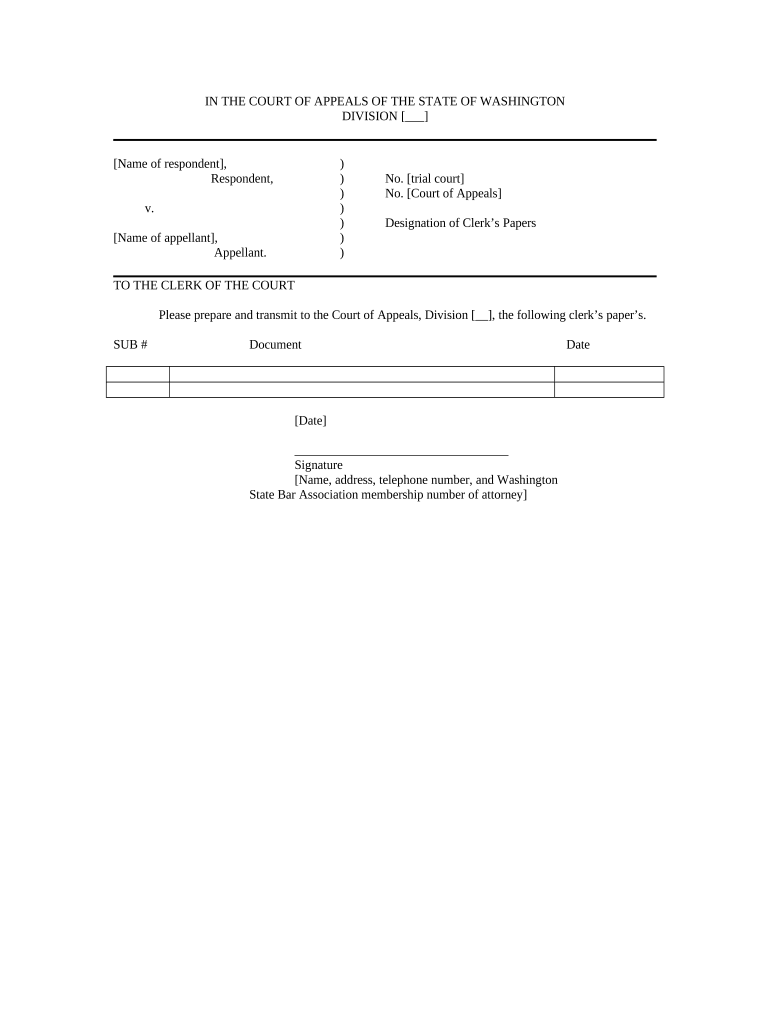
A precise designation reduces the risk of omitted exhibits or transcripts, minimizes disputes about what the appellate court will review, and speeds record assembly. It creates a clear roadmap for the clerk and opposing counsel, which limits surprises during briefing and better preserves issues for appeal.

Typical filers are appellants and appellate counsel who assemble and submit the list of record items to the clerk.
Accurate identification reduces clerical errors and limits delays in record assembly and appellate briefing.
| Field | Configuration |
|---|---|
| Upload method | PDF preferred | combine documents into single file |
| Field placement | Label exhibits clearly | place signatures and dates |
| Authentication | Email or SMS code for signer verification |
| Delivery | File to court e-filing portal and serve opposing counsel |
A numbered index listing each pleading, order, transcript, and exhibit with exact titles and corresponding page ranges to avoid ambiguity and speed assembly.
Consistent pagination or Bates stamping across items ensures cross-reference accuracy between briefs and the clerk’s papers during appellate review.
Brief descriptions for exhibits clarify relevance and content, reducing time spent by clerk and opposing counsel locating and identifying items.
Cite reporter volume, date, and page ranges for each transcript excerpt to ensure the appellate record contains the exact portions relied upon.
Include a signed certificate of service that states how and when opposing counsel received the designation to prove proper notice.
Reference trial docket entries and motion dates where appropriate so the court can reconcile the designation with the existing trial record.
Refer to RAP and trial court notice for exact timing; often concurrent with notice of appeal.
Serve the designation at the time of filing or within the period specified by local rules.
Clerk compiles and paginates papers before transmitting to appellate court; timing varies by workload.
Promptly file any corrected or supplemental designation if items were omitted.
Clerk transmits assembled clerk’s papers to the appellate court per court procedures.
Compile and index all trial-court items for inclusion before filing.
Provide opposing counsel a copy to allow review and objections.
Submit the designation to the trial court clerk via e-file or in person per local rules.
Clerk paginates, compiles, and transmits the clerk’s papers to the appellate court.
Ensure your platform supports court-acceptable file types and secure signer authentication before preparing the designation.
Confirm the court clerk’s e-filing specifications and preserve an unaltered audit trail and signed copy; use platforms that provide tamper-evident storage and a complete signature certificate for the record.
| signNow | DocuSign | Adobe Sign | PandaDoc | HelloSign | |
|---|---|---|---|---|---|
| Starting Price | $8/user/mo | $15/user/mo | $14/user/mo | $19/user/mo | $15/user/mo |
| Free Trial | 7-day free trial | Varies | Varies | Varies | Varies |
| Bulk Send | Yes | Yes | Yes | Yes | No |
| Audit Trail | Yes | Yes | Yes | Yes | Yes |
| HIPAA Compliant | Yes | Yes | Yes | No | No |
| Envelope Cap | No cap | 100 envelopes/user/year | Varies | Varies | Varies |
A small appellate practice files a detailed designation to avoid missing exhibits in time-sensitive appeals
Corporate counsel prepares a consolidated designation for multi-docket disputes
Appellate counsel prepares and authorizes the designation, certifies completeness, signs the document, and provides contact and Bar number information so the clerk and court can verify authority.
A pro se litigant files the designation directly. They must ensure party names and case number match trial records and follow local filing rules to avoid rejection.