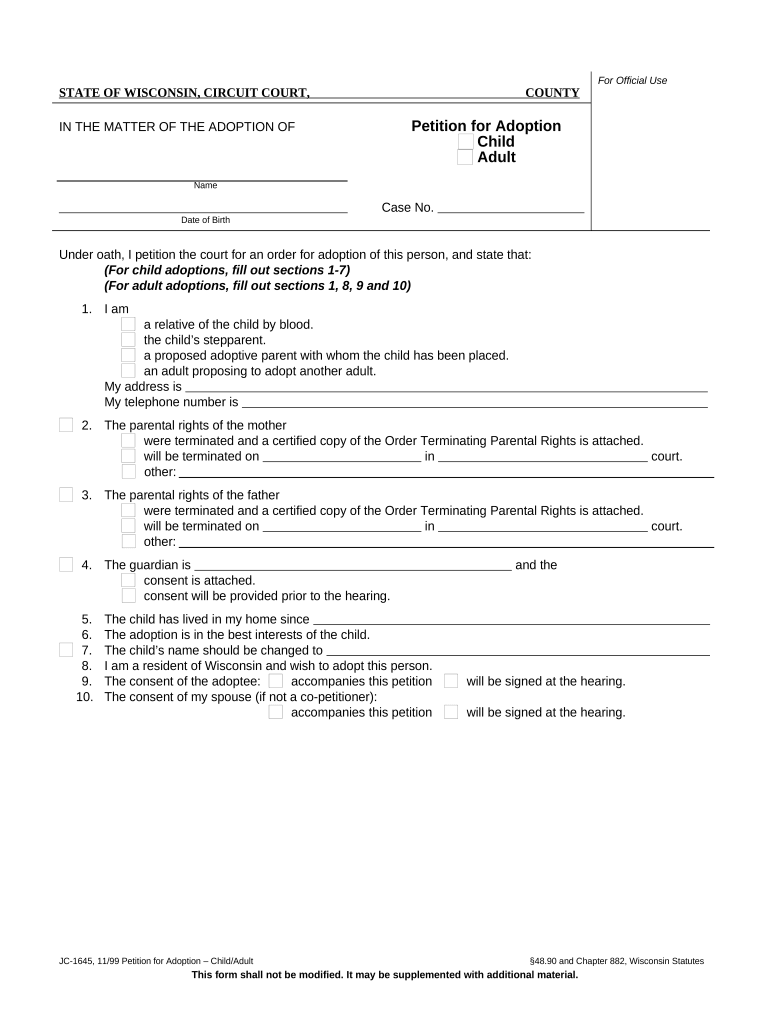
Wisconsin Adult Adoption
What Wisconsin Adult Adoption Is and what it changes
Why people pursue a Wisconsin adult adoption
Adult adoption clarifies legal relationships for inheritance, estate planning, family membership, guardianship clarity, and social recognition. It is commonly used to formalize long-standing family bonds or to ensure clear intestacy rights for the adoptee.
Who typically prepares or signs an adult adoption in Wisconsin
The following groups most commonly complete or sign Wisconsin adult adoption petitions.
- Adult adoptee and adopting parent(s) — The adult being adopted and the person(s) seeking to adopt for legal recognition and inheritance certainty.
- Family law attorneys and court clerks — Attorneys draft petitions and clerks process filings and hearing schedules in county circuit courts.
- Estate planners and benefits administrators — Professionals who update wills, beneficiary designations, and benefit eligibility after an adoption.
Each participant has different responsibilities: adoptees give consent, adopters file paperwork, and courts issue the final decree that creates the new legal relationship.
Step-by-step: filing an adult adoption in Wisconsin
-
01Prepare Petition: Draft the petition with names, DOB, consent, and reason for adoption.
-
02Attach Consents: Collect the adoptee's written consent and any required supporting documents.
-
03File with Court: Submit the petition and pay filing fees at the county clerk's office.
-
04Attend Hearing: Appear at the scheduled hearing; the court may issue a decree if requirements are met.
How the Wisconsin adult adoption process flows
-
Document Preparation: Assemble petition, consents, and identity documents for each party.
-
Sign and Notarize: Execute signatures and obtain any required notarizations or witness attestations.
-
Court Filing: File petition and receive a hearing date from the county clerk.
-
Final Decree: Judge signs adoption decree, creating the legal parent-child relationship.
Setting up a digital workflow for your adoption petition
| Authentication Method | Email link, SMS code, or ID verification depending on court requirements |
|---|---|
| Signature Format | Choose typed or drawn signature; courts accept electronic signatures when permitted by law |
| Attachments | Include consent forms, IDs, and proof of residence as required documents |
| Notarization | Select remote or in-person notarization if county allows RON or requires acknowledgement |
| Retention | Ensure completed packet and audit trail are exportable for long-term storage |
Common preparation mistakes to avoid for Wisconsin adult adoption
- Failing to include the adoptee's explicit written consent, which most courts require and which can lead to dismissal.
- Submitting inconsistent names or dates across documents, causing clerks to return the petition for correction.
- Neglecting required attachments such as proof of residence or identity, which delays scheduling of a hearing.
- Skipping notarization or witness steps when a county requires them, resulting in rejected filings or the need to refile.
Risks and consequences of an incorrect or incomplete petition
Key timing checkpoints to track during the adoption process
Filing Date:
Date petition is submitted to county clerk
Service & Notice:
Provide notices per local court rules
Hearing Date:
Scheduled by the court after filing; varies by county
Decree Entry:
Judge signs the final adoption order at the hearing
Record Updates:
Update wills, titles, and account records after decree
eSignature vendor comparison for executing adoption documents
| signNow | DocuSign | Adobe Sign | PandaDoc | HelloSign | |
|---|---|---|---|---|---|
| Starting Price | $8/user/mo | $15/user/mo | $14/user/mo | $19/user/mo | $15/user/mo |
| Free Trial | 7-day free trial | Varies by plan | Varies by plan | Varies by plan | Varies by plan |
| Bulk Send | Yes | Yes | Yes | Yes | No |
| Audit Trail | Yes | Yes | Yes | Yes | Yes |
| HIPAA Compliant | Yes | Yes | Yes | No | No |
Frequently asked questions about Wisconsin adult adoption
-
Does an adult need to consent?
Yes. Courts expect explicit written consent from the adult adoptee in most jurisdictions; lack of consent typically prevents entry of a decree and may require additional proceedings.
-
Will adoption change inheritance rights?
A granted adoption generally establishes inheritance rights between adoptee and adoptive parent under state intestacy rules; update wills and beneficiary forms to reflect intent.
-
Do I need a lawyer to file?
You may self-represent, but an attorney can ensure compliance with local court rules, draft clear petitions, and reduce the risk of dismissal or delay.
-
Can the adoptee change their name?
Name change options are typically included in the petition; courts often allow the adoptee to request a legal surname change as part of the decree.
-
Is notarization required for signatures?
Notarization or witness requirements vary by county and document; check local circuit court rules to confirm whether acknowledgements are necessary.
-
How do I update official records after decree?
Obtain a certified copy of the final decree and provide it to agencies, banks, and courts to update birth records, title documents, wills, and beneficiary information.