Judgment Details
Include original judgment date, case number, judgment amount, itemized costs and accrued interest so the garnishee and court can verify the debt and compute proper withholdings.
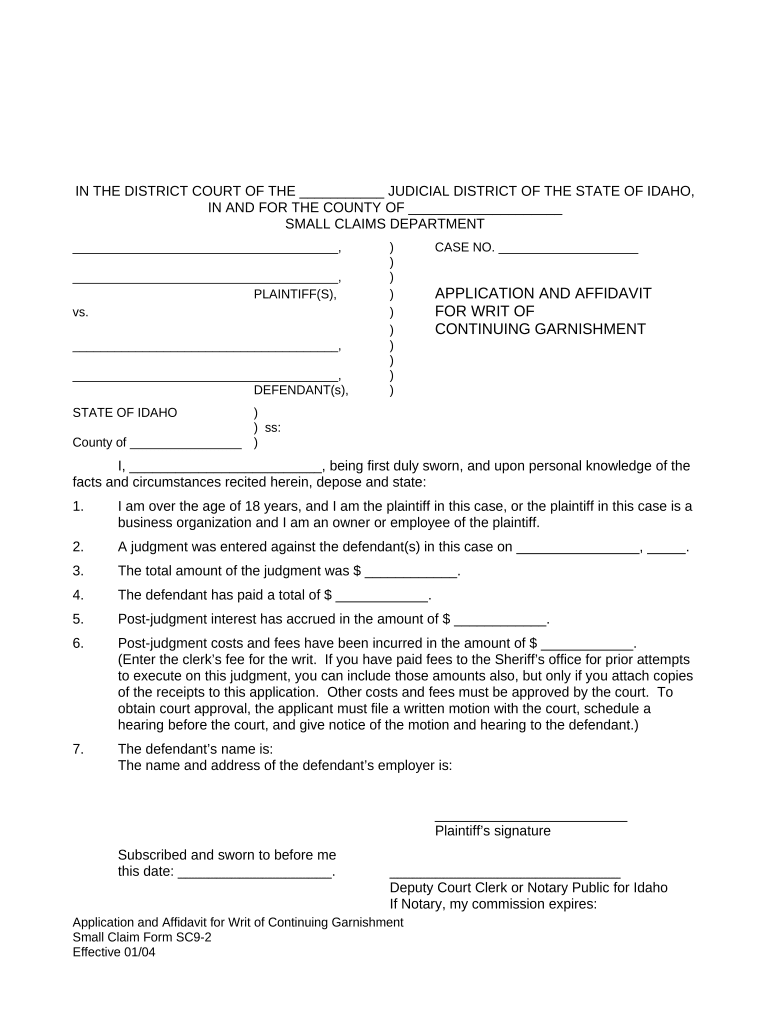
A Writ of Continuing Garnishment preserves a judgment creditor's collection rights by enabling recurring seizures without re-litigating entitlement. It streamlines enforcement, reduces administrative cycles for creditors, and provides a predictable legal mechanism for recovering unpaid monetary judgments over time.

Common users who prepare or encounter a Writ of Continuing Garnishment include judgment creditors, collections attorneys, and court clerks managing enforcement actions.
A collections attorney prepares and files the writ, calculates post-judgment interest and allowable deductions, advises creditors on exemption claims, and represents the creditor in garnishment challenges or contested hearings to enforce judgment collection.
A garnishee receives the writ, identifies funds subject to withholding, withholds amounts per court directions, remits payments to the court or creditor, and maintains records to limit liability and demonstrate compliance.
Include original judgment date, case number, judgment amount, itemized costs and accrued interest so the garnishee and court can verify the debt and compute proper withholdings.
Clearly instruct the garnishee on the amounts to withhold, frequency, remittance address, documentation to submit with each payment, and a contact person for any processing questions.
State statutory exemptions and include a form or checklist for the garnishee to evaluate exempt income like SSI or public benefits to avoid wrongful withholding.
Specify the start date, duration, renewal conditions, notice requirements, and how the writ terminates once the judgment is satisfied or legally superseded, including filings required to release garnishment.
Require a sworn return of service or affidavit showing how and when the garnishee and debtor were served to establish jurisdiction and chain of custody.
Document calculations, payment dates, communications, and retained receipts; preserving a detailed audit trail supports enforcement, simplifies accounting, and aids in defending disputes or appeals and recordkeeping.
Prepare and file writ per local clerk schedules.
Serve garnishee and debtor according to state service rules.
Garnishee typically answers within a statutory period; common ranges are 14–30 days.
Withholding generally begins after service and any court-ordered waiting period.
Writ ends when judgment satisfied or court issues release or stay.
| Criteria | Writ of Continuing Garnishment | Writ of Execution |
|---|---|---|
| Purpose | recurring collections | one-time seizure |
| Duration | until satisfied | single event |
| Targets | wages, accounts | personal property, fixtures |
| Court Order Needed |
| signNow | DocuSign | Adobe Sign | PandaDoc | HelloSign | |
|---|---|---|---|---|---|
| Starting Price | $8/user/mo | $15/user/mo | $14/user/mo | $19/user/mo | $15/user/mo |
| Free Trial | 7-day free trial | Varies by plan | Varies by plan | Varies by plan | Varies by plan |
| Bulk Send | Yes | Yes | Yes | Yes | No |
| Audit Trail | Yes | Yes | Yes | Yes | Yes |
| HIPAA Compliant | Yes | Yes | Yes | No | No |
| Envelope Cap | No envelope cap | 100 envelopes/user/year | Varies | Varies | Varies |