Case Caption
Full court caption with case number, judge, and county to ensure the order applies to the correct file and is accepted by court clerks.
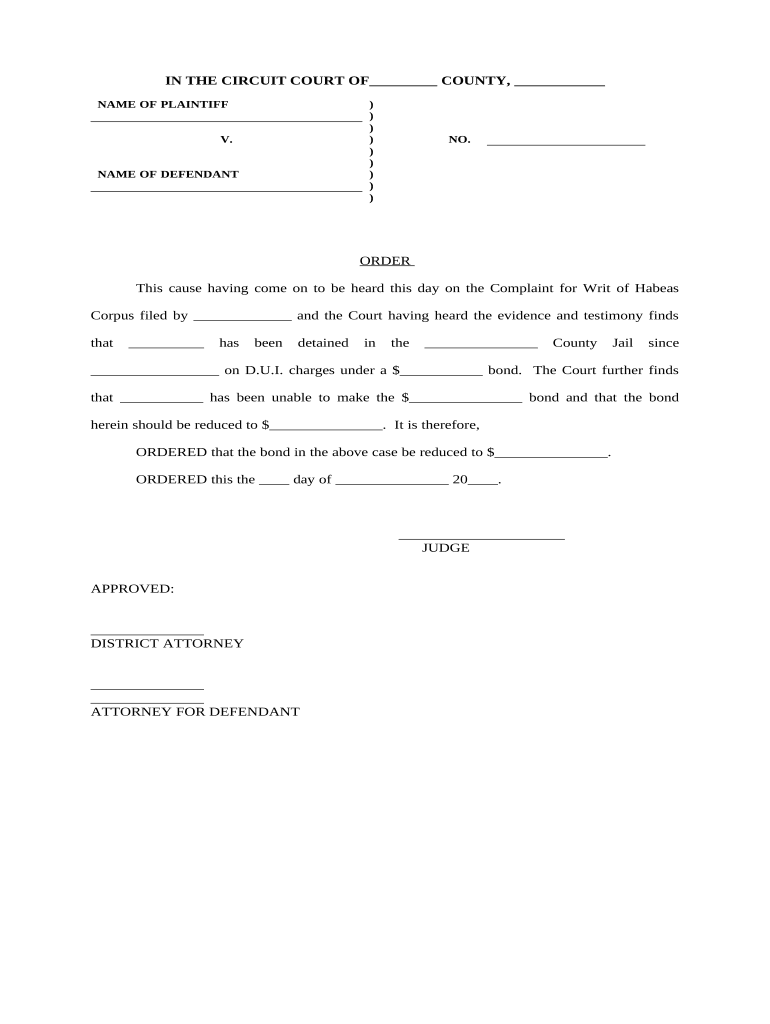
Courts use bond reduction orders to balance public safety with an accused person’s right to reasonable bail; reducing bond can prevent unnecessary pretrial detention.

The following parties most often prepare or request an Order to Reduce Bond in a D.U.I. Case.
Each party must follow local court rules for motion format, service, and hearing notice; requirements vary by jurisdiction.
An attorney representing the defendant prepares the motion and proposed order, verifies client identity and financial facts, and signs as counsel of record to present justification to the court.
The judge signs and files the official order to reduce bond; the judicial signature is required to change pretrial release conditions and make the order enforceable.
Full court caption with case number, judge, and county to ensure the order applies to the correct file and is accepted by court clerks.
Defendant name, booking number, DOB or other identifier to avoid confusion with similarly named persons in custody.
Brief reference to the filing or hearing that prompted the order and the factual basis for reduction.
Precise monetary amount, surety conditions, or substitute conditions (e.g., electronic monitoring) stated in plain terms.
Date and time when the reduced bond becomes operative so jail staff and sureties know when to act.
Judge’s signature, printed name, and clerk’s filing stamp to authenticate the order for enforcement.
| Field | Configuration |
|---|---|
| Document Template | Use a court-friendly template with fillable caption and proposed order fields. |
| Signer Roles | Assign counsel as filer, judge or clerk for judicial signature placeholder. |
| Authentication | Use two-factor or court-approved eID where required by local e-filing rules. |
| Delivery | Enable automatic submission to court e-file system and service to prosecutors. |
Electronic workflows require compatibility with court e-filing portals and suitable signer authentication.
Verify local court e-filing specifications and authentication requirements before submitting electronically.
File as soon as practicable; many jurisdictions require prompt motion after arraignment.
Local rules often dictate days of notice to the prosecutor—commonly 3–14 days.
Some courts permit immediate ex parte consideration for emergency financial hardship.
Clerk action and jail notification typically occur the same day or within 24–72 hours.
Once ordered, bond posting and release timing vary; expect same-day to multi-day processing.
Counsel drafts and files the motion initiating the reduction request.
Prosecutor receives notice and may respond before the hearing.
Judge hears argument and reviews evidence supporting reduction.
Signed order is filed and transmitted to jail for enforcement.
| signNow | DocuSign | Adobe Sign | PandaDoc | HelloSign | |
|---|---|---|---|---|---|
| Starting Price | $8/user/mo | $15/user/mo | $14/user/mo | $19/user/mo | $15/user/mo |
| Free Trial | 7-day free trial, no credit card | Varies | Varies | Varies | Varies |
| Bulk Send | Yes | Yes | Yes | Yes | No |
| Audit Trail | Yes | Yes | Yes | Yes | Yes |
| HIPAA Compliant | Yes | Yes | Yes | No | No |
Client lacked funds to post $10,000 bond following arrest
Defendant hospitalized and unable to post bond due to medical bills