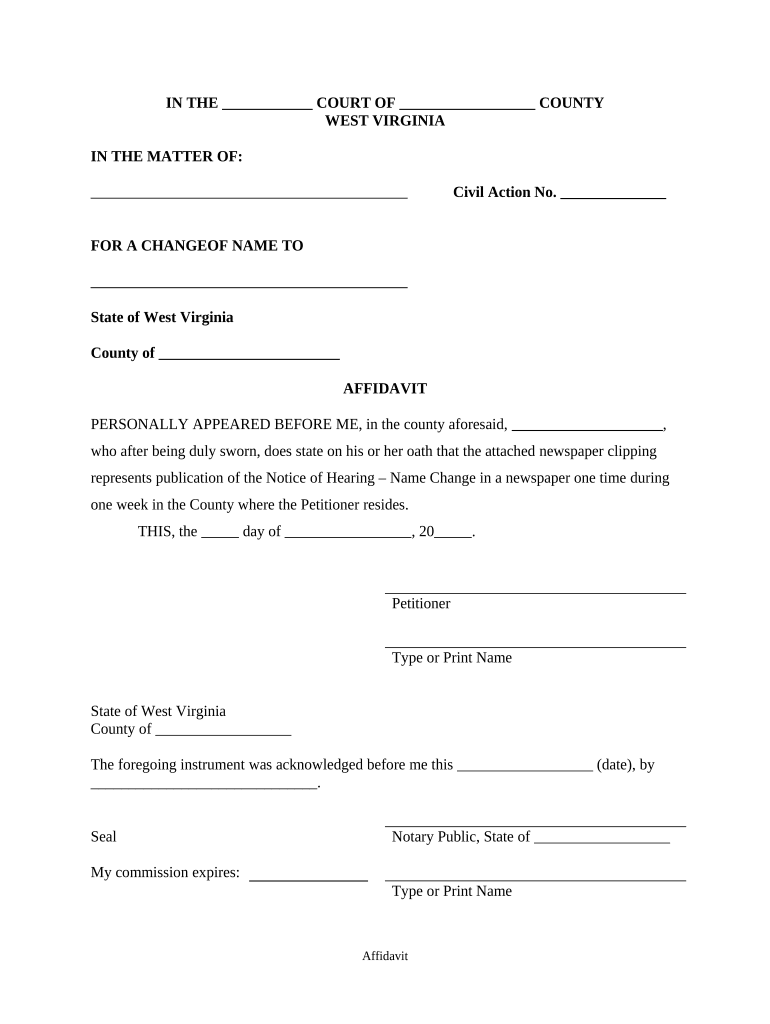
West Virginia Petition to Change Name
What the West Virginia Petition to Change Name Is
Why a Proper Petition Matters
A correctly completed petition ensures the court can process the request without avoidable delays, supports identity verification, and creates an official order for updating records.
Who Typically Files This Petition
Individuals seeking a legal name change for personal, safety, or administrative reasons commonly file this petition in the county where they reside.
- Adults changing a name after marriage, divorce, or personal choice — files for a personal legal identity update.
- Parents or guardians seeking a child’s name change — typically include consent or notice as required by court rules.
- Attorneys or court-appointed guardians filing on behalf of a petitioner with diminished capacity — follow specific procedural safeguards.
The court may require additional steps for minors or petitioners with a criminal history; verify local circuit court rules before filing.
Step-by-step: preparing and filing your petition
-
01Prepare Petition: Complete all required fields and attachments accurately.
-
02Notarize Signature: Have the petitioner sign before a notary if the court requires notarization.
-
03File with Court: Submit petition and pay filing fee at the county circuit clerk’s office.
-
04Serve Notice / Publish: Complete publication or service steps if the court’s rules require public notice.
How the court processes a name change petition
-
File: Clerk assigns case number and accepts documents.
-
Background Review: Court may request criminal history or fingerprint checks.
-
Notice or Publication: Public notice is posted or served if required.
-
Hearing and Order: Judge may hold hearing and issue final order granting name change.
Setting up an online filing workflow
| Field | Configuration |
|---|---|
| Authentication | Use email plus SMS code or stronger identity proofing for signer verification. |
| Signature Type | Select an acceptable e-signature method consistent with court rules. |
| Conditional Fields | Show or hide fields for minors or guardian petitions as needed. |
| Notifications | Enable confirmation emails to petitioner and counsel after submission. |
Technical considerations for e-submission and signing
Confirm the court accepts electronic filings or copies before relying on e-signatures or digital submission.
- Browser Support: Modern browsers; enable TLS for secure upload.
- File Formats: PDF or DOCX are commonly accepted formats.
- Integrations: Use case management or cloud storage integrations as needed.
Retain signed originals as the court or third parties may request certified paper copies for certain record updates.
Practical tips to avoid processing delays
Typical timing and deadlines to expect
Filing:
Case opened upon payment of filing fee.
Publication Window:
Public notice often runs for about 30 days when required.
Background Checks:
Criminal record checks may take several days to weeks.
Hearing Date:
Hearing scheduled in 4–12 weeks in many counties.
Final Order Entry:
Judge issues decree after hearing and any required waiting periods.
Risks and consequences of an incorrect petition
Common pitfalls to avoid when preparing the petition
- Failing to notarize the petitioner’s signature can cause immediate rejection or require resubmission, adding weeks to the process.
- Publishing notice incorrectly or missing the publication period may lead the court to continue or deny the petition for failure to provide required public notice.
- Submitting inconsistent names or incomplete identification documents often triggers background check mismatches and administrative holds on the case.
- Neglecting to disclose required criminal history or outstanding legal obligations can result in denial and potential court sanctions.
Representative examples of how the petition is used
Adult Name Change
An adult petitioner seeks a personal name change after divorce to restore a former surname.
- The court schedules a hearing and often requires publication.
- After a successful hearing the judge signs an order; the petitioner then uses the certified order to update Social Security, DMV, banks, and other records.
Minor’s Name Change
A parent petitions to change a child’s surname following adoption or parental agreement.
- Consent from both parents or additional notice may be required.
- The court reviews best-interest factors, may require consent or guardian ad litem input, and issues an order that is used to amend the child’s birth certificate and other records.
eSignature vendor pricing overview for submitting and signing petition documents
| signNow | DocuSign | Adobe Sign | PandaDoc | HelloSign | |
|---|---|---|---|---|---|
| Starting Price | $8/user/mo | $15/user/mo | $14/user/mo | $19/user/mo | $15/user/mo |
| Free Trial | 7-day free trial | Trial available | Trial available | Trial available | Trial available |
| Bulk Send | Yes (Business Premium) | Yes | Yes | Yes | No |
| Audit Trail | Yes | Yes | Yes | Yes | Yes |
| HIPAA Compliant | Yes | Yes | Yes | No | No |
Frequently asked questions about West Virginia name change petitions
-
Can I change my child’s name?
Yes, parents or guardians can petition for a minor’s name change. Courts commonly require consent from both parents or notice to nonconsenting parents and will consider the child’s best interests before issuing an order.
-
Is publication always required?
Publication is required in many jurisdictions but can vary. Courts sometimes waive publication for safety reasons. Confirm the county circuit clerk’s rules for publication requirements and timelines before filing.
-
Are electronic signatures acceptable?
Electronic signatures are legally recognized under the ESIGN Act (15 U.S.C. ch. 96) and UETA in most states, but some courts require notarized ink signatures or original documents; verify local court acceptance of e-signed petitions.
-
Do I need a lawyer to file?
You may file pro se, but attorney assistance can help with procedural nuances, background disclosures, and hearings. For complex situations such as contested petitions or criminal history, legal counsel is advisable.
-
What if I have a criminal record?
Courts typically require disclosure of criminal convictions; certain offenses may affect the court’s willingness to grant a name change. Failure to disclose can result in denial or sanctions.
-
How do I correct errors on the petition?
Contact the circuit clerk promptly to learn whether an amendment, supplemental filing, or refile is required. Small clerical errors may be correctable by amendment; substantive omissions often require resubmission.