Establishing secure connection…Loading editor…Preparing document…

Wyoming Divorce Form

This template is fully customizable. Edit the text, fill out the fields, and send it for signature. Give it a try!
Wyoming Divorce Form

What the Wyoming Divorce Form Is and When It’s Used

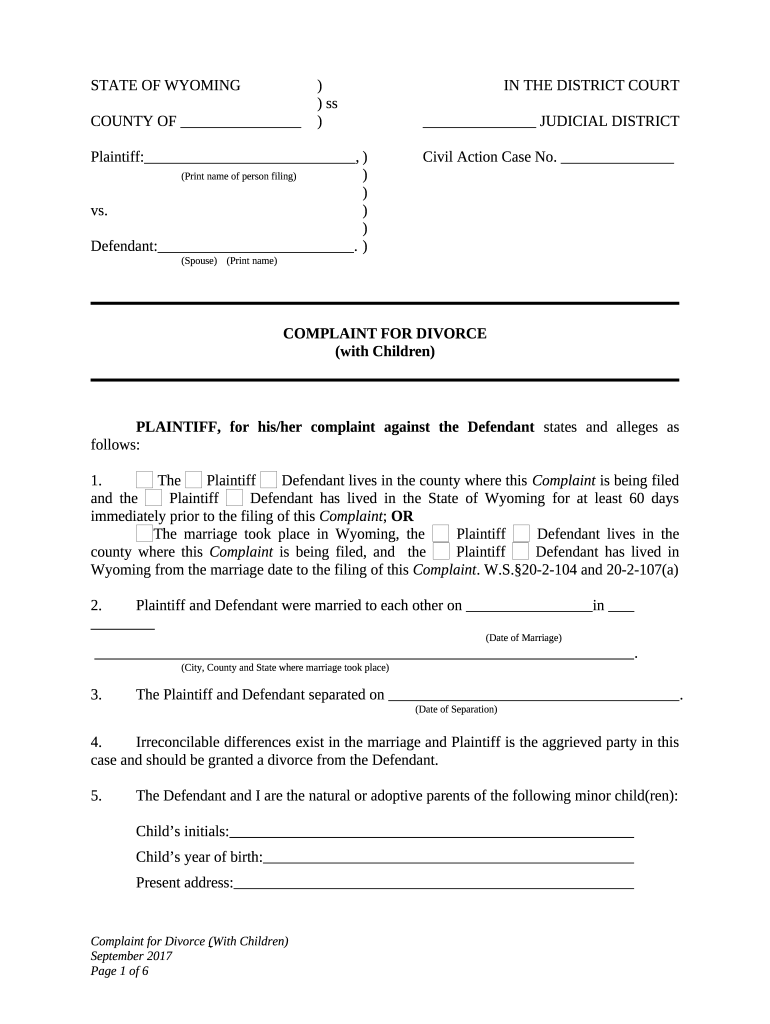
The Wyoming Divorce Form is the set of court documents used to start and process a marital dissolution action in Wyoming county courts. It typically includes a petition or complaint for divorce, financial affidavits, parenting plans when children are involved, and other local forms required by the clerk. Filing initiates court jurisdiction and starts timelines for service, response, disclosure, and hearings. Individual counties may supply standardized fillable PDFs or require e-filing through the court’s electronic filing system; check county clerk instructions for exact document names and submission rules.

Why Using the Correct Wyoming Divorce Form Matters

Completing the proper Wyoming Divorce Form ensures the court has the information needed to exercise jurisdiction, schedule hearings, and issue orders on property division, custody, and support. Accurate and complete forms reduce delays, avoid rejection by the clerk, and help preserve legal rights related to property, parental responsibility, and financial support.

Why Using the Correct Wyoming Divorce Form Matters

Who Typically Prepares and Submits These Forms

County clerks, family law attorneys, self-represented petitioners, and mediators commonly prepare or assist with Wyoming Divorce Forms depending on case complexity and local practice.

  • Self-represented petitioner preparing an uncontested divorce using standardized county forms and local filing rules.
  • Family law attorney preparing contested petitions, discovery, and motions for hearings or temporary orders.
  • Court clerks and e-filing vendors validating submission format and routing documents to judicial staff.

If you are unsure which forms apply, consult the county clerk’s office or a family law attorney to confirm required attachments and filing procedures.

Step-by-Step: How to Complete and File a Wyoming Divorce Form

Follow these core steps to prepare and submit the divorce petition and required attachments in Wyoming.

  • 01
    Gather documents: Collect IDs, financial records, and marriage certificate.
  • 02
    Complete forms: Fill Petition, Affidavit of Service forms, and financial disclosures.
  • 03
    File with clerk: Submit originals or e-file per county procedures and pay fees.
  • 04
    Serve respondent: Arrange service by sheriff or certified process server per local rules.

Typical Document Flow After Filing

This outlines the sequence from filing to resolution so you can track where your case stands.

  • Filing submitted: Clerk accepts or rejects based on completeness and fee payment.
  • Service performed: Respondent is served with petition and proof returned to clerk.
  • Response period: Respondent may file an answer or counter-petition as allowed.
  • Hearings and final order: Court schedules hearings and issues final decree when ready.

Key Components Included with a Professional Wyoming Divorce Form Package

A complete submission bundle groups the main court forms with attachments and instructions to reduce rejection risk and support court processing.

Petition / Complaint

The initiating pleading explaining the grounds for divorce, parties, and relief requested; forms vary by county but must accurately state jurisdictional facts and desired orders.
Service Documents

Summons and proof of service templates required to demonstrate the respondent received notice; improper service may invalidate further proceedings.

Financial Disclosures

Affidavits or schedules listing income, assets, liabilities, and expenses that inform support and property division decisions and must be truthful and complete.

Parenting Plan

When children are involved, a proposed parenting plan addresses custody, visitation, decision-making, and timeshares tailored to best-interest standards.

Proposed Orders

Draft temporary or final orders for support, custody, property division, or injunctions that the judge may adopt with modification after hearings.

County Cover Sheet

Local administrative cover forms, fee transmittal, and e-filing metadata ensure the clerks can process, index, and route your submission correctly.

Required Information Commonly Requested

Party Names: Full legal names
Dates of Birth: MM/DD/YYYY format
Addresses: Street, city, state, ZIP
Income Details: Gross monthly income
Asset List: Real and personal property
Signature Dates: Date signatures executed

Supporting Documents Often Included with Filing

Courts commonly expect supporting documentation to corroborate statements made in the petition; include originals or certified copies as required.

Marriage Certificate

Certified copy confirms marriage date and jurisdiction; required in many counties.

Financial Records

Recent pay stubs, tax returns, bank statements, and retirement account statements demonstrate income and assets.

Child Records

Birth certificates, school records, and medical records support parentage and custody considerations.

Proof of Service

Return of service, affidavit of service, or acceptance documents proving respondent received notice.

Timing Considerations and What to Expect

Timelines for family law matters differ by county and case type; check local court rules and the county clerk for exact deadlines.

Residency requirement:

Varies by state and county; verify with county clerk

Service response:

Response period varies; consult local civil procedure rules

Temporary orders:

Can be requested immediately but hearing dates vary

Discovery timelines:

Deadlines set by court scheduling order

Final decree timing:

Depends on contested issues and court calendar

Key Case Milestones from Filing to Finalization

A typical sequence helps you prepare documents and anticipate court interactions during the case lifecycle.

01

File Petition

Petitioner files initial complaint and pays filing fee.

02

Serve Respondent

Respondent must be served with papers per local rules.

03

Response or Default

Respondent files answer or the petitioner may seek default.

04

Final Hearing / Decree

Court issues decrees following settlement or hearing.

Consequences of Incomplete or Incorrect Divorce Filings

Case Delay: Missing information can delay processing
Rejected Filing: Clerk may refuse incomplete submissions
Default Risk: Failure to serve can lead to default judgments
Support Errors: Incorrect finances affect support calculations
Evidence Loss: Poor retention risks losing key documents
Legal Exposure: False statements can carry penalties

Common Preparation Mistakes to Avoid

  • Using incomplete financial disclosures or failing to update balances and income leads to contested hearings and recalculation delays.
  • Misnaming or misspelling parties and addresses can frustrate service, produce jurisdictional issues, or require amended pleadings.
  • Assuming all courts accept electronic signatures; family law matters sometimes require wet signatures or in-court filings.
  • Skipping local cover sheets or clerk instructions often causes administrative rejections and re-submission delays.

Digital Filing and eSignature Requirements

Electronic completion and submission can speed processing when local rules permit; verify county e-filing policies first.

  • Integrations: Salesforce, NetSuite, Google Workspace
  • File Formats: PDF, DOCX, HTML, XLSX
  • Authentication: Email, SMS code, SSO options

How to Configure an Online Filing Workflow

Set up fields, signer order, and authentication to match court needs and ensure evidence of intent and consent.

Field Configuration
Authentication Method Email + optional SMS or SSO
Template Library Pre-fill local county forms
Conditional Fields Show fields based on answers
Notifications Email reminders and confirmations

How eSignature Pricing Compares for Handling Forms

Compare baseline pricing and key capabilities that matter for secure completion and storage of legal forms; signNow is listed first per vendor comparison format.

signNow DocuSign Adobe Sign PandaDoc HelloSign
Starting Price $8/user/mo $15/user/mo $14/user/mo $19/user/mo $15/user/mo
Free Trial 7-day free trial, no credit card Varies Varies Varies Varies
Bulk Send Yes Yes Yes Yes No
Audit Trail Yes Yes Yes Yes Yes
HIPAA Compliant Yes Yes Yes No No

Typical Signatories and Their Roles

Petitioner

The filing spouse who initiates the divorce. Responsible for completing the petition, paying filing fees, and arranging service. The petitioner must provide accurate jurisdictional facts and financial disclosures; their signature starts deadlines for the respondent.

Respondent

The spouse served with the petition who may file an answer or counter-petition. The respondent’s timely response preserves rights to contest relief, propose counter-orders, and participate in discovery and hearings.

Representative Use Cases for the Wyoming Divorce Form

Below are two brief scenarios illustrating how the form set is used in practice and typical outcomes when prepared correctly.

Uncontested Divorce Scenario

A couple agrees on division and parenting plan and files jointly to simplify process.

  • Parties exchange complete financial affidavits and proposed orders.
  • The court reviews documentation, approves the settlement, and issues a final decree with minimal hearing time, reducing cost and delay for both parties.

Contested Divorce Scenario

One spouse files and the other contests custody and support.

  • Counsel exchanges discovery and schedules temporary hearings.
  • Accurate financial disclosures and timely responses lead to clear temporary orders and an evidentiary hearing where the judge issues final rulings after considering evidence and testimony.

Frequently Asked Questions About the Wyoming Divorce Form

Answers to common practical and legal questions about completing, submitting, and validating divorce forms in Wyoming.


Need help? Contact support

be ready to get more
Join over 28 million airSlate SignNow users