Establishing secure connection…Loading editor…Preparing document…

Wyoming Child Custody

This template is fully customizable. Edit the text, fill out the fields, and send it for signature. Give it a try!
Wyoming Child Custody

What Wyoming Child Custody paperwork covers and why it matters

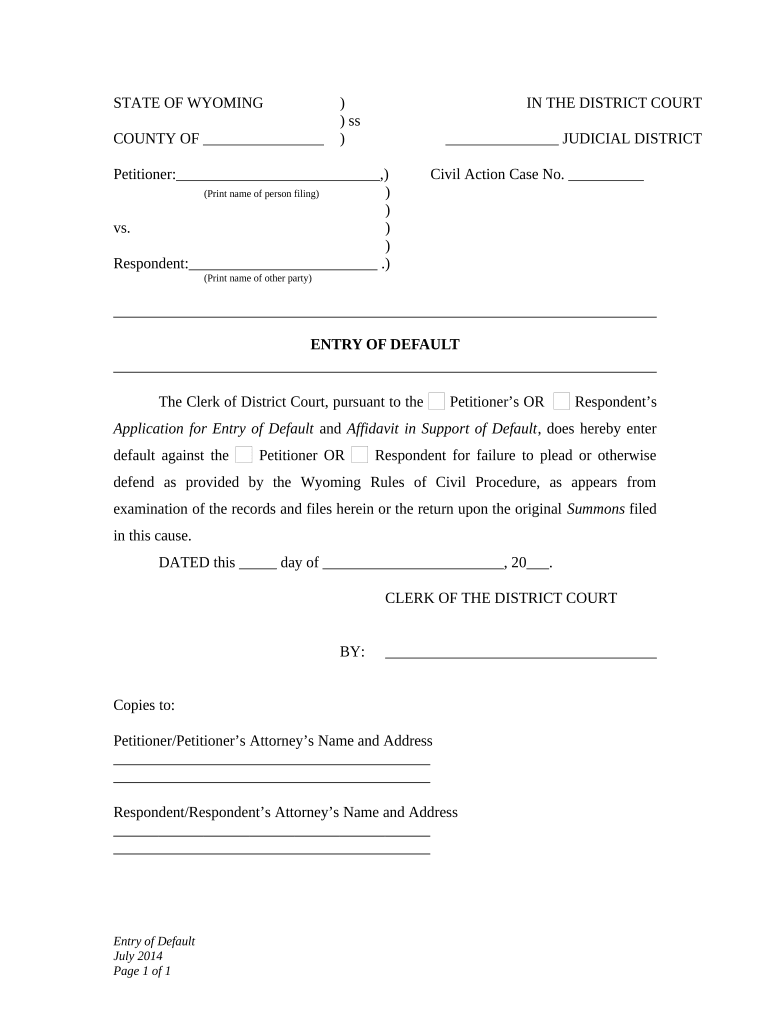
Wyoming Child Custody refers to the set of pleadings, parenting plans, and related court orders used to establish parental rights and responsibilities for children in Wyoming. These documents specify legal custody (decision-making), physical custody (where the child lives), parenting time schedules, child support, and dispute-resolution procedures. Family law proceedings are handled under state court rules; some documents are submitted to district or family courts depending on county practice. Accurate, complete forms help the court evaluate the child's best interests and can reduce delays and contested litigation.

Why clear custody paperwork improves outcomes

Clear, correctly completed custody documents help courts assess custody issues more quickly, reduce procedural challenges, and create enforceable parenting plans tailored to the child's best interests.

Why clear custody paperwork improves outcomes

Who typically files or completes Wyoming Child Custody forms

Parents, guardians, family law attorneys, and court clerks commonly prepare or submit custody pleadings and parenting plans in Wyoming.

  • Self-represented parents preparing initial custody petitions or responses in district or family court.
  • Attorneys drafting orders, parenting plans, or modifications on behalf of clients.
  • Court personnel processing filings, scheduling hearings, and producing signed orders.

Accurate completion reduces return-to-file events, shortens time to hearing, and helps preserve court resources while protecting children’s interests.

Core elements every Wyoming custody filing should include

A professional custody submission presents clear party identities, the relief requested, a parenting plan, proposed schedules, relevant facts about the child, and a proposed order for the judge to sign.

Party Details

Full legal names, dates of birth for parties and child, current addresses, and contact information for counsel or pro se filers.
Relief Requested

A concise statement of the relief sought (sole custody, joint legal custody, primary physical custody, temporary orders, custody modification).

Parenting Plan

Detailed schedule for parenting time, decision-making authority, holiday and school-year provisions, and communication rules for parents and the child.

Child-Centered Facts

Information about the child's age, health, school, special needs, significant relationships, and any history relevant to safety or welfare.

Support & Expenses

Child support calculations or requests, allocation of extraordinary medical, educational, or childcare expenses, and proposed payment mechanisms.

Proposed Order

A ready-to-sign order for the court to adopt the parenting plan and custody terms if the judge approves the submitted agreement.

Required identification and case details

Petitioner Name: Full legal name of the person bringing the action.
Respondent Name: Full legal name of the other parent or party.
Child Information: Child’s full name, date of birth, and current residence.
Case Number: Court-assigned case number or blank if filing first pleading.
Relief Requested: Specific custody and parenting time outcomes sought.
Signature Date: Date the document is signed by the filer or attorney.

Step-by-step: preparing and filing a custody petition in Wyoming

Follow these steps to prepare, sign, and file custody documents so the court can schedule a hearing efficiently.

  • 01
    Gather Evidence: Collect birth certificates, school records, medical records, and any safety concerns.
  • 02
    Draft Pleadings: Complete the petition, parenting plan, and proposed order with clear, factual statements.
  • 03
    Sign and Notarize: Sign where required; follow court rules on notarization or verification.
  • 04
    File with Court: File in the appropriate county court clerk’s office and pay filing fees or submit fee waiver.

Typical online filing and e-submission workflow

Online completion streamlines custody filings: prepare forms, add signatures, and submit or upload to the court or your attorney.

  • Prepare Forms: Upload template and populate fields with case data.
  • Add Signers: Assign signature roles and provide authentication methods.
  • eSign: Parties sign electronically where permitted by court rules.
  • Export & Submit: Export PDF for court upload or deliver to counsel for filing.

Configuring a digital workflow for custody documents

Set up fields and signer authentication thoughtfully so the document meets legal and court requirements during e-signing and submission.

Field Configuration
Signature Type Electronic signature acceptable unless court requires wet signature
Authentication Email link or SMS code; use stronger methods for contested cases
Audit Trail Capture IP, timestamps, and action history for admissibility
Export Format PDF/A recommended for consistent court upload and archival

Technical considerations for secure electronic custody forms

Use a platform that supports secure PDFs, reliable audit trails, and appropriate authentication for signers and signatories.

  • File Types: PDF, DOCX accepted for drafting; final submission should be PDF
  • Integrations: Connectors to cloud storage (Google Drive, Box) ease transfers
  • Security: TLS encryption in transit and AES-256 at rest

Ensure the chosen platform supports retention of audit logs and export of a certificate of completion to meet court evidentiary needs.

Key timing and response expectations for custody filings

Timelines in family law vary: some deadlines are statutory while others are set by local court schedules or judge orders.

Initial Filing:

Court schedules first hearing or status conference — timing varies by county

Service of Process:

Respondent must be served in accordance with Wyoming rules promptly after filing

Response Deadline:

Respondent’s time to answer varies; local rules or summons set the deadline

Temporary Orders:

Emergency or temporary custody hearings may be scheduled within days to weeks

Final Hearing:

Final hearing date depends on case complexity and court calendar

Milestones from filing to final order

A typical timeline moves from filing through service, temporary relief, discovery, mediation, and final hearing.

01

File Petition

Petitioner files custody petition with court clerk to open the case.

02

Serve Respondent

Respondent is served and receives notice of allegations and hearing dates.

03

Temporary Hearing

Court may issue temporary custody or protection orders on short notice.

04

Final Hearing

Hearing where evidence is presented and judge issues a final custody order.

Common errors to avoid when preparing custody forms

  • Missing or incomplete child information that prevents the court from confirming jurisdiction or identity.
  • Vague parenting schedules without specific days, times, and exchange locations that invite disputes.
  • Failing to attach supporting records such as school or medical documents that substantiate custody claims.
  • Incorrectly completed signature or notarization blocks leading clerks to return the filing.

Consequences of defects or inaccurate custody filings

Case Delay: Incomplete filings often result in continuances or return-to-file orders.
Adverse Inference: Missing disclosures or records may harm credibility with the court.
Enforceability Risk: Poorly drafted orders can be hard to enforce or interpret later.
Sanctions: Frivolous or noncompliant filings may expose a party to court sanctions.
Service Issues: Improper service can leave the court without jurisdiction to act.
Financial Cost: Additional hearings and attorney time increase litigation expense.

Real-world examples of custody document use

Representative scenarios show how completed forms move cases toward resolution and provide enforceable parenting plans.

Uncontested Parenting Plan

A mutual parenting plan was filed and proposed as the final order

  • The court adopted the plan after a short hearing
  • The clear schedule reduced post-judgment disputes and simplified enforcement proceedings for both parents.

Temporary Emergency Order

An emergency petition requested temporary sole physical custody due to safety concerns

  • The judge issued a temporary order after ex parte review
  • The order provided immediate protection and scheduled a full hearing within weeks to determine longer-term custody.

How custody orders differ from parenting plans

Compare the legal effect and typical use of a court custody order versus a negotiated parenting plan submitted with the case.

Criteria Court Custody Order Parenting Plan
Binding yes — entered by judge yes — if adopted by judge
Created By judge or joint proposal parties and counsel
Modification requires court motion requires court approval
Detail Level may be concise legal directives often includes detailed schedules and communications rules

eSignature vendor comparison for custody document workflows

A concise feature and pricing comparison to consider when choosing an eSignature provider for custody paperwork. signNow is listed first per vendor comparison guidelines.

signNow DocuSign Adobe Sign PandaDoc HelloSign
Starting Price $8/user/mo $15/user/mo $14/user/mo $19/user/mo $15/user/mo
Free Trial 7-day free trial Varies by vendor Varies by vendor Varies by vendor Varies by vendor
Bulk Send Yes Yes Yes Yes Varies
Audit Trail Yes Yes Yes Yes Yes
HIPAA Compliant Yes (BAA available) Varies Varies Varies Varies

Frequently asked questions about completing Wyoming custody forms

Answers to common procedural and technical questions to reduce filing errors and clarify court expectations.


Need help? Contact support

be ready to get more
Join over 28 million airSlate SignNow users