Insertar Campos En El Documento Para Firmar Electrónicamente

airSlate SignNow te permite insertar fácilmente campos en tu documento y asignar roles. Edita campos, agrega más roles y envía documentos para firmar desde tu escritorio o dispositivo móvil.

Solución de firma electrónica galardonada

What it means to insert fields into the document

Inserting fields into the document refers to placing interactive placeholders for signatures, initials, dates, text, checkboxes, and other data points directly onto a digital file so recipients can complete required elements without modifying the underlying content. This process standardizes where and how signers provide information, enforces required inputs, and enables downstream automation such as data extraction, conditional routing, and template reuse. In enterprise workflows, field insertion reduces errors, supports compliance through clear signer responsibilities, and creates machine-readable metadata for recordkeeping and audit trails.

Why structured fields matter for eSigning

Using structured fields ensures accurate data capture, enforces required inputs, and reduces signer confusion while preserving document integrity and auditability.

Why structured fields matter for eSigning

Common obstacles when placing fields

  • Incorrect field placement can lead to missing or invalid data and require manual correction.
  • Overlapping or misaligned fields confuse signers and delay completion of the document.
  • Failing to mark required fields increases incomplete submissions and follow-up overhead.
  • Using inconsistent field names prevents reliable data extraction and template reuse across documents.

Typical user roles when inserting fields

Legal Counsel

Legal counsel configures signature blocks, witness fields, and initial locations to ensure contract integrity and chain of approval. They also set field-level requirements and review audit trails to verify execution history and admissibility in regulatory or dispute scenarios.

HR Manager

HR managers prepare employment and benefits documents with required text fields, checkboxes, and dates to collect accurate personnel information and obtain signed consent. They rely on templates and conditional fields to handle variations across hire types.

Who typically inserts fields and why

Legal, HR, sales, and operations teams commonly insert fields to streamline approvals, capture required information, and enforce consistent signing sequences.

  • Legal teams place signature and initial fields to document consent and maintain evidentiary records.
  • HR departments use text and date fields for onboarding forms and employment agreements.
  • Sales and operations embed signature, pricing, and checkbox fields to finalize deals and confirm terms quickly.

These same teams rely on standardized fields to enable reporting, integrate form data into back-end systems, and maintain compliant records.

Key tools for effective field insertion

These tools improve accuracy, speed, and control when preparing documents with fields for signature and data capture.

Drag-and-drop editor

A visual editor lets preparers place signature, text, date, checkbox, and radio button fields precisely, reducing preparation time and improving layout consistency across templates.

Conditional fields

Show or hide fields based on prior responses to create dynamic forms that adapt to signer input and reduce unnecessary complexity for recipients.

Field validation

Built-in validation enforces formats for emails, phone numbers, and numeric values to ensure captured data meets system requirements and reduces follow-up work.

Template library

Save frequently used field arrangements as templates to standardize documents across teams and accelerate repetitive processes while preserving compliance controls.

Bulk Send

Automate sending templated documents with pre-inserted fields to large recipient lists while tracking completion status centrally for high-volume workflows.

Data mapping

Map filled fields to external systems or CSV exports so completed values integrate directly with CRMs, HRIS, or document management systems.

prepárate para obtener más

Elige una mejor solución

Integrations that enhance field insertion

Common integrations let teams insert fields without leaving familiar environments and push completed field data to downstream systems for automation.

Google Workspace

Insert fields from within Google Docs or Drive, then send documents for signature while maintaining original file structure and collaboration history.

CRM Systems

Prepopulate fields with contact and deal data from CRMs to reduce manual entry and ensure consistent values across agreements.

Cloud Storage

Save templated documents and completed files to Dropbox, OneDrive, or Box to centralize retention and backup policies.

API Connectors

Use API calls to place fields dynamically during document generation and to retrieve completed field data programmatically.

How field insertion works across the signing lifecycle

Field insertion is integrated into document preparation, signer interactions, and post-execution processing to maintain data accuracy and auditability.

  • Preparation: Insert and configure fields prior to sending.
  • Delivery: Recipients receive an interactive document with assigned fields.
  • Completion: Signers fill and submit fields; fields lock upon signature.
  • Processing: Extracted field data flows into systems for reporting.
Recoger firmas
24x
más rápido
Reduce los costos en
$30
por documento
Guardar hasta
40h
por empleado / mes

Step-by-step: inserting fields into a document

Follow these core steps to place fields accurately and prepare a document for signing.

  • 01
    Upload: Add the source document to the workspace.
  • 02
    Place fields: Drag signature, initial, and text fields to desired locations.
  • 03
    Assign roles: Map each field to the correct signer role.
  • 04
    Validate: Preview and test fields before sending.

How to review and test inserted fields before sending

A quick validation checklist ensures fields behave as intended for signers and integrations.

01

Preview:

Open the document in signer view to confirm placement.
02

Test required fields:

Attempt to submit without required fields to verify enforcement.
03

Check mobile layout:

Validate field size and order on a mobile screen.
04

Validate integrations:

Simulate data export to connected systems.
05

Confirm role assignments:

Ensure each field is assigned to the correct signer.
06

Lock finalized fields:

Apply locking to prevent post-signature edits.
prepárate para obtener más

Por qué elegir airSlate SignNow

  • Prueba gratuita de 7 días. Elige el plan que necesitas y pruébalo sin riesgos.
  • Precios honestos para planes completos. airSlate SignNow ofrece planes de suscripción sin cargos adicionales ni tarifas ocultas al renovar.
  • Seguridad de nivel empresarial. airSlate SignNow te ayuda a cumplir con los estándares de seguridad globales.
illustrations signature

Automation and workflow settings for field-based documents

Configure workflow settings to automate reminders, routing, and data export after signers complete inserted fields.

Setting Name Configuration
Reminder Frequency 48 hours
Expiration Window 30 days
Conditional Routing Rules Enabled
Auto-archival 7 years
Post-signature webhook Enabled

Platform support summary

  • Web browsers: Chrome, Edge, Safari, Firefox
  • Mobile apps: iOS and Android native apps
  • APIs: REST API for server-side integration

For consistent results, use the latest browser versions and keep mobile apps updated; API integrations require appropriate authentication and token management for secure automation.

Security controls related to field insertion

Field locking: Prevents edits after signing
Role-based fields: Limits fields by signer role
Audit metadata: Records field-level changes
Conditional visibility: Shows fields as needed
Encryption at rest: Protects stored documents
Transport security: TLS for data in transit

Industry examples of inserting fields into documents

Two brief case outlines show how structured fields streamline workflows in regulated and high-volume environments.

Healthcare Consent Form

A hospital prepares a patient consent form with signature, date, and checkbox fields to capture consent for procedures

  • Clinicians complete checkboxes for pre-screening
  • Data is exported to the EHR and billing systems for accuracy

Resulting in auditable consent records and reduced intake time while preserving HIPAA-required protections.

Sales Contract Batch Signing

A software vendor sends standardized sales contracts with preplaced pricing and signature fields to a distribution list

  • Bulk Send populates recipient fields automatically
  • Completed field data imports into the CRM to update deal stages and invoicing

Leading to faster close cycles, consistent contract terms, and reduced manual data entry across the sales team.

Best practices when inserting fields into documents

Applying standard conventions and validation reduces signer errors and ensures field data is usable for automation and compliance.

Use clear, consistent field labels across templates
Standardize field names and data formats to enable reliable extraction, mapping into databases, and template reuse across teams and systems.
Minimize required fields to essential information only
Limit required inputs to those necessary for legal or business needs to reduce friction and incomplete submissions while preserving data quality.
Position fields logically with adequate spacing
Place fields where signers expect them, avoid overlaps, and ensure mobile-friendly sizing so users can complete forms on any device without confusion.
Validate formats and use input constraints
Apply format restrictions for emails, phone numbers, and dates, and use dropdowns or checkboxes where applicable to improve accuracy.

FAQs About inserting fields into the document

This FAQ addresses frequent questions about field placement, validation, and post-signature handling to help preparers and administrators avoid common issues.

Feature availability: signNow vs DocuSign vs Adobe Sign

A concise feature availability comparison for common field-related capabilities across three major providers.

Criteria signNow (Recommended) DocuSign Adobe Sign
Drag-and-drop editor
Bulk Send
API access
HIPAA compliance Available Available Available
prepárate para obtener más

¡Obtenga firmas legalmente vinculantes ahora!

Retention and document lifecycle considerations

Define retention schedules and archival rules for documents containing inserted fields to meet legal, operational, and industry-specific requirements.

Retention period for contracts:

Seven years for many commercial records.

Records containing PHI:

Follow HIPAA retention requirements and organizational policy.

Educational records:

Apply FERPA guidance for student-related documents.

Financial and tax records:

Retain per IRS timelines and audit needs.

Document disposal:

Use secure deletion after retention expires.

Risks if fields are misused

Incomplete records: Missing data
Noncompliance: Regulatory exposure
Disputes: Signature ambiguity
Data leakage: Exposed PII
Operational delay: Extra processing
Audit failures: Insufficient evidence

High-level pricing and capability snapshot

Overview of entry-level pricing and core capabilities across providers; signNow is listed first and marked as Recommended for clarity in this comparison.

Plan signNow (Recommended) DocuSign Adobe Sign HelloSign PandaDoc
Starting price (approx.) Approx. $8/user/month Approx. $10/user/month Approx. $9.99/user/month Approx. $15/user/month Approx. $19/user/month
Free trial or tier 7-day trial commonly available 30-day trial commonly available 30-day trial commonly available 30-day trial commonly available 14-day trial commonly available
Mobile app availability iOS and Android apps iOS and Android apps iOS and Android apps iOS and Android apps iOS and Android apps
API access Available across plans Available across plans Available across plans Available across plans Available across plans
Bulk Send capability Included in business plans Included in business plans Included in enterprise plans Available on select plans Available on select plans

Cómo importar campos a un documento con airSlate SignNow

airSlate SignNow te permite convertir tus documentos en formularios interactivos y rellenables en segundos. Solo arrastra y suelta campos rellenables en cualquier parte de tu documento para garantizar una finalización rápida y sin errores.

Sube un documento a tu cuenta

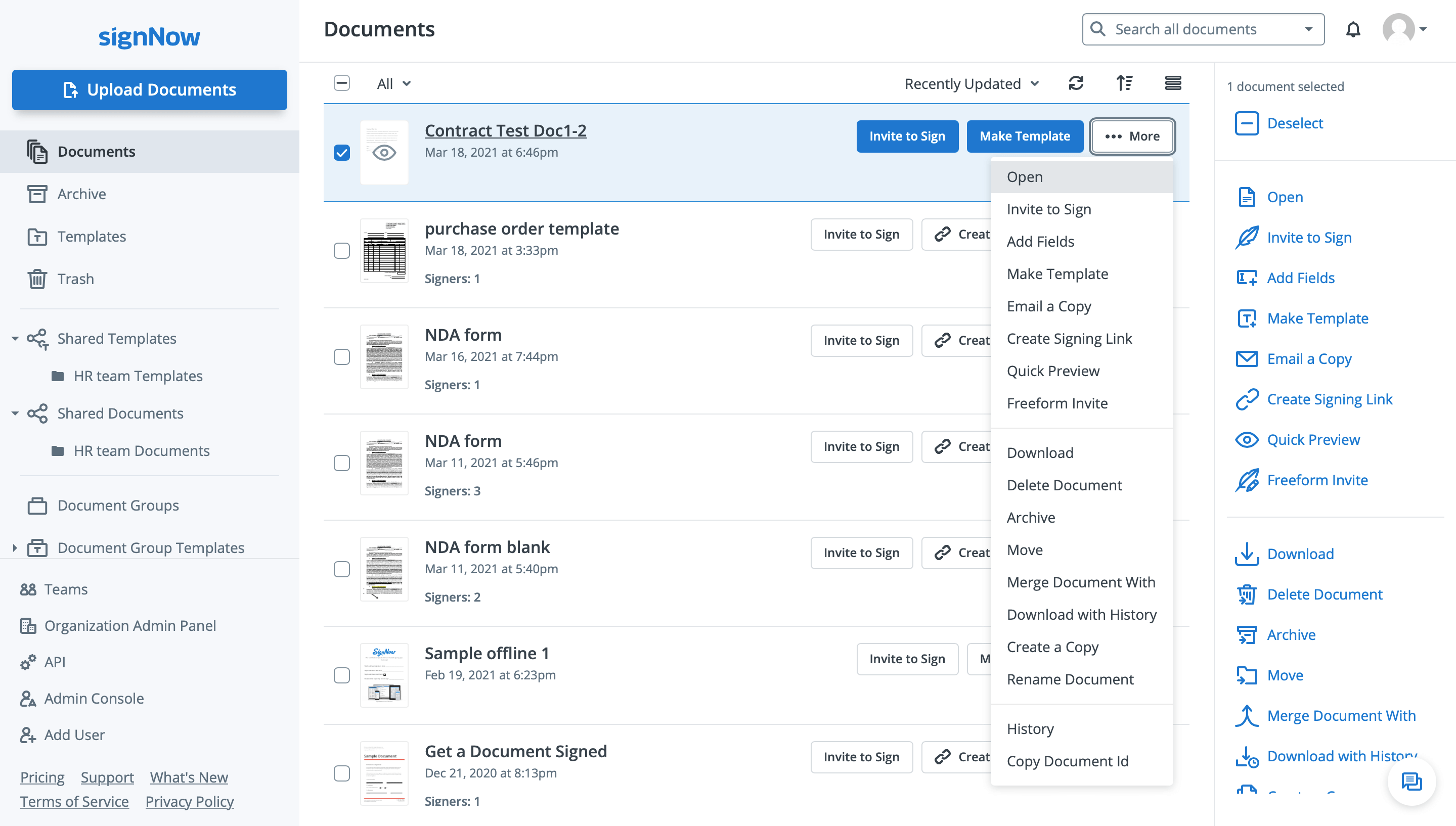
En la aplicación web de airSlate SignNow, haz clic en el botón Subir documentos y busca en tu dispositivo el documento que necesitas que sea firmado. Luego, ábrelo en el editor haciendo clic en Más > Abrir.
guía de llenado - ilustración

Selecciona diferentes tipos de campos rellenables

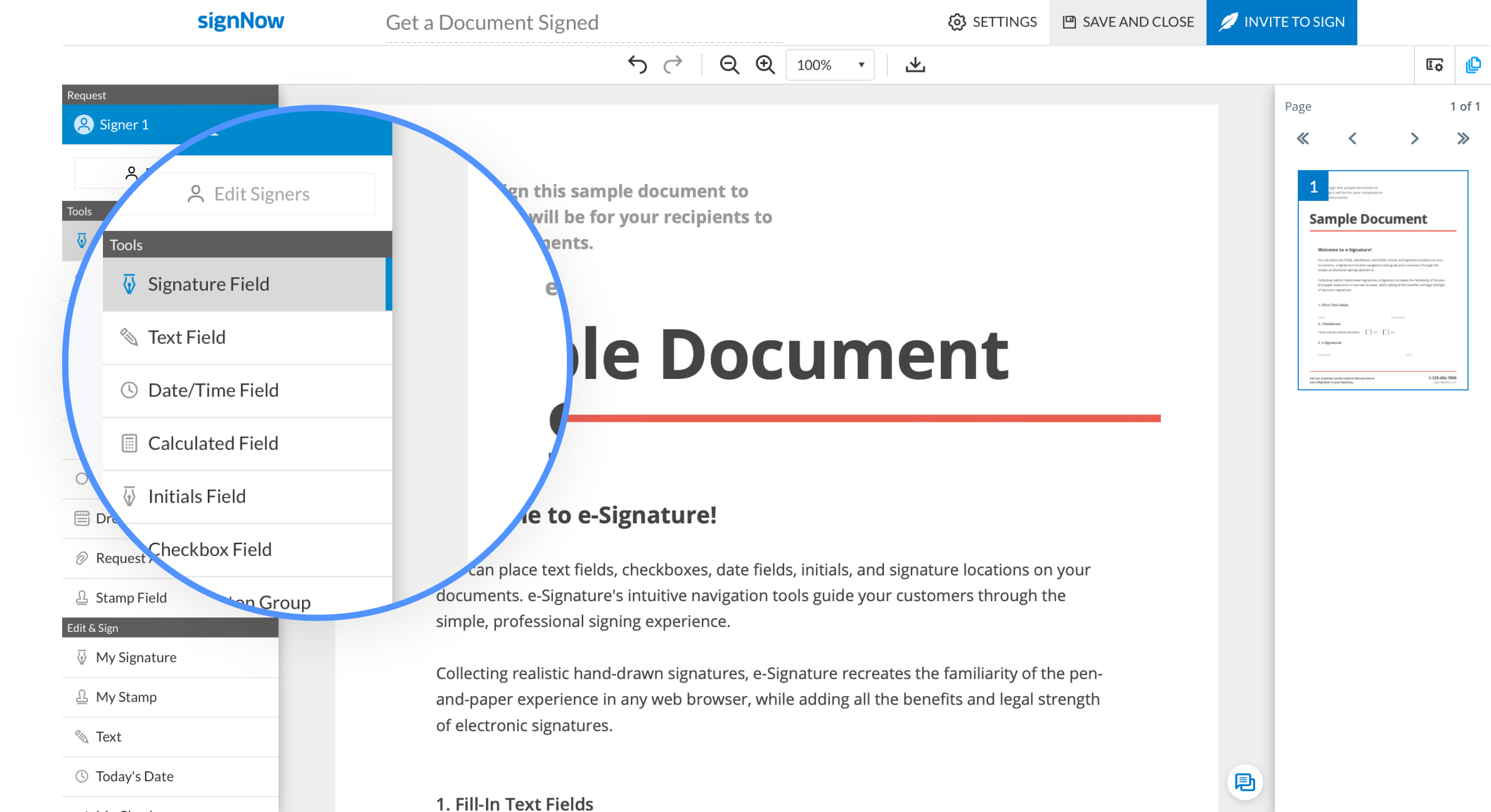
airSlate SignNow te permite insertar varios tipos de campos rellenables en tus documentos, incluyendo campos de texto, campos de firma, campos de fecha/hora, campos calculados, campos de iniciales, campos de casillas de verificación, grupos de botones de opción, campos desplegables y campos de solicitud de adjuntos. Encuentra todas estas opciones en la barra de herramientas izquierda del editor de airSlate SignNow (la sección Herramientas).
guía de llenado - ilustración

Agrega campos rellenables en segundos

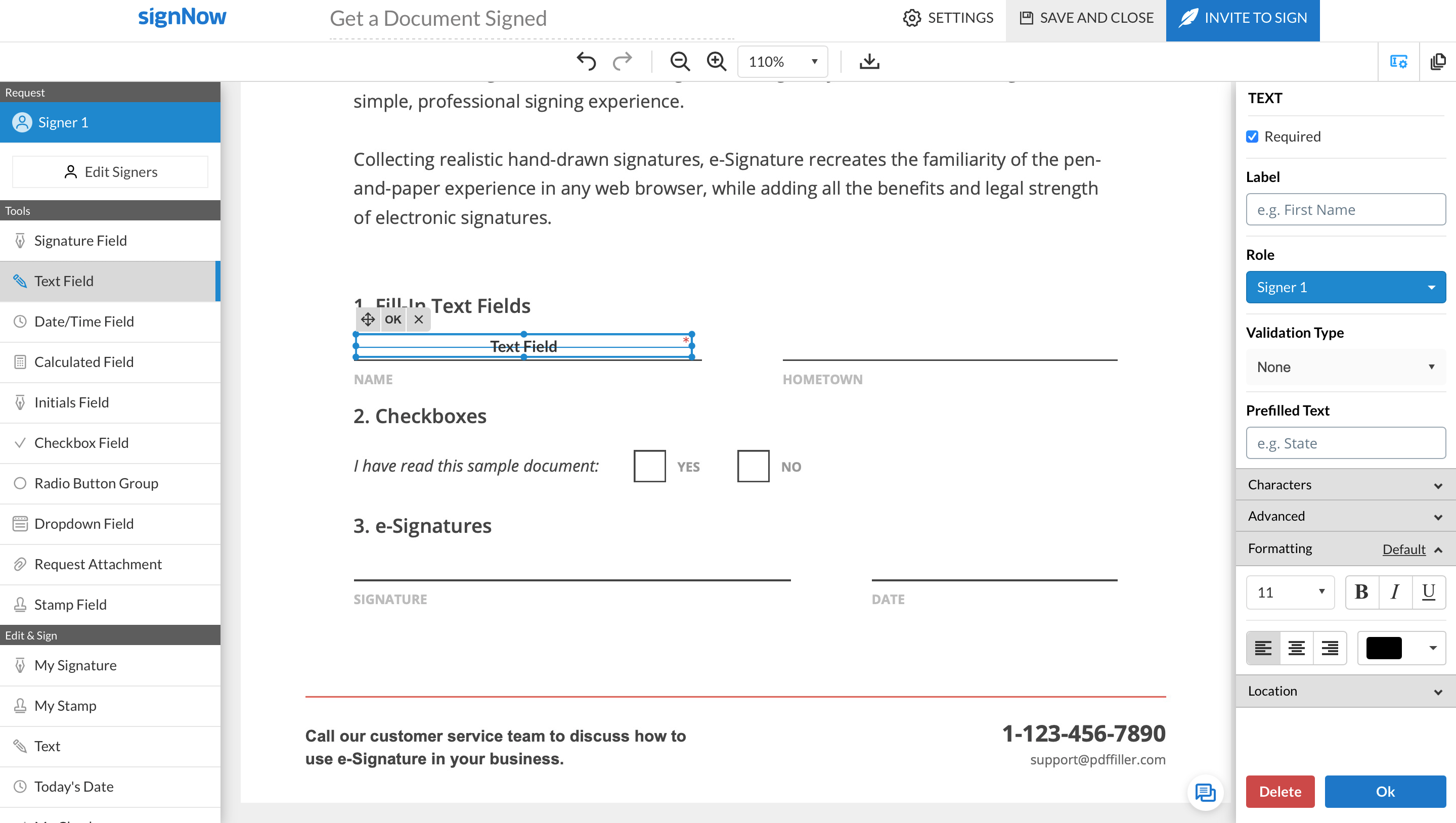
Para colocar un campo rellenable en un documento, simplemente selecciona el tipo de campo que necesitas en la barra de herramientas de la izquierda y haz clic en el lugar del documento donde quieres que aparezca. Alternativamente, arrastra y suelta los campos en tu documento.

Una vez que un campo está en su lugar, puedes ajustar su posición arrastrándolo por la página. Cambia el tamaño del campo arrastrando sus puntos de anclaje (puntos en los bordes). Cuando termines, haz clic en OK.
guía de llenado - ilustración

Configura los campos con facilidad

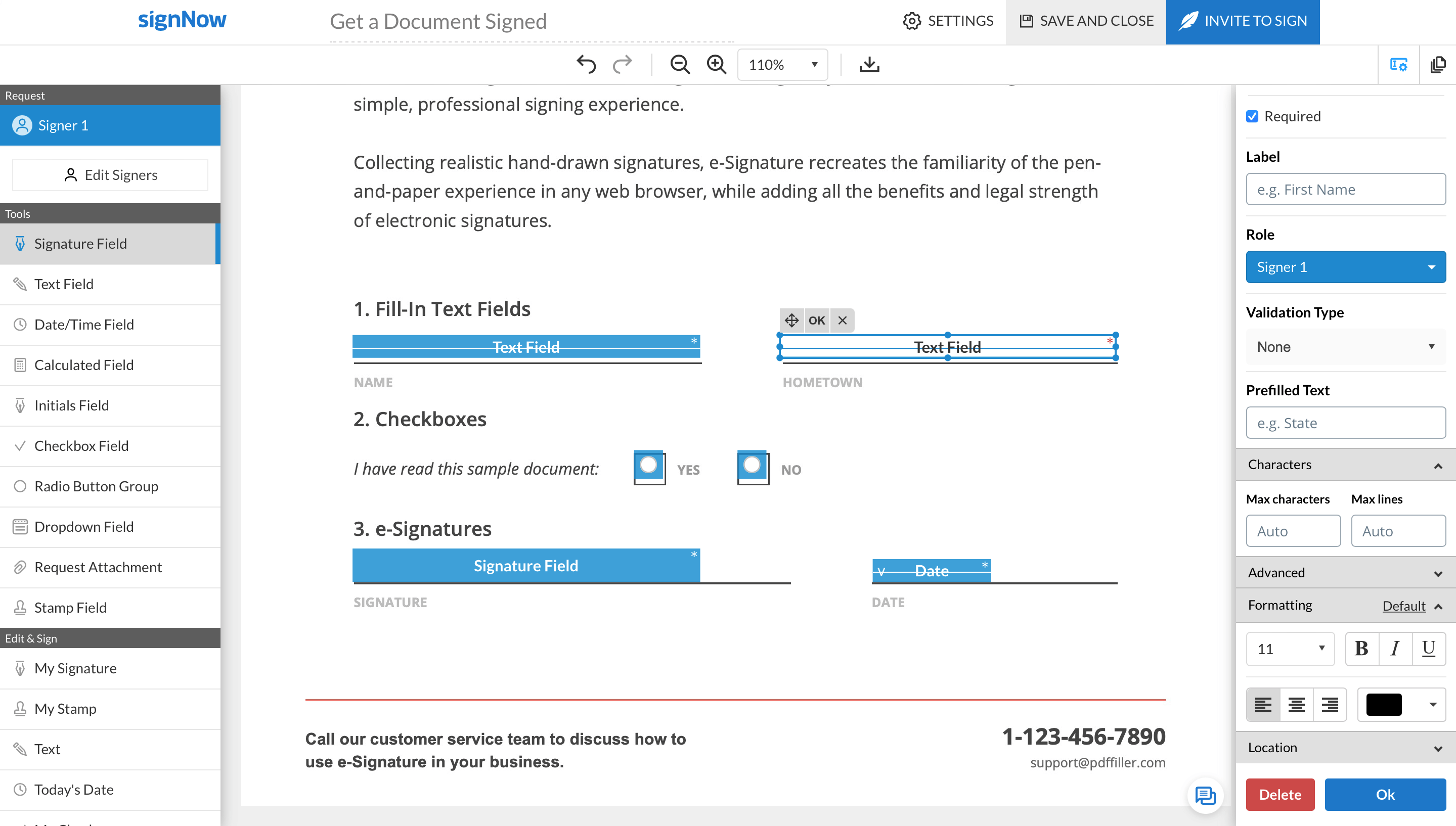
Al hacer clic en un campo, aparece el panel de configuración a la derecha. Úsalo para personalizar tus campos rellenables. Ten en cuenta que diferentes campos pueden tener configuraciones ligeramente diferentes. Por ejemplo, puedes personalizar la etiqueta de un campo, el texto prellenado y el ID único; establecer validaciones de formato de datos, límites de caracteres, formato de texto, etc.
guía de llenado - ilustración

Asigna roles de firma

Para establecer un orden de firma adecuado y dirigir a tus firmantes a los campos que necesitas que completen, asigna roles de firma a cada campo en tu documento. Para hacerlo, haz clic en un campo y abre el desplegable Rol en la barra lateral derecha. Si tienes más de un firmante, selecciona cuál de ellos tiene derecho a completar el campo. Para agregar un firmante, haz clic en Agregar rol en el desplegable y escribe un nombre de rol en la nueva ventana emergente.


walmart logo
exonMobil logo
apple logo
comcast logo
facebook logo
FedEx logo
esté listo para obtener más

¡Obtenga ahora firmas vinculantes desde el punto de vista jurídico!








